Key takeaways
- For most sites, relevant backlinks from a small, topically matched page beat a big pile of generic ones, and Google widened that gap with its 2024 and 2025 spam updates.
- A handful of niches break that pattern. Solitaire is one: five providers rank at the top of a competitive keyword on backlink profiles that are, by volume, almost entirely non-relevant.
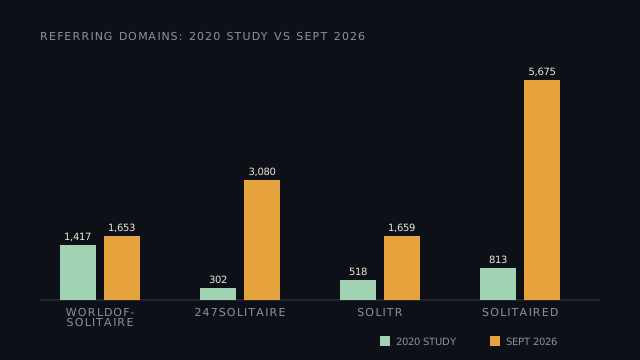
- I pulled fresh referring-domain data on September 8, 2026, for the same four sites I tracked originally. Every one of them grew, and 247solitaire.com went from 302 referring domains to 3,080.
- Google spent 2022 through 2025 tightening its site reputation abuse policy, aimed at rented authority on a trusted domain. An off-topic link earned the slow way was never the target.
- Count how many topically matched publishers link to your own SERP's page one before picking a strategy. Hundreds means chase relevance first. Single digits means authority has to do the work instead.
What changed since I first studied Solitaire
Google's algorithm gets a correction of some kind most days. Google's own How Search Works materials describe thousands of updates a year, most invisible to any single site. A handful of those updates target link building directly, and three of them reshaped the argument this piece makes.
The short version: Google spent 2022 through 2025 closing the gap between "this link looks natural" and "this link is natural." Sites that leaned on volume over relevance had a harder time hiding by 2025 than they did in 2020, when I first researched Solitaire.
SEOs who bet on topical match and content quality back then were ahead of the curve. The rest of the industry caught up once the updates below landed. Some niches still slip through, and the rest of this piece explains both halves.
How Google's link building rules shifted between 2022 and 2025
Google spent three years tightening how it treats relevant backlinks versus generic ones. It shipped a Link Spam Update in 2022 aimed at sites buying links and at PBNs, private blog networks built to pass authority without any topical connection to the pages they linked to.
That update targeted plainly manufactured link networks more than the organic, unrelated links that show up in a normal backlink profile. The bigger shift came in March 2024, when Google introduced a spam policy against "site reputation abuse," commonly called parasite SEO: third-party content published on a trusted domain to borrow its authority.
Google updated that policy again in November 2024 to close a loophole. A human editor approving the content no longer exempts it. If the primary goal is to exploit the host site's ranking signals, the policy applies regardless of oversight.
Enforcement followed quickly. In November 2024, Google de-ranked affiliate-review subfolders run by major publishers, including Forbes Advisor, the Wall Street Journal's Buy Side, CNN Underscored, and Time Stamped.
The policy entered Google's Quality Rater Guidelines in early 2025 and went fully algorithmic in that year's spam updates, meaning human raters and automated systems now both watch for it. None of it outlaws off-topic backlinks on its own.
It raised the bar for one specific tactic: renting a stranger's domain authority for content that domain never would have published by itself. The policy names third-party content on someone else's trusted domain. It doesn't name a small site earning its own off-topic links the slow way.
What Google's search engineers say about search rankings today
Google evaluates a relevant backlink differently from a random inbound link. A relevant backlink tells Google that a topically connected page is willing to vouch for the content behind it, while a generic link mostly signals that a page exists somewhere on the web.
Google combines that topical signal with anchor text, placement, and the linking domain's own history before deciding how much weight to pass through. Google increasingly discounts links that show no contextual relationship to the page they point to at all, a shift several SEO teams have flagged in Search Engine Land's coverage of recent core updates.
None of that means Google ignores authority. Google still weighs domain authority, referring domains, and a site's history, which is exactly why Solitaired's authority-first approach worked in a thin niche: Google had other trust signals to lean on even without dense topical relevance.
Google's own staff have been saying for a few years that link count doesn't tell the story people think it does. Gary Illyes called a spade a spade about it at Pubcon Pro in Austin in September 2023: "I believe they are important, but I think people overestimate their significance. I don't agree that they are in the top three. They haven't been for some time" (Search Engine Land).
John Mueller has made a similar point from a different angle. Discussing backlink counts, he told a questioner that Google can and does ignore links it judges low-value, and that one link from a page like a major news site's homepage can outweigh thousands of throwaway ones (Search Engine Journal).
On a Search Off the Record episode, he said Google weighs the quality of the linking page itself over raw backlink counts, and that he expects link count to matter less as time passes.
Neither engineer said relevance always wins. Both said the crude version of link building, more links from anywhere, matters less than it did.
That's a fair description of the climate my original Solitaire numbers were gathered in, and it sets up the real question: does the case study still hold under it, three spam updates and one policy rewrite later?
Relevant backlinks vs authority: the Solitaire case study, revisited
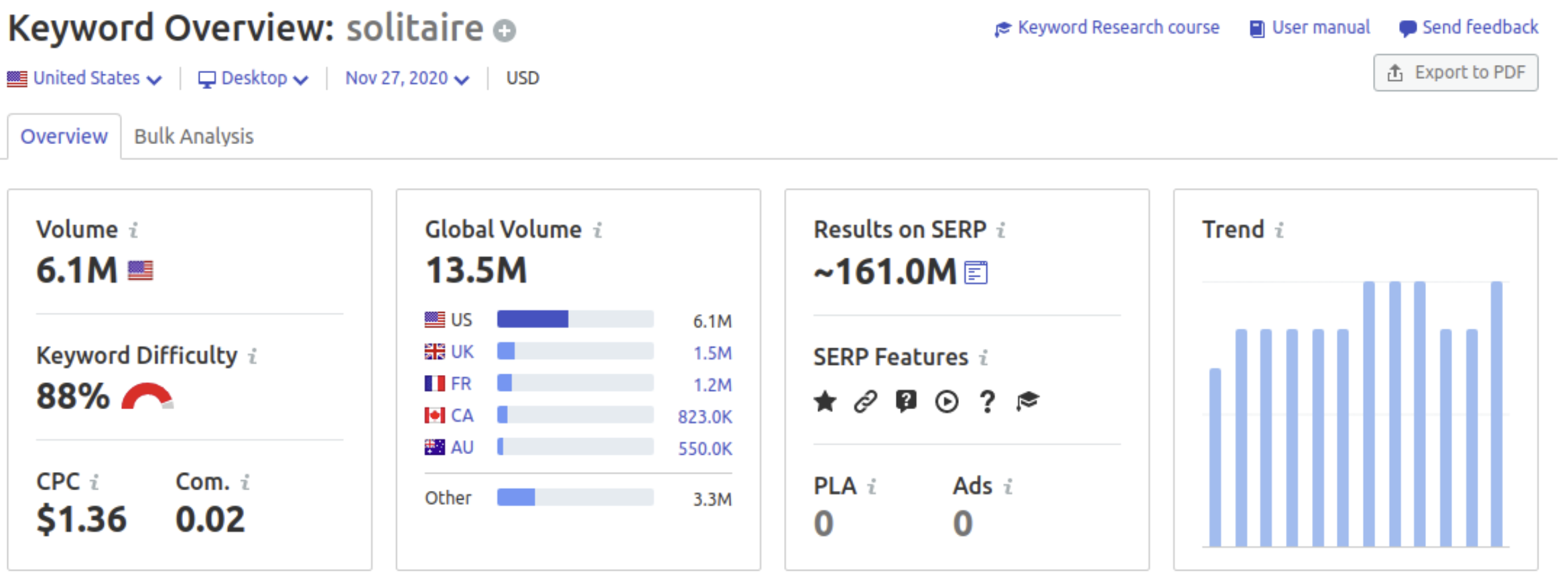
Some niches never played by the general rule in the first place. Solitaire is the clearest one I have data on: a search term with genuine commercial competition, ranked by sites whose backlink profiles are, on paper, exactly what the last three years of Google policy were built to catch.
Top providers ranking for solitaire in 2026
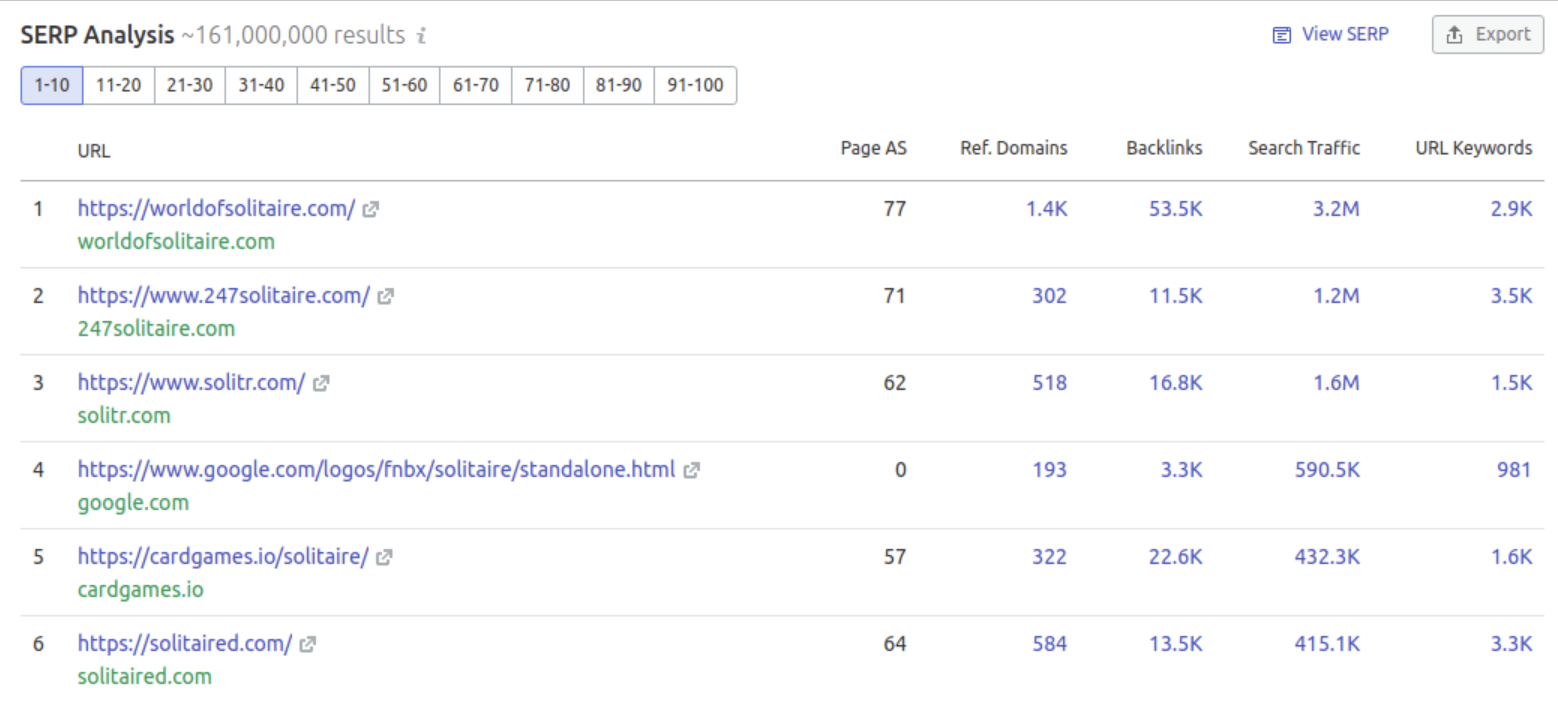
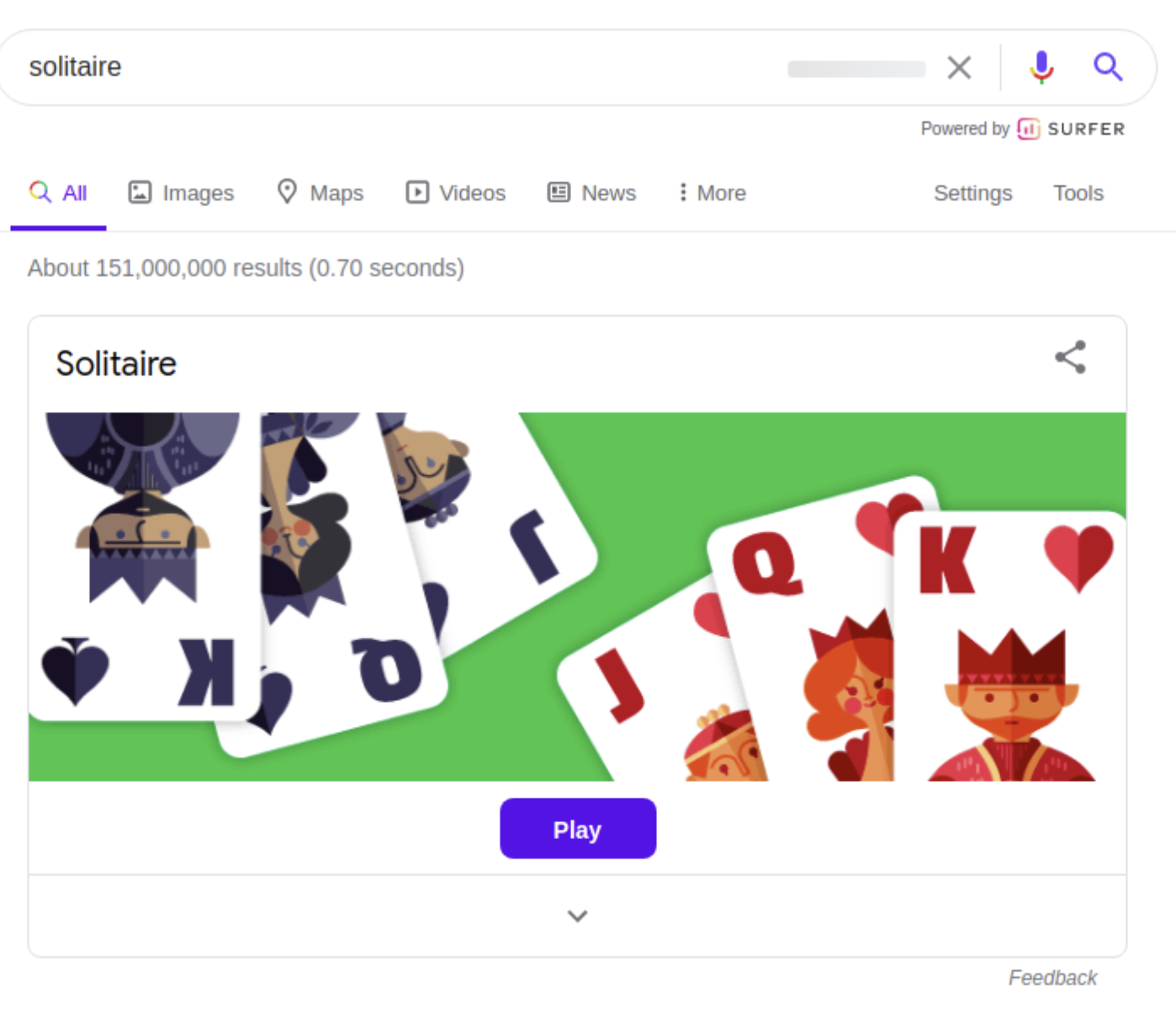
Five providers still hold the non-Google results at the top of the page for the keyword "solitaire": Worldofsolitaire.com, 247solitaire.com, Solitr.com, Cardgames.io/solitaire, and Solitaired.com. Google's own solitaire game still sits above all five, which is par for the course on any keyword popular enough for Google to have built a first-party version of it.
Card games as a content category is thin. Few blogs or publications write about solitaire with any regularity, and even fewer treat it as a primary beat.
General-web sites will still link to a popular free game somewhere in a roundup or a resource page. That's a separate matter from a topically matched publisher choosing to cover it.
That scarcity is the root of the pattern below, and the devil's in the details: there aren't enough topically matched linking pages in existence for a Solitaire site to build a relevant-heavy profile even if it tried, no matter how good its content or its outreach team is.
How much of the backlink profile is topically relevant links
A fresh pull of referring-domain data for this update, run September 8, 2026, shows the pattern from my original research holding steady, and in most cases getting more pronounced.
| Site | Referring domains, original study | Referring domains, September 2026 | Backlink authority rank (0 to 1000) |
|---|---|---|---|
| Worldofsolitaire.com | 1,417 | 1,653 | 279 |
| 247solitaire.com | 302 | 3,080 | 292 |
| Solitr.com | 518 | 1,659 | 268 |
| Solitaired.com | 813 | 5,675 | 379 |
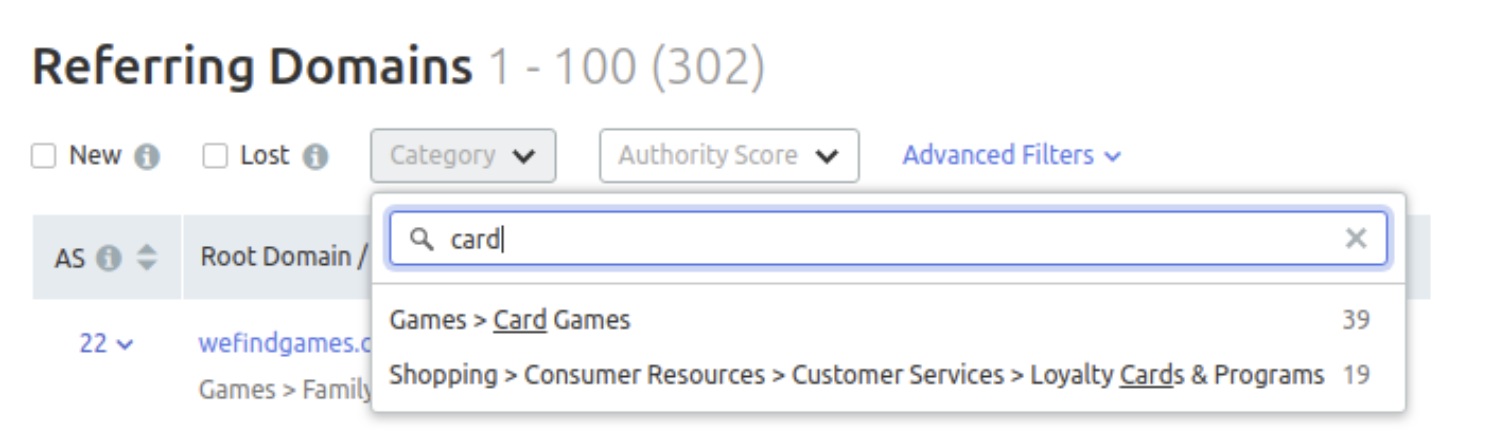
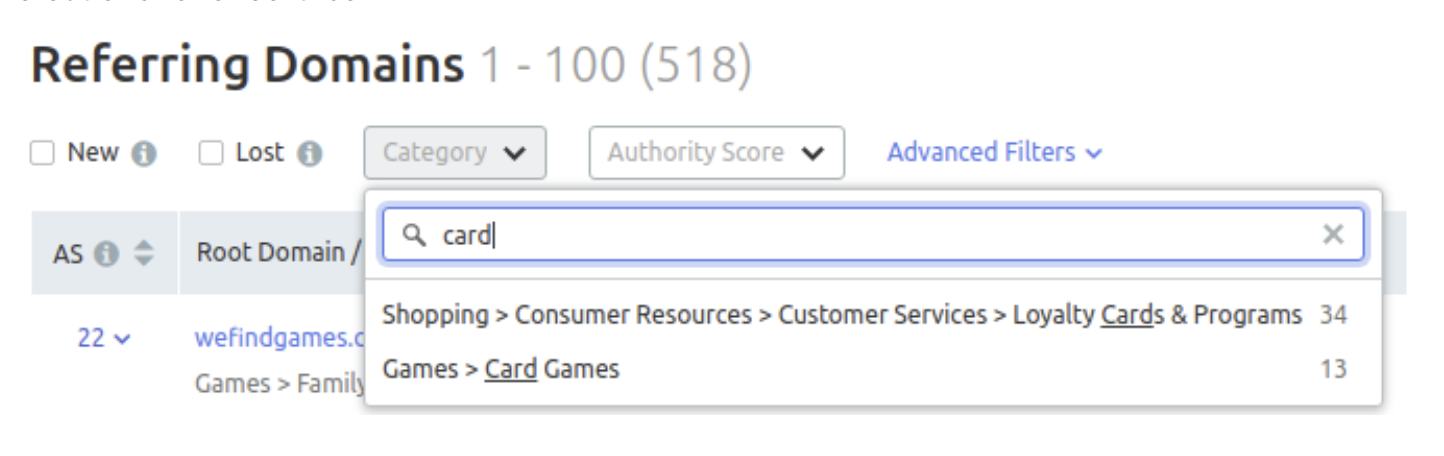
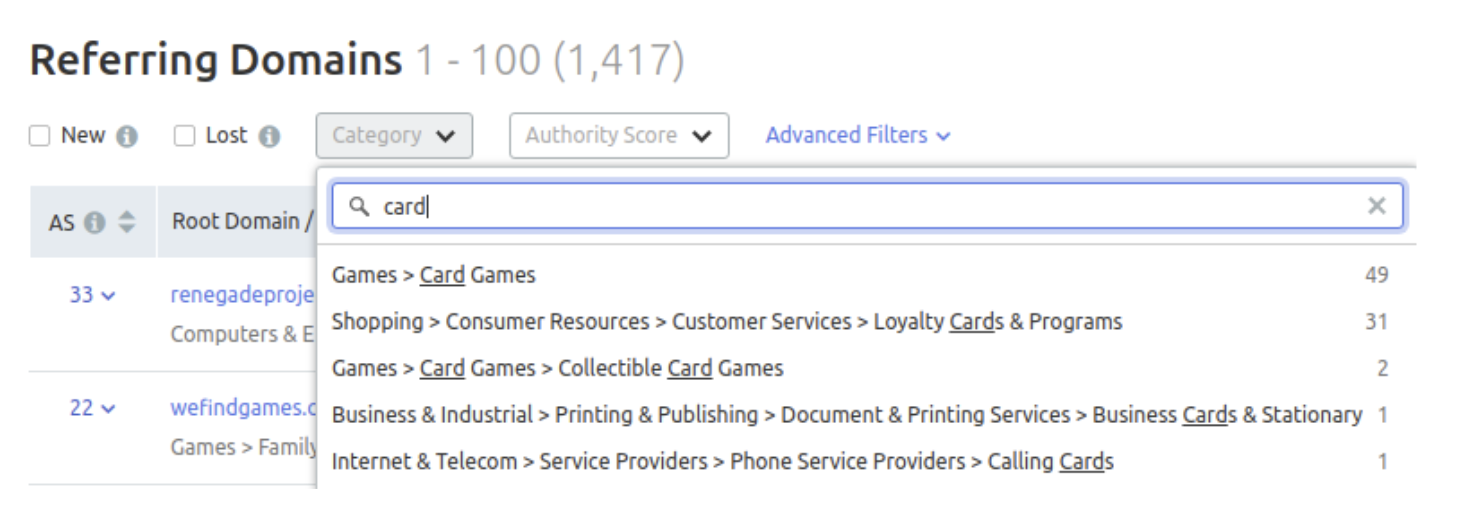
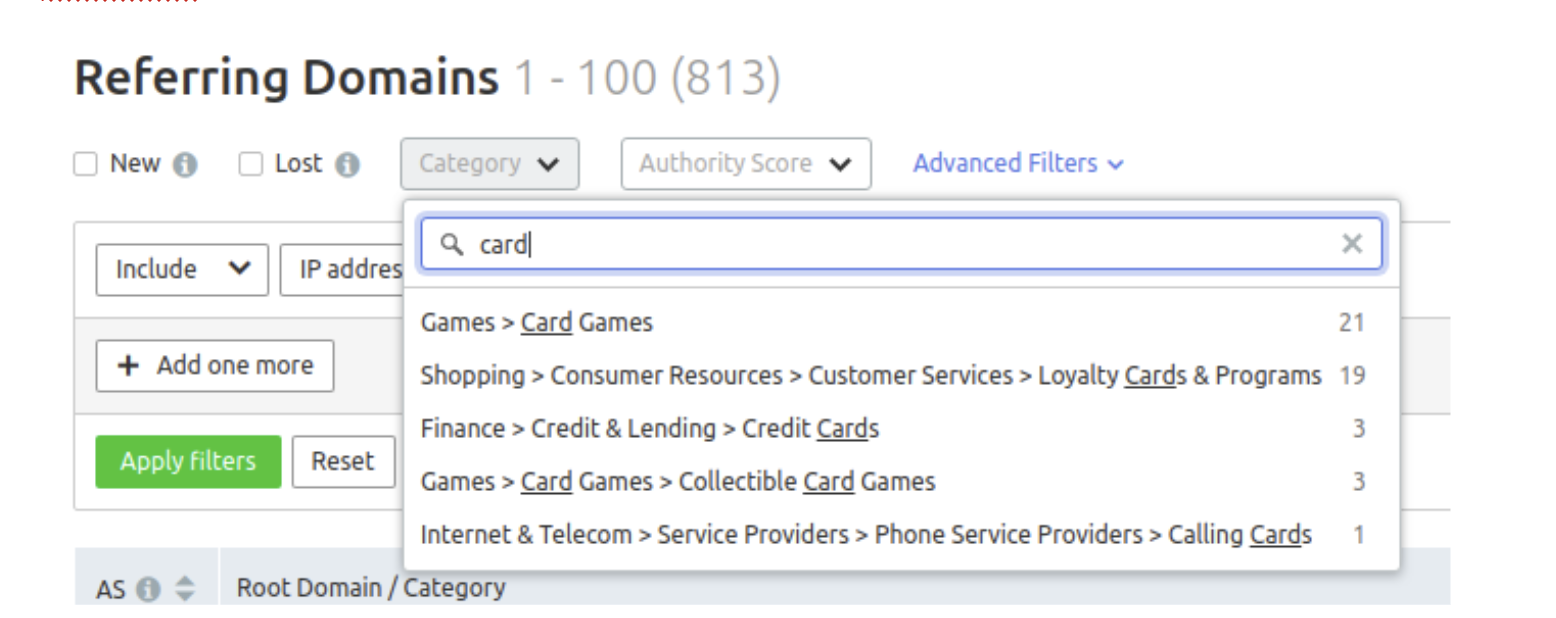
Every one of these sites grew its referring-domain count since my first pass, and the growth isn't modest. 247solitaire.com went from 302 referring domains to 3,080, a tenfold jump.
None of that growth came from a sudden explosion of card-game blogs. Relevant, topically matched links remain a small slice of each profile, a drop in the bucket next to the general-web domains that make up the rest.
How Solitaired went from newcomer to the niche's biggest backlink profile
Solitaired is still the most interesting case in the set. My original study caught it a little over a year into competing for "solitaire," already inside the top five with 813 referring domains against competitors that had five to seven years of link accumulation behind them.
Worldofsolitaire.com's SEMrush profile, at the time, showed at least seven years of activity, meaning Solitaired had made up most of that gap in under a fifth of the time. It built that position from scratch, without the tenure its rivals relied on.
Solitaired's edge came down to concentrated authority. Topical relevance played a small part in it. It carried the largest count of high-authority backlinks in the group, including links from Forbes, MIT, and the University of California, Berkeley, most of them earned through HARO (Help a Reporter Out) pitches and large-scale outreach. Card-game content partnerships had little to do with it.
HARO worked for Solitaired because the pitches didn't depend on the topic matching the outlet. A reporter working on a piece about memory, procrastination, or screen habits needs a source, and a card-game blog rarely fits that brief. Solitaired's team answered enough of those queries to land placements a topically focused outreach campaign never would have reached.
That's the same mechanism behind its current lead: an authority strategy scales past a relevance ceiling that a thin niche imposes on everyone competing in it.
That bet paid off past the initial study window. The September 2026 pull puts Solitaired at 5,675 referring domains and a backlink authority rank of 379, the highest of the four sites I tracked and well ahead of Worldofsolitaire.com's 1,653 despite that site's longer history in the space.
Solitaired knocked it out of the park on a strategy built entirely around domain authority, in a niche where topical match was never realistically available at scale.
Why non-relevant backlinks still work in this niche
The obvious question, given three years of Google policy aimed at exactly this pattern, is why these sites aren't being penalized. Part of the answer is in the target: site reputation abuse policy is built to catch third-party content riding a trusted domain's authority. A card-game site earning its own links through outreach and content sits outside that target, however off-topic those individual links are.
Backlink spam scores for the four sites in this study run from 31 to 42 on a 100-point scale, a range that would draw scrutiny in most commercial niches expecting mostly quality backlinks. These sites are, by that measure, skating on thin ice.
They're still ranking, which says more about the shortage of topically relevant linking opportunities in the solitaire space than it does about any special exemption from Google's rules.
The lesson generalizes past card games and this one set of sites. Any niche with a thin base of topically matched publishers, hobby verticals, narrow B2B tools, and regional service categories among them, will show some version of this pattern.
Relevance still matters, but only as far as the available relevant pages go. Once those run out, authority has to fill the gap, and Google's spam policies are built around intent and manipulation. A link's topic by itself was never the trigger.
Topical relevance vs authority: a framework for other sites and niches
A B2B SaaS tool selling into marketing teams sits at the opposite end of the publisher-density scale from Solitaire. Marketing blogs, review sites, agency roundups, and newsletter sponsorships number in the thousands, so a relevance-first strategy has enough raw material to compete on quality alone.
A regional plumbing company or a niche hobby brand looks more like Solitaire: a short list of genuinely topical publishers, most of them already linked out by every competitor.
Before copying either strategy, read the room of your own SERP. Pull the top ten results for your target keyword using a backlink tool, list every referring domain across those results, and count how many linking domains, across those sites, publish content in your topic on a regular basis.
If that number is in the hundreds, chase relevance first, because Google's engineers are on record saying relevant, well-placed links carry more weight than generic ones. If that number is in the single digits, an authority-first strategy isn't a shortcut. It may be the only strategy that scales.
Don't put all your eggs in one basket regardless of which side you land on. A profile built entirely on authority, with zero topical signal, reads as unnatural even in a thin niche, and Solitaire's providers all carry some relevant links alongside the general-web ones.
A profile built entirely on relevance, in a competitive niche with real publisher density, will lose to a competitor who also has authority behind the relevant links.
What relevant backlinks still do for a site
Relevant backlinks do more than lift a single keyword's ranking. They send referral traffic from readers who already care about the topic, which tends to convert better than traffic arriving from an unrelated placement.
A topically connected link also reduces ambiguity in how a search engine reads the linked page, since it acts as a second vote for the page's subject matter, beyond a plain vote that the page exists.
Quality backlinks from active, frequently crawled sites help a search engine discover and crawl new pages faster, and a heavier share of relevant links in a profile lowers the odds that one low-quality link drags the rest into a manual review.
None of this happens through cold outreach alone. The sites that keep sending links year after year are usually the ones a team has built a genuine relationship with. A one-time pitch that never gets a reply rarely repeats.
How to build links and get relevant backlinks in 2026
For niches where relevant linking pages exist in real numbers, three tactics still produce them without paid placements. Each one earns links because the page it points to is useful on its own terms, which is the same test Google's site reputation abuse policy applies to third-party content: does it exist to help the reader, or only to move a ranking signal.
Broken link building for relevant links
Broken link building finds dead pages on topically relevant sites and pitches your own live page as the replacement. Done well, it kills two birds with one stone: the linking site fixes a broken reference for its own readers, and you get a citation that's relevant by definition, since the original link was there because the topic matched.
The tactic depends on relevant sites existing at scale, which is exactly the constraint Solitaire's providers don't have.
Guest posts and journalist outreach after HARO's shutdown
Guest posts on niche-relevant blogs remain one of the most direct ways to earn a topically matched link, provided the target site has real readers and doesn't exist purely to sell placements. Journalist-request platforms are a second channel; Solitaired's own Forbes and university links came largely through this route.
That channel had a rough stretch. Cision rebranded HARO as Connectively in 2024, introduced paid tiers running up to $149 a month, and shut the platform down entirely on December 9, 2024, sending PR teams reliant on it back to square one.
Featured.com bought the platform in April 2025 and relaunched it, free, as HARO again on April 22, 2025, restoring the three-times-daily query emails the original ran on.
Response quality dropped during the gap. Independent estimates put roughly 85 percent of pre-shutdown responses as AI-generated spam, which means a specific, human answer to a query now stands out more than it did when I first covered this tactic.
Content marketing and unlinked mentions
A data study, an original tool, or a detailed teardown gets cited by relevant sites without any outreach at all, because writers link to sources when a number in their own article needs backing up.
This is the content marketing half of the equation: broken link building and guest posts find the sites, but a page worth citing is what makes the pitch land.
Checking for unlinked brand mentions, an article that names a company or product without linking to it, is a related, low-cost source of relevant links, since the writer already judged the mention worth including.
High quality backlinks vs high quality content marketing
None of the tactics above work without a page worth linking to. High quality backlinks and high quality content marketing run in sequence: content earns the citation, and outreach finds the sites willing to give it.
Quality backlinks rarely arrive unprompted even for a strong page, which is why every tactic in this piece still needs a pitch behind it. A thin, unresearched page won't convert a broken-link pitch or a HARO response into a link no matter how well the outreach is written.
You don't need the whole nine yards of every tactic in this piece. A single-product SaaS tool in a busy category should weight relevance and content marketing heavily, because relevant publishers exist in that market by the hundreds.
A niche hobby brand should study Solitaired's approach instead: fewer, more authoritative links, earned through outreach that doesn't depend on topical match being available.
Relevant backlinks FAQ
Are backlinks still relevant in 2026?
Yes. Google's own engineers describe backlinks as one signal among many, stopping short of calling links a top-three ranking factor, but a documented site reputation abuse policy exists specifically because link-based authority still moves rankings enough to be worth abusing.
What is the best way to get backlinks?
No single tactic hits the nail on the head for every site. Broken link building and guest posts earn quality backlinks fastest where topically relevant publishers exist in number. Digital PR through journalist-request platforms and large-scale outreach earn quality backlinks where they don't, Solitaired's own history being the clearest example on record.
What is the 80/20 rule in SEO?
In link building, it usually means a small share of a site's backlinks, the handful from genuinely authoritative or topically relevant pages, account for most of the ranking benefit, while the bulk of a typical profile does comparatively little work. Solitaire's four providers fit that pattern closely: thousands of referring domains each, with authority concentrated in a small subset.
What is a relevant link?
A relevant link comes from a page that covers the same topic, or a closely adjacent one, as the page it links to. Search engines use that topical match as a trust signal separate from the linking domain's general authority.
Which backlink is most powerful?
Per Mueller, one link from a highly authoritative, relevant page, a major publication's homepage was his example, can outweigh thousands of low-value links combined. Power comes from relevance and authority working together; either one alone falls short, and a handful of high quality links beats a wall of average ones.
Is link building illegal?
No. Buying links in a way designed to manipulate rankings violates Google's spam policies and can cost a site its rankings, but link building itself, including guest posts, digital PR, and broken link building, is a standard and permitted practice.
How do you get relevant backlinks without existing content or history?
Solitaired's answer, in a niche with limited topical publishers, was outreach volume aimed at general-authority sites. A search for topical match at scale was never going to work there. In a niche with real publisher density, broken link building and guest posting on topic-matched sites will get there faster.
How to audit your own backlink profile for relevant backlinks
Before deciding to chase relevance or authority, check what you already have. Auditing relevant backlinks doesn't need to be complicated, and most of it happens in three passes through a standard backlink tool or Google Search Console.
Start with anchor text. A profile where every anchor text is an exact-match keyword reads as manufactured to search engines, while a mix of branded, naked-URL, and topical anchor text reads as something a real site would attract on its own.
Pull your external links and referring domains, and flag anything from link farms, spammy sites, or domains with no organic search traffic of their own. Those are the low quality links and low quality sites worth disavowing. They shouldn't count toward your total, and they rarely help the website links you're trying to build elsewhere.
Next, separate dofollow links from nofollow links, since only dofollow links pass ranking signal directly, and check how many come from authoritative websites versus general directories or blog comments.
A profile heavy on nofollow links isn't automatically harmful, but it won't move search rankings the way a handful of dofollow links from high domain authority, topically relevant sites will. Site owners who never check this split are often surprised how few of their existing backlinks are doing any work at all.
Finally, run a backlink comparison against two or three direct competitors. If they're earning links from niche relevant websites and relevant content you've never pitched, that gap is your next link building opportunity, and a reasonable goal for the quarter.
If their referring domains look as generic as yours, relevance was never available to them either, and the honest link building technique is to build links the way Solitaired did: put the effort into outreach volume. No link building agency can generate relevant backlinks from publishers that don't exist, sharper targeting included.
How many backlinks you end up with matters less than how many of them are backlinks that matter, meaning links your own site would earn again if you started from zero.
A few more distinctions are worth keeping straight. Search engine optimization treats link quality, link diversity, and link volume as three separate checks. Collapsing them into one score hides real gaps: a profile can carry high quality links and still show poor diversity if every one of them comes from the same ad network.
Random link insertions in old blog post comments rarely help a website's search engine rankings, and neither do harmful links from spammy backlinks a site owner never disavowed.
The realistic goal centers on building quality backlinks and earning high quality backlinks that move search results for a keyword your site competes on, over generating backlinks or attracting backlinks in raw bulk.
More backlinks, and even more high quality backlinks, only help once the basics, working anchor text, a linked page search engines can find, links pointing somewhere relevant, are already in place.
Track where your link appears across relevant web pages already, using standard Google search operators, before assuming the shortfall is links pointing your way. A fair share of link building efforts fail because existing links were never pointed correctly in the first place.
The answer for your niche
In a nutshell: check how many topically matched linking pages exist for your keyword before choosing a strategy. Most niches have enough that Google's relevance-weighted approach, backed by three years of spam enforcement, rewards chasing topical match first, and quality backlinks from those publishers will outperform a generic pile every time.
A few, Solitaire chief among the ones I have data on, don't have enough relevant pages to make that strategy complete on its own, and authority fills the gap instead.
Not sure which side your niche falls on?
Send me your target keyword and I'll run the same referring-domain count I ran on Solitaire against your own SERP, free.
get a free read on your SERP