The numbers to know before the rest of this guide
- Search demand inside ChatGPT for "chatgpt seo" and "seo for chatgpt" hit 1,859 monthly searches in August 2026, up from 905 a year earlier, based on DataForSEO's AI search volume data.
- Reddit is ChatGPT's most-cited domain by a wide margin: 847,338 mentions across Ahrefs' analysis of millions of AI responses, against 431,710 for Wikipedia and 97,457 for Amazon.
- ChatGPT cites URLs that are 393 days newer than the pages ranking organically in Google for the same query, and 458 days newer in its full citations, per Ahrefs' study of 17 million citations across seven AI platforms.
- Content with a question mark in the heading gets cited at roughly double the rate of content without one: 18% versus 8.9%, per a citation-pattern analysis by Kevin Indig covering 1.2 million ChatGPT citations.
- I checked jansuski.com against the "link building" query cluster on ChatGPT with DataForSEO's LLM mention tool. Zero mentions. That's the starting line this guide is written from.
Why "ranking" is the wrong word for ChatGPT
ChatGPT's answers don't hold still the way a Google ranking does. SparkToro's research on AI consistency found less than a 1 in 100 chance that ChatGPT, asked the same question 100 times, returns the same list of brands twice. Claude scored highest among the major models on repeat consistency, at 1.65%. Every other model, including ChatGPT, landed lower, and order consistency across all of them stayed under 0.3%.
That doesn't mean the game is unwinnable. The target is a probability: the share of relevant queries where your brand or your page shows up at all, regardless of position. Ahrefs reached the same conclusion after analyzing 75,000 brands for correlations between site signals and ChatGPT mentions, and I'll walk through what they found holds up.
AI search demand for this topic, in numbers
Before writing a word of strategy, it's worth checking if anyone is typing these queries into an AI tool at all. I ran the core keyword cluster through DataForSEO's AI search volume tool, which tracks query volume inside ChatGPT itself, separate from Google.
"Chatgpt seo" and "seo for chatgpt" run 1,859 monthly AI searches as of August 2026, peaking at 2,856 in December 2025 and sitting at 905 a year before that: roughly double the demand in twelve months. "Chatgpt sources" carries 455 monthly AI searches, holding steady through most of 2026. "Ai visibility" grew from 25 monthly AI searches in September 2025 to 92 in August 2026.
"Chatgpt ranking," "how to rank on chatgpt," and "how to rank in chatgpt" each sit in the 26 to 29 range. The literal phrase "how to get cited by chatgpt" barely registers, at 1 a month, which tells you people are searching for the concept under several different names before they've settled on one.
Those names include generative engine optimization, LLM SEO, AI search optimization, and answer engine optimization. No single term won the naming fight by late 2026, and search engines themselves treat them as close synonyms. The underlying task doesn't change with the label: get named, get cited, stay crawlable.
So, how does ChatGPT rank websites?
It doesn't work like SEO ranking at all. ChatGPT retrieves passages from multiple sources and stitches an answer together from them: no position, no page one. The pages that get pulled into that answer are the ones that already carry consensus: multiple sources describing the same brand as a strong fit for the same problem.
Ahrefs' Si Quan Ong put it plainly in his March 2026 breakdown of the mechanism: the model learns to reflect that consensus back when several authoritative sources agree on who solves a given problem.
Traditional SEO signals still matter here, just different ones than you'd expect. Ahrefs' correlation study found that YouTube mentions and mention impressions had the strongest single correlation with ChatGPT visibility of anything they tested, ahead of backlinks, ahead of branded search volume, ahead of site size.
Part of the reason: OpenAI's GPT-4 was trained on more than a million hours of YouTube transcripts, according to reporting by the New York Times. A mention inside a video transcript became training data before it ever became a live citation.
There's a mechanical reason ranking still carries this much weight, and it needs a correction from where this guide stood as of publication. For two years, the working assumption in SEO circles, mine included, was that ChatGPT retrieves only through Bing and Google and keeps no index of its own.
Peec AI's GEO research team found server-side evidence that assumption is wrong: ChatGPT runs its own retrieval index internally, alongside the same broader web-search layer Google's own AI features draw on, generated fan-out queries included. The next section covers what that index is, and what changes because of it.
Surfer's Joshua Hardwick ran this exact test across 10,000 keywords and found that 67.82% of Google AI Overview citations don't rank in the top 10 for the main query or any of its fan-outs. Narrowed to the top 3 citations only, that flips: 54.14% do rank in the top 10 for the query, a fan-out, or both. Ranking somewhere in that combined set, main query or fan-out, is the single strongest lever this guide covers.
ChatGPT built its own search index
Peec AI's GEO research team, led by Tomek Rudzki, published server-side evidence in September 2026 that settles this: ChatGPT runs its own retrieval index, built internally under the name Labrador. It isn't one index. It's a family of them, broken out by content type.
The verticals: general web, PDF, YouTube, news (split into last-day, last-7-days, and older tiers), arXiv, Wikipedia, local, finance, legal, medical, shopping, and images. Each entry stores the kind of data Google's own index stores: full page content, crawl date, publication date.
The evidence came from a field called result_source that appeared directly in ChatGPT's server-side events between May 21 and July 21, 2026. It carried exactly four values: Labrador, OpenAI's own index, and three external scraping providers, Bright, Oxylabs, and SERP.
This isn't a side project. OpenAI's own antitrust testimony backs up the timeline. During Google's antitrust trial, Nick Turley, who leads ChatGPT, testified that OpenAI had "significant quality issues" with search data from non-Google API partners, that OpenAI wanted to work with Google directly, and that Google turned the offer down.
Turley said the company started building its own index in 2023, aiming to answer 80% of queries from it by the end of that year, a target that turned out to be far too aggressive. In the same testimony, he put the honest horizon at five years just to determine if fully replacing outside providers is achievable at all.
Open roles at OpenAI point the same direction. A Foundations Search engineering posting asks for experience "designing and operating indexing systems, retrieval pipelines, and serving layers." An Online Data Systems posting describes running database and indexing infrastructure at "multi-region, multi-cloud, exabyte scale" behind ChatGPT and OpenAI's other production apps.
A third role, focused on embedding retrieval, asks for work on "dynamic indexing methods" across dense, sparse, and hybrid representations, the combination needed to blend lexical ranking, the method Google itself was built on, with vector search.
Shopping is where the build is easiest to watch happen live. Peec AI spotted an A/B test named "prefer-index-over-serp-v3" running against 8% of chats in mid-August 2026, and traced the stack behind a related test to a BM25 lexical pass narrowing results to 10 sources, a rerank step across 400 candidates, and approximate nearest-neighbor vector search run at two embedding dimensions.
As of September 2, five separate shopping experiments were still live, testing OpenAI's own product index against scraped results on real traffic.
ChatGPT also caches. A separate test run by Peec AI researcher Metehan Yesilyurt published a one-billion-page test site built specifically to measure ChatGPT's crawl rate; as of early September 2026 it had crawled 6 million of those pages at roughly 35,000 requests an hour, evidence that the content is going somewhere and not being fetched and thrown away.
Turning on ChatGPT's lockdown mode, which blocks live browsing but still returns cached results, confirmed it: asked to show the latest homepage for sites like Search Engine Journal and Search Engine Land, ChatGPT served cached versions, never fetching live.
None of this replaces Google and Microsoft. ChatGPT still queries Google directly, confirmed by Peec AI CPO Malte Landwehr's test showing a Google Search Console traffic spike on a zero-traffic site on the exact days he asked ChatGPT about it.
Bing shows up in Deep Research's own server-side events. Microsoft's Web IQ grounding platform names ChatGPT directly among the products it already powers, alongside Copilot and enterprise clients like Nasdaq.
Counting every provider the investigation surfaced, ChatGPT is stitching together at least eight of them on top of its own crawler: Bright Data, Oxylabs, a third SERP-scraping channel, Yelp, TripAdvisor, two internal pipes tagged b1 and b3 that route to business listings and Google Maps, and Web IQ.
What changes for a strategy built on the old assumption: stop treating Bing visibility as a proxy for ChatGPT visibility, since a lot of what looks like Bing is Web IQ, a different product built for a different purpose. Sellers of physical products should watch the shopping A/B tests, the most visible place OpenAI's own index is already shaping which products get surfaced.
Where local listings matter for the business, Yelp and TripAdvisor are treated as licensed partners with a real say in the data; Google Maps data reaches ChatGPT either way, just without that same input. And checking lockdown mode directly answers if ChatGPT has already cached your own most important pages.
Which domains ChatGPT already cites in a niche
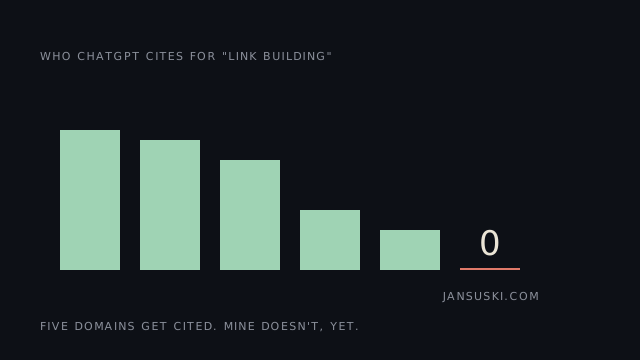
I ran DataForSEO's LLM mentions tool against the "link building" query cluster on ChatGPT to see which domains show up as sources. Across 1,832 mentions and 30,461 in aggregated AI search volume, five domains account for most of it: ahrefs.com (59 mentions, 1,809 AI search volume as a cited source), reddit.com (59 mentions, 932), seo.com (53 mentions, 1,858), developers.google.com (41 mentions, 1,600), and semrush.com (32 mentions, 699).
Backlinko, Wikipedia, Search Engine Land, WebFX, and TechRadar round out the top ten.
That list is dominated by vendor-owned domains and Reddit. Practitioner sites, personal blogs, agency owners writing under their own name, are absent. I checked jansuski.com against the same query cluster using the same tool. Zero mentions. Not low. Zero. That's the honest baseline for a personal site with no software brand and years of content behind it, and it's the gap the rest of this guide works to close.
Content structure built for machine extraction
What ChatGPT Search pulls into an answer is a single passage, chosen for information density over position on the page. Getting that passage written, and placed where a retrieval pass can find it, is a content structure problem before it's a writing problem.
ChatGPT skips the top-to-bottom read a person gives a page, extracting the single passage with the highest information value and dropping the rest. Kevin Indig's analysis of 1.2 million ChatGPT citations found what he calls the "ski ramp" pattern: 44.2% of citations come from the first 30% of a page's content, the middle 40% of the page accounts for 31.1%, and the final third gets just 24.7%.
A key fact buried in paragraph twelve of a twenty-paragraph post is roughly 2.5 times less likely to get cited than the same fact placed in the intro.
Inside a paragraph, the picture flips: 53% of citations pull from the middle sentence, well ahead of the opening one. ChatGPT picks the sentence carrying the highest information density, regardless of which one comes first. But that sentence still needs to sit near the top of the page to get seen at all.
A few patterns correlate with getting picked. Definitive phrasing ("X is defined as," "X refers to") appears in cited text nearly twice as often as vague framing: 36.2% versus 20.2%. Cited passages run an entity density of 20.6%, three to four times the 5 to 8% typical of ordinary English prose: concrete, specific brands, tools, people, and named products.
Cited content also averages a subjectivity score around 0.47 on a 0 to 1 scale, sitting between dry reference text and pure opinion, closer to an analyst explaining what the facts mean.
That translates into a short list of habits: write short paragraphs with a clear hierarchy of headings, favor natural language over jargon, name real tools and companies, skip vague filler like "leading solutions," and give each section a complete answer a reader could act on without opening a second tab.
Which AI models cite pages like yours
ChatGPT isn't the only model retrieving from the live web, and the AI models don't behave the same way. Claude held the highest repeat-consistency score in SparkToro's test, at 1.65%; every other model tested, ChatGPT included, scored lower. That gap matters for anyone building a consistent presence across AI platforms as a whole, beyond tuning for one model's quirks alone.
A page structured the way this guide describes travels reasonably well across ChatGPT, Gemini, and Perplexity, because the underlying signal, consensus across authoritative sources plus a citable, fresh, well-structured page, isn't model-specific.
Brand mentions beat backlinks for ChatGPT visibility
A backlink and a mention aren't the same thing anymore. Ahrefs' correlation data ranks branded web mentions, your name appearing across the web with or without a link attached, as the second-strongest factor behind YouTube. The logic: an LLM looking for consensus weighs how many independent, credible sources describe you the same way, with or without an anchor tag attached.
The move that compounds is finding out which domains ChatGPT already cites for your category, then getting added to the ones that don't mention you yet. A review platform with a filled-out profile and 50-plus positive reviews signals legitimacy to the model the same way it signals legitimacy to a buyer, and those credible mentions carry more weight than a generic company profile.
An industry publication with a contributor program is a mention opportunity as much as a backlink opportunity.
This is a marketing strategy question as much as an SEO strategy one. The agency or in-house team that treats brand mentions, YouTube presence, and review coverage as part of the same budget as backlinks is the one building AI visibility on purpose, ahead of any accident doing it for them.
Getting on the lists ChatGPT already cites
Ahrefs' Glen Allsopp studied page types across ChatGPT responses and found that "best of" list posts account for close to half of citations, 43.83% on average, for the query types where a recommendation is being requested. Blog posts proper trail at 14.34%.
The mistake is chasing a mention on every listicle that exists. A better approach: find sites in your category that haven't published a "best of" post yet, and pitch them the content itself, ahead of a mention buried inside someone else's list.
Offer them the keyword research showing search demand for "best [category]," show them what competitors are already capturing, give them hands-on access to evaluate your product first. If the post gets written, you've created a new page ChatGPT can start citing the next time someone asks.
Fresh content and ChatGPT's citation window
Ahrefs studied 17 million citations across seven AI search platforms and found that AI assistants prefer content that runs 25.7% fresher than what ranks organically in Google for the same query. ChatGPT showed the strongest preference of any platform tested: it cites URLs 393 days newer than organic Google results in its in-text references, and 458 days newer in full citations.
The study also found pages with no organic ranking and no organic traffic at all that were cited thousands of times by ChatGPT, purely because they were fresh and relevant to the query.
Changing a publish date without changing the content doesn't work, and the study's authors warn that ChatGPT's systems can pick up on metadata that doesn't match a real content update. What holds up: replacing outdated numbers with current ones, updating screenshots when the interface has changed, adding a section that answers a question that's emerged since the last update.
Technical access: confirm ChatGPT can reach the page
None of the above matters if the crawler can't get in. Check yoursite.com/robots.txt for a Disallow: / rule under the user agents GPTBot or OAI-SearchBot; either one blocks OpenAI's crawlers outright. If you run Cloudflare, check the "Block AI training bots" toggle under AI Crawl Control.
It ships on by default on a lot of accounts, and when it's on, your content stops feeding the model's training data or its live retrieval. The model then learns about your brand from whoever it can still reach: review sites, forums, competitor comparison pages.
Structured data earns its keep here too. A page with clean Article and FAQ schema gives a retrieval system a shortcut to the question a section answers and the entity it's about, on top of whatever it does for a rich result in Google's own search results.
AI search visibility versus traditional SEO: what carries over
Traditional SEO and AI search visibility share more ground than the "everything's different now" framing suggests. Crawlable pages, clear structure, and content that answers a real user need still matter to both. Schema markup still helps a machine parse what a page is about, in Google's index and in a model's retrieval pass alike. Authoritative sources still outrank thin ones, in both systems.
What changed is the unit being measured: from a keyword's rank on Google to the share of relevant prompts, increasingly the same conversational queries people used to type into other search engines, where a brand gets mentioned at all, and separately, if the specific page gets cited as a source.
A page can rank on page one of Google and never get pulled into an AI answer, and a page with no organic ranking at all can get cited repeatedly if it's fresh, specific, and structured for extraction. Both systems reward the same underlying thing: content that a reader, or a model retrieving on a reader's behalf, can trust and use without extra digging.
Building topical authority still works the same way it always did: a coherent set of pages on one subject, cross-linked, outperforms one page trying to cover everything. That authority is what earns trust signals from both a search algorithm and a language model looking for a consistent, credible source. Platforms like Positive Surfer's AI Tracker now measure that overlap directly, showing where a page ranks in Google next to where it gets cited by name.
Does ChatGPT visibility need its own playbook, or is it just SEO
Two practitioners published real, checkable positions on this in 2026, and they land in different places. I pulled the studies behind both of them, because the honest answer decides how much of this guide is worth doing at all.
The two positions, stated plainly
John McKusick, Founder and CEO of NextLeft, lists "you need to completely pivot to optimize for ChatGPT/Perplexity" as one of two SEO trends worth ignoring in 2026. His mechanism claim: AI tools "pull information from the same underlying web sources Google indexes," so "you won't get visibility in AI answers that you don't already earn with authoritative, quality content." Optimizing for chatbot discovery alone, he writes, is "putting the cart before the horse."
Jarred Smith, a marketing executive and author of the book "Explainable," argues the opposite in a long 2026 breakdown of AI search data: that AI visibility needs its own measurement stack, its own tactics per platform, and a strategy revisited every quarter because "most of what's being sold as 'AEO best practice' is at least one quarter behind the published data."
The case for "it's just SEO"
Google still holds 89.85% to 91.32% of global search referral share through 2026, per StatCounter, month to month. Cloudflare's own referral data for the 28 days ending April 20, 2026 put every AI chatbot combined, ChatGPT plus Gemini plus Claude plus Perplexity, at 0.27% of search referral traffic, against Google's 87.52%.
Within Google's own AI Overviews specifically, Ahrefs' 1.9-million-citation study (Louise Linehan and Xibeijia Guan, July 2025) found 76.1% of cited pages rank in the traditional top 10, and 86% rank somewhere in the top 100.
Domain traffic, a proxy for a site already having earned organic success, is the single strongest predictor of citation in Google's AI Mode too, per SE Ranking's 2.3-million-page study: sites with over 1.16 million monthly visitors earn 3x the citations of sites under 2,700.
Two independent studies, Ahrefs' own controlled before and after test on 1,885 pages and SE Ranking's cross-sectional analysis, both found schema markup produces no measurable citation lift once a page is already being cited.
Where that argument breaks
The 76% figure is specific to Google's own AI Overviews, built on Google's own index. It says nothing about ChatGPT, Gemini, Copilot, or Perplexity, the tools McKusick names directly.
Ahrefs ran the equivalent test against those four assistants for 15,000 real prompts, published August 2025, and found the opposite: on average, only 11.9% of what ChatGPT, Gemini, and Copilot cite ranks in Google's top 10 for that same prompt, and 80% of their citations don't rank anywhere in Google for the query at all. Perplexity, built specifically to cite sources, does better at 28.6%, but still pulls most of its citations from outside Google's top 10.
Ahrefs' own writer, Louise Linehan, summed up the split plainly in the second study: "AI Overviews follow the SERPs. AI assistants don't. Even the assistants built by Google aren't closely aligned with Google's SERPs." McKusick's claim holds for Google's own AI features. It doesn't hold for the third-party chatbots he names.
The case for a dedicated playbook
ChatGPT weighs referring domains, backlinks, roughly twice as heavily as Google's own AI Mode does, per SE Ranking's SHAP analysis, meaning the same page can perform differently across the two systems.
Citation behavior swings hard by platform too. Superlines tracked 34,234 AI responses across 10 platforms over 30 days and found the same brand's citation rate varying from 27.01% on Grok down to 0% on Claude and Mistral and DeepSeek, a 615x gap between the highest and lowest.
Volatility runs deeper than platform choice. Semrush documented Reddit's share of ChatGPT citations falling from around 60% to about 10% within weeks in September 2025, after OpenAI adjusted its source mix. None of that shows up in a normal Google rank tracker, which moves far slower.
Freshness carries separate, measurable weight too. Ahrefs' 17-million-citation study found ChatGPT cites pages 393 to 458 days newer than what ranks organically for the same query, the strongest freshness preference of any platform tested; Google's own AI Overviews are the outlier, citing pages that run slightly older than the organic SERP.
Where that argument overstates it
Several of the specific tactics Smith's own sources treat as distinct GEO moves don't survive scrutiny either. Schema, llms.txt, and FAQ blocks all show weak or contradictory citation lift across the same research he cites: Ahrefs and SE Ranking found no measurable effect from schema on pages already being cited; BrightEdge reports a lift, with no published methodology to weigh against the other two.
Smith concedes as much himself: "most of what's working in 2026 is what worked in 2024 plus a sharper bias toward citation-ready formats," and "none of this is novel."
The net read
The two positions are each right about a different slice of "AI search." For Google's own AI features, AI Overviews and AI Mode, McKusick's claim holds about as well as the data allows: citation tracks organic ranking closely enough that a dedicated program adds little beyond what already-strong SEO earns.
For the standalone chatbots, ChatGPT, Gemini, Copilot, and to a lesser extent Perplexity, his mechanism claim is contradicted by Ahrefs' own study: four out of five citations there come from pages that don't rank in Google at all for that query.
Smith's case for tracking those platforms as a separate, monitored channel holds up on the evidence. But his own sources cut against several of the specific new tactics vendors sell as the reason to hire a GEO specialist.
The zero on jansuski.com is the same zero this guide opened with. Closing that gap on ChatGPT specifically, given how little it overlaps with Google's own rankings, is a separate job from closing it on Google. Both are worth doing. Neither substitutes for the other.
Tracking ChatGPT traffic and citations
GA4 will show ChatGPT referral traffic under source=chatgpt.com once someone clicks through from an answer, though most citations never generate a click at all; being named in an answer with no link is still a mention, one that analytics alone will miss.
Running the same handful of prompts through ChatGPT on a schedule and logging who gets mentioned is a manual but reliable check. Third-party tools built on the same kind of LLM-mentions data used earlier in this guide, DataForSEO's included, do this at scale and can flag when a competitor starts showing up where you don't.
A working checklist for the next 30 days
- Pull your robots.txt and confirm GPTBot and OAI-SearchBot aren't blocked, and check Cloudflare's AI Crawl Control setting if you're on it.
- Run your brand name and your core query cluster through an LLM-mentions check to replace assumption with a real mention count.
- Find the domains that already get cited for your category and check which ones don't mention you yet.
- Rewrite your best existing page's opening paragraphs so the answer, with a real number in it, sits in the first three sentences.
- Add one FAQ section with question-form headings to your highest-intent page.
- Update one page's statistics and examples this month, and only change the publish date alongside a real substantive edit.
- Publish one piece built around data you collected yourself. That beats another summary of what everyone else already wrote.
- Turn on ChatGPT's lockdown mode and ask it to show your most important pages, to see if they're already cached.
- If you sell physical products, check how you show up in ChatGPT's shopping results specifically. That's where OpenAI's own index is easiest to see in production right now.
FAQ
How do you get your content indexed in ChatGPT?
ChatGPT runs its own retrieval index internally, called Labrador, split into verticals for web, PDF, YouTube, news, local, shopping, and more, on top of external providers including Google and Microsoft's Web IQ. The path in stays the same either way: an accessible, crawlable page (GPTBot and OAI-SearchBot both allowed), ranking for the query or one of its fan-outs, mentioned across sources the model already treats as consensus.
Does ChatGPT have its own search index, or does it just use Bing and Google?
It has its own, internally called Labrador, split into verticals for web, PDF, YouTube, news, shopping, local, and more, confirmed by OpenAI's own job postings and 2024 antitrust testimony from ChatGPT lead Nick Turley. It also still pulls from outside providers, Google and Microsoft's Web IQ among at least eight others. Bing visibility alone is not a reliable stand-in for ChatGPT visibility.
Is SEO dead now that ChatGPT answers questions directly?
No. Ahrefs' own correlation work and the freshness study both draw on organic ranking and crawl data as inputs to AI visibility. Neither treats it as a replacement. The skill set is expanding to include AI search visibility, layered on top of the discipline that already existed.
Can ChatGPT be used as an SEO tool itself?
Yes, for drafting, summarizing, and prompt research. The SERP and citation data behind this guide came from dedicated tools, Ahrefs and DataForSEO, never from asking a model to guess at its own citation patterns.
What's the single fastest way to check where you stand right now?
Run your own domain through an LLM-mentions tool against your core query cluster before changing anything. A zero, like the one jansuski.com returned for its link building cluster, is a baseline you can measure the next update against. Guessing isn't a baseline at all.
Is SEO for AI search a different job from regular SEO?
It's a related discipline with its own name (generative engine optimization, or LLM SEO, depending on who you ask), layered on top of regular SEO. Crawlability, authority, and clear answers to real user needs carry over. What's new is optimizing for citation and mention share on top of position.
Is SEO still worth doing in 2026, with AI answering questions directly?
Yes. AI answers still draw on organic rankings, crawl access, and the same authoritative sources SEO has always chased. A page invisible to Google is invisible to the AI systems that read the same web.
How do you track brand ranking in ChatGPT over time?
The same way you'd track any metric with no built-in dashboard: run a fixed set of prompts on a schedule (weekly is reasonable), log which brands and domains appear, and watch the trend across weeks. ChatGPT's own inconsistency means one snapshot tells you little on its own.
What's a realistic first goal for a small site with zero AI mentions?
Getting mentioned at all inside a narrow query cluster, the way jansuski.com currently isn't for link building terms. One citable, fresh, data-backed page aimed at one specific cluster will move that number faster than a general rewrite of the whole site.
Want to know where you stand with ChatGPT?
Send me your site and the query cluster you care about, and I'll run the same LLM-mention check I ran on jansuski.com against it, free.
get a free eye test