Key takeaways
- Surfer is an AI visibility platform: it tracks and grows how often ChatGPT, Perplexity, Gemini, Google AI Overviews, and Google AI Mode cite and mention your brand, and shows you exactly where competitors are getting mentioned instead.
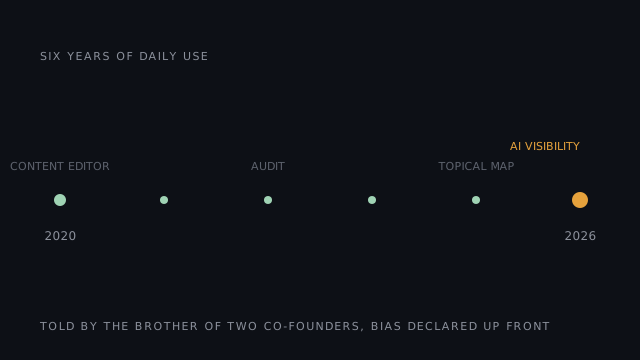
- I've been using Surfer daily since 2020 as a content writer and link builder. This review covers six years of hands-on experience, from early Content Editor days to the full AI visibility platform of 2026.
- Surfer's content score, grounded in a study of 1 million SERP entries showing a 0.28 Spearman correlation with Google rankings, beats every other third-party content optimization metric I've tested. It's gotten better every year I've used it.
- My core workflow revolves around the Surfer content editor, Content Audit, SERP analyzer, Topical Map, keyword research, Prompt, and Rank Tracker. Surfer is my main on-page SEO engine.
- In 2026, I consider Surfer the best-in-class content optimization tool for serious search engine optimization work. This is a positive (pun intended), opinionated review from someone who's seen the tool evolve from the inside.
- If you produce content at scale and care about search engine results pages, this review will tell you exactly why Surfer still dominates, and exactly who it's built for.
My Surfer story (2020–2026): from front-row baby steps to AI visibility platform
I need to start with a disclosure that doubles as context. My name is Jan Suski. I run link building and SEO strategy, mostly for tech and SaaS companies. I've spent six years manually vetting backlinks, building editorial relationships, and obsessing over on-page SEO details that most people skip. I can usually tell at a glance if a link is an asset, a liability, or a waste of someone's money.
I'm the brother of Surfer's co-founders. I watched this software grow from late-night conversations at family dinners into a company with 50+ people, speaking slots at BrightonSEO, and a product that content teams across the world now treat as infrastructure. I stayed on the practitioner side, building links and writing content, while my brothers built the company. But I had the best front-row seat in the industry.
One more update before the story starts: Surfer joined Group Positive in late 2025 and now goes by Positive Surfer, same founding team, same product. I'll keep calling it Surfer for the rest of this review since that's still what everyone types into Google.

2020: the year it got real
I first used Surfer "for real" in client projects in 2020. Before that, I'd seen prototypes and heard the pitch. But 2020 was when I plugged it into my fledgling workflow for English tech blog posts and SaaS landing pages.
The early content editor was simple. You'd enter a target keyword, and Surfer would pull the top ranking pages, then generate guidelines: recommended word count, number of headings, a list of NLP terms to include. The toolset was minimal: just a sidebar telling you "the top 10 pages average 2,400 words, use these 47 terms, include 6 H2s."
It was basic. It was also shockingly effective.
I remember optimizing a 2,800-word guide on API integrations for a SaaS client. The content editor flagged that I was missing 11 entities the top pages consistently mentioned. I wove them in, restructured two headings to match the SERP's dominant format, and watched the page climb from position 19 to position 7 in about six weeks. Search Console confirmed the clicks doubled in roughly three months. The tool distilled what the SERP rewarded, and I executed on it.
What made it surreal: the software shaping my work had been coded by family. I'd debug feature requests over dinner and then use the fixes the following morning.
2021–2022: the refinement era
This is when Surfer got serious about NLP and entity extraction. The content score tightened up: the editor moved past a rough "include these words" list to differentiate between critical entities and nice-to-haves. The Surfer audit tool matured: I could connect a Google Search Console account, pull performance data for dozens of URLs, and spot pages stuck on page 2 that needed a structural rebuild.
I used this relentlessly. One specific case: a 3,000-word SaaS comparison guide that had been sitting at positions 11–14 for months. I ran it through Audit, which flagged missing subtopics (pricing comparison, integration depth, customer support channels), a heading structure out of step with the dominant SERP format, and an average word count that was 600 words short of the competition.
I opened the content editor, restructured the piece, added the missing sections, and hit a content score of 82. Within 10 weeks, the page was sitting in the top 5. Clicks from Search Console went from ~40/week to ~95/week.
The SERP analyzer became my microscope for edge cases: queries like "developer tools comparison" or "API pricing models" where the top results were a mix of guides, product pages, and forum threads. Surfer showed me exactly which format was winning, so I wrote the right format on the first try.
2023–2024: scale & systems
I started building content systems for multiple domains. I moved past individual blog posts into planning entire content programs with dozens of articles per quarter. Surfer's Topical Map launched during this period, and it changed how I thought about content creation: I could map clusters, see content gaps, and build a production queue that made topical sense, well beyond picking keywords one at a time.
The content editor became the backbone of my on-page SOPs. I'd create Content Editor docs for every article, share them with writers, and use the content score as an objective quality bar. It eliminated the "is this good enough?" guessing game that kills editorial velocity.
Surfer AI entered the picture here. I'm a hands-on writer: I always rewrite AI drafts before they go out. I started using AI outlines and partial drafts for speed, always guided by the content score and SERP intent. The difference between generic AI slop and Surfer AI output was clear: Surfer's drafts came pre-loaded with the right structure, entity coverage, and keyword usage, grounded in live SERP data; a generic LLM works from its training corpus alone.
2025–2026: AI visibility & QOL
This is when Surfer stopped being "just" a content optimization tool and became what it now calls an AI Visibility Platform. The unified content score now integrates both SEO Score (traditional ranking signals) and AI Search Score (facts coverage, upfront intent alignment for AI-powered search).
Surfer tracks visibility on large language models like ChatGPT and Claude, alongside Google. Features like Mention Gap, Sentiment Analysis, and Gemini support in the AI Tracker mean I can see exactly where my content is being cited by AI, and where competitors are getting mentioned instead.
I expanded my own usage into prompt-based content generation, structured Surfer keyword research, and rank tracking. The quality-of-life features stacked up: distilled SERP insights in the content editor (clear topics, questions, entities to cover), smarter Auto-Optimize that shifts focus once SEO signals are covered, cleaner UI for internal linking suggestions, and workspace-level organization that survives having 30+ active documents.
What matters most to me after six years: Surfer kept improving, release after release. The content score remained reliable. The SERP analyzer stayed grounded in real data. Each release made it easier to optimize content for both readers and search engine rankings.
I watched other SEO tools peak around 2021 and then get bloated, unreliable, or confused about what they were, while Surfer kept its focus and got sharper instead.
In the big 2026, I run larger-scale content and SEO systems with Surfer as my default content optimization environment. They're still killing, nay, slaughtering, decimating, and destroying it in on-page SEO. Six years of my own tracked results back that claim up.
What is Surfer in 2026? (and what it does better than other SEO tools)
Surfer is an AI visibility platform in 2026. The priority is getting content cited across the "Big 5": ChatGPT, Perplexity, Gemini, Google AI Overviews, and Google AI Mode. Mention Gap and Sentiment Analysis, both in the AI Tracker, show exactly where your content is getting cited in AI answers and where competitors are getting mentioned instead, and the content editor's guidelines now include AI Search Score and facts coverage.
Surfer is built around content optimization, the on-page layer of SEO. It handles the stuff that sits inside your article:
- Word count ranges based on what's ranking
- Heading structure and page structure guidance
- Topical coverage: entities, NLP terms, related keywords
- Content structure, keyword usage, and length recommendations
- Internal linking suggestions powered by your site's data
- AI-assisted content creation and optimization
In 2026, the core modules include: content editor, Surfer AI / Prompt, Content Audit (GSC-connected), Topical Map and keyword research tools, SERP Analyzer, Rank Tracker, AI visibility tracking, and integrations with Google Docs, WordPress (via the Surfer WordPress plugin), and API.
Surfer supports content optimization in over 20 languages. For content writers, editors, and SEO-focused teams, Surfer is the on-page engine that sits between keyword research tools like Ahrefs or Semrush and analytics platforms like Google Search Console. It's how you turn keyword ideas into web pages that rank.
Surfer's content editor: still the tool I pay for
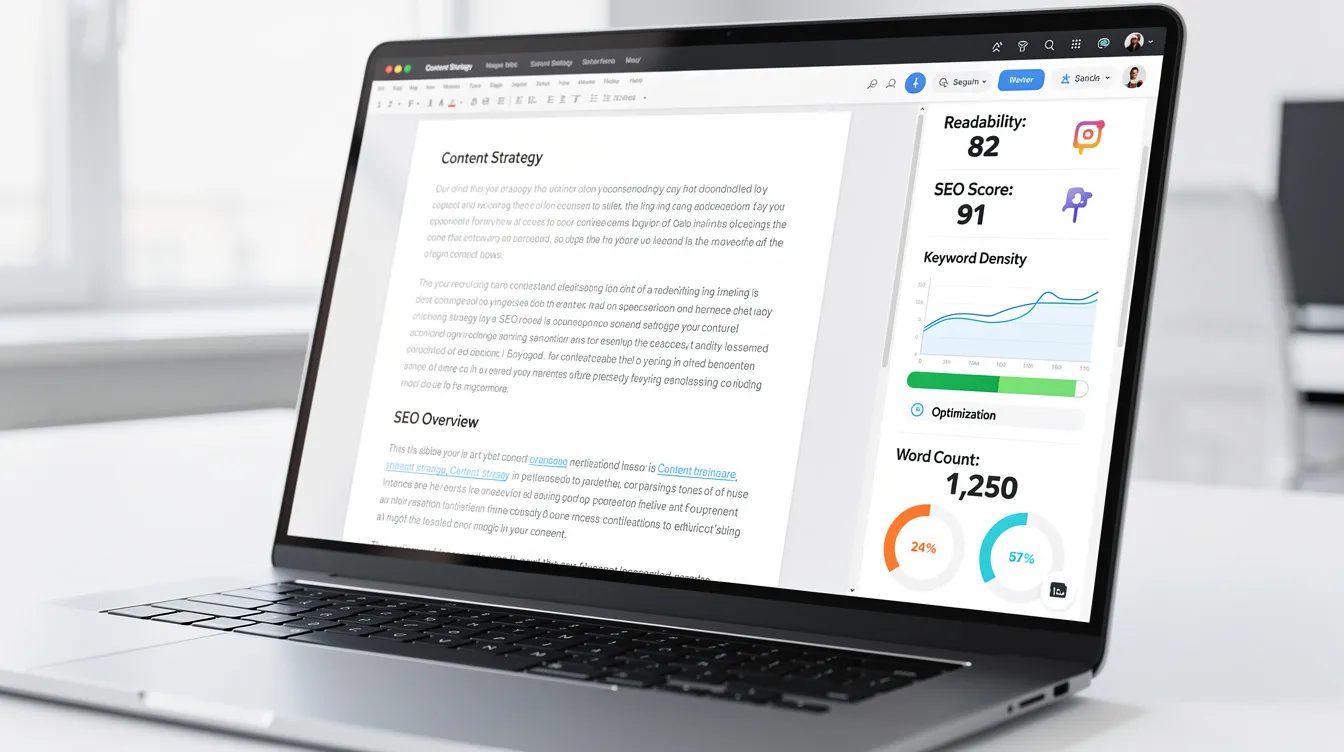
The Surfer content editor is the reason I pay for Surfer. Here's how it works in 2026:
You enter one or more target keywords. Surfer analyzes top-performing competitors for those queries.
The content editor builds a live guideline panel: ideal word count range, headings count, paragraph and image guidance, and a list of NLP terms and entities to include.
Content Score ranges from 0 to 100, indicating optimization level. A score of 70+ is considered good. I typically aim for 75–85 on high-priority pages. Surfer recommends a score 10–20 points above competitors, without chasing 100/100.
Surfer's Content Editor provides real-time optimization suggestions: as you write or paste content, the score updates and the sidebar shows what you're missing or overusing, including warnings for potential keyword stuffing and over-optimization.
The 2026 quality-of-life features are excellent: better grouping of related terms, clear separation of must-have vs nice-to-have phrases, distillation of SERP headings into outline ideas, and intent cues that keep you writing for the right search intent. Surfer's recommendations come from measurable patterns found in top-ranking pages.
My personal setup: I draft in Google Docs with the Surfer sidebar (via the Google Docs integration), or inside Surfer's own editor for solo projects. I rarely chase a perfect score but I always chase full topical coverage and natural language. Surfer provides guidance on effective content structure, keyword usage, and length, and that's enough to consistently outperform pages that skip this step.
For me, Surfer's content editor is the single biggest reason I rarely log into competing content optimization tools. It's fast. It's reliable. It's aligned with real ranking outcomes.
Content Audit: turning "almost there" content into winners
The Surfer audit tool connects to Google Search Console, pulls performance data for 100–1,000+ URLs, and identifies pages with the best upside. The tool helps identify opportunities for updating older content: pages with decent impressions but low CTR, mid-pack rankings, or content score gaps.
What Audit generates:
- Adjust word count based on current SERP competition
- Add missing subtopics, entities, and specific phrases
- Update headings and fix content structure issues
- Improve internal linking and add/remove sections
- The platform detects ranking drops and provides re-optimization suggestions
I use Audit as a triage tool. I scan "Best Opportunities" first, then open promising URLs directly in the content editor to apply on-page SEO fixes. In my experience, existing content that was under-optimized shows movement in 4–12 weeks. Surfer's own data backs this: pages written or updated with Surfer are 2× more likely to reach the Top 10 within 30 days.
Audit's real strength for writers is structural: it tells you when an article needs a new section, when it's missing an FAQ, or when it's accidentally optimized for the wrong intent. That kind of structural insight is what separates "almost ranking" content from content that wins.
Surfer SERP Analyzer: deep-dive on-page SEO when it matters
Surfer offers a SERP Analyzer to analyze search results at a granular level. The Surfer SERP analyzer maps out top results for a keyword, often top 10–50, showing trends in word count, headings, content score ranges, internal and external links, and hundreds of other on-page signals relevant to ranking.
I focus on a handful of those data points:
- Content length bands (how many words are the winners writing?)
- Intent patterns (guides vs product pages vs lists)
- Structural similarities across top pages (SERP similarity)
- Format fit (does the SERP favor a specific structure?)
When do I reach for it? New, competitive topics where being slightly off in format or search intent can bury a page. Something like "AI customer support software" or "SaaS pricing strategy," queries where structural fit is often the deciding factor between position 3 and position 30.
In 2026, many SERP Analyzer insights are already baked into the content editor. I treat Analyzer as an advanced sanity check reserved for high-stakes content.
Keyword research & Topical Map: from keywords to real content systems
I still use heavy-duty keyword research tools, Ahrefs and Semrush, for large-scale discovery, search volume analysis, and competitor research. But Surfer keyword research and the Topical Map are what I use to translate raw keyword ideas into executable content plans.
The Keyword Research tool generates related keyword ideas from a seed keyword: clusters of related terms with monthly search volume, relative difficulty, and intent classification. The SERP similarity grouping and keyword suggestions are the most useful parts: they show which keywords can be targeted on the same page and which need separate content.
The Topical Map connects to your domain data, surfaces realistic topics you can rank for based on current authority, and groups them into hubs and supporting articles. It feeds directly into the content creation process: map to idea to content editor to publish.
In 2026, Surfer's topical and keyword features are strong enough that, for many niche sites and content programs, you can run most of your topic ideation and clustering entirely inside Surfer. You can go from a seed keyword to a full production queue of related keyword ideas, all inside the platform.
Surfer AI & Prompt: from draft assistants to full workflows
Surfer AI takes a keyword, and optionally competitor URLs, tone, POV, and produces a draft that already follows on-page optimization guidelines, target word count, and topical coverage from the SERP. Surfer's AI writing assistant can generate articles quickly, often in under 20 minutes.
AI Content Generation includes features for creating and optimizing content efficiently, and as of June 2026, Surfer AI auto-links internal and external sources during content generation, so first drafts arrive closer to publish-ready.
Surfer incorporates AI-assisted writing to aid in content generation, but here's how I use it: my habit is to treat AI drafts as a first pass I always rewrite. I use Surfer AI for structure, coverage, and speed, then rewrite and add my own expertise, data, and examples. The value is AI text grounded in the live SERP, with content score, intent, and keyword coverage baked in. Generic LLMs work from training data alone and miss that layer.
Brand Knowledge lets you configure your brand identity so AI tools write with your tone, priorities, and facts, replacing the generic voice most AI tools default to. Combined with the Humanizer and AI Detector, it keeps AI-assisted content sounding human.
Rank Tracker & AI visibility: closing the loop on performance
Surfer's Rank Tracker lets me follow position changes for key queries across multiple domains, right next to the content optimization environment. This makes it easy to tie ranking changes back to specific Audit or content editor work. Users can experience improved search visibility with Surfer's data-driven guidance, and the Rank Tracker is how you verify it.
The AI visibility angle is new and significant. Surfer's AI Tracker covers the "Big 5": ChatGPT, Perplexity, Gemini, Google AI Overviews, and Google AI Mode. Features like Mention Gap and Sentiment Analysis show where your content is being cited in AI answers and where competitors are getting mentioned instead.
My practical loop: I watch for pages that plateau or slip, push them into Audit for a refresh, then monitor the recovery. Conversely, I note which Surfer-optimized pages made sudden jumps and reverse-engineer what worked. The platform detects ranking drops and provides re-optimization suggestions, which closes the feedback loop between content creation and performance.
QOL features that make using Surfer genuinely pleasant
The "little things" are what separate a tool you tolerate from a tool you enjoy. Surfer improves workflow efficiency for high-volume content production through features that have stacked up over six years:
- Cleaner UI with faster report generation and less noise
- Smarter auto-suggestions that differentiate critical terms from optional ones
- Automatic internal linking suggestions powered by GSC data and semantic matching
- Better multi-language support (over 20 languages for content optimization)
- Workspace-level organization with brand/domain isolation
- Content exports as HTML and Markdown for non-WordPress workflows
Surfer integrates with common writing tools like Google Docs and WordPress, plus Chrome extensions and a new API. These integrations keep me inside one or two tabs while I optimize an article.

Compared with many SEO platforms that became cluttered and slow as they added AI tools, Surfer's evolution has been about making complex SERP data feel usable as it grew. Every update I can remember made real-time optimization suggestions clearer.
Surfer pricing & value in 2026
Surfer offers five pricing plans ranging from $49 to $399 monthly. Here's the structure:
| Plan | Monthly cost | Annual cost | Key limits |
|---|---|---|---|
| Basic | $49/month | · | 10 articles/month |
| Essential | $99/month | $79/month billed annually | More articles, Audit access |
| Scale | $219/month | $175/month billed annually | Higher limits, API, advanced features |
| Enterprise | $399/month | Custom | Full platform, team features |
The basic package allows 10 articles per month for $49. The Essential Plan costs $79 per month when billed annually. The Scale Plan starts at $175 per month when billed annually. Surfer includes a 30-day money-back guarantee across all plans.
Surfer pricing positions it as more affordable than pure content graders like Clearscope or MarketMuse for what you get, and it's priced like the serious tool it is. It's an investment for teams that care about consistent publishing and search engine rankings.
My perspective: one or two well-optimized articles that bring in qualified leads easily justify a month of Surfer cost. For agencies and SaaS teams, the ROI compounds as you scale. If you publish one article every two months, Surfer might feel expensive. If you're running a real content program, it's one of the subscriptions I renew without a second thought.
How Surfer compares to other content optimization tools (from my desk)
I've tried most Surfer alternatives. Here's where they land:
Clearscope costs more than Surfer and covers a narrower slice: strong content grading, limited to that alone.
MarketMuse is often better for larger teams and enterprises with deep content inventories, but slower in day-to-day workflows and pricier.
Frase focuses on content briefs and research automation: decent for research-heavy workflows but lighter on optimization.
PageOptimizer Pro is more technical and less user-friendly than Surfer, which makes it harder to deploy across a content team.
Dashword offers content briefs and monitoring features, with SERP fidelity that trails Surfer's on competitive queries.
NeuronWriter is cheaper and suits smaller bloggers or side projects, but loses ground on hard keywords. Call me biased, but it's also a shameless rip-off of Surfer's straightforward Content Editor design. I saw their booth once at Festiwal SEO in Katowice (2022 or 23), and I burst into laughter seeing the carbon copy of Content Editor with a different logo stamped on it.
Surfer excels in on-page optimization; backlink analysis lives elsewhere in your stack. I still use Ahrefs and Semrush for backlinks, technical audits, and macro-level keyword research. Surfer complements them, providing the on-page execution layer they leave out.
If your main bottleneck is "How do I turn these keywords into pages that deserve to rank?", Surfer is where I'd put my money first.
Who Surfer is for (and who can skip it)
Surfer is most beneficial for content marketing teams and SEO agencies producing many articles. It is particularly effective for content marketers, bloggers, and SEOs who publish at least weekly and care about rankings as much as output.
Surfer is overkill for tiny local sites with 5–10 static pages, where local SEO basics and reviews carry the real weight, well beyond what a content optimization suite adds.
Non-SEO writers can learn Surfer's basics in a few days: understand content score, keyword suggestions, heading structure, and how to avoid keyword stuffing. At least one person on the team should own strategy, keyword research, and search intent alignment.
Serious publishers should build Surfer into the workflow from the start, before a word is written. The tool rewards proactive use throughout the process.
My day-to-day workflow using Surfer
Here's what using Surfer looks like in practice:
- External keyword research: Ahrefs or Semrush for broad discovery, search volume, and competitive landscape
- Surfer keyword research / Topical Map: cluster topics, find related keywords, identify content gaps
- Create Content Editor doc: plug in target keyword, review SERP guidelines
- Draft: write in Google Docs with the Surfer sidebar, or in Surfer's editor; iterate until content score hits 75–85
- Internal linking: accept or reject Surfer's automated internal linking suggestions
- Publish: export to CMS or use the Surfer WordPress plugin
- Monitor: Rank Tracker for position changes; Audit for future refreshes; AI visibility for LLM citations
I treat Surfer's suggestions as a map I can deviate from when it serves the reader. I'll sometimes deliberately skip a recommendation if it would hurt readability or misalign the article with my audience. Content score is a guide I follow loosely, adjusted by judgment.
For larger content batches, I create multiple Content Editor docs at once, assign them to writers, and use the content score as a shared standard. It makes editing faster and more objective across an entire team, which directly supports enterprise content strategies.
Strengths: why I think Surfer is "best in biz" in 2026
Three pillars:
Content Score that correlates with rankings. A study of 1 million SERP entries found a 0.28 Spearman correlation between Surfer's content score and Google ranking position. That's stronger than many backlink metrics. Surfer claims 57% of articles created using Topical Map + content editor rank in the top 10.
A mature content editor that's both powerful and usable. Surfer features have expanded from basic NLP terms to a unified content score with AI Search Score, auto-optimize, auto-linked sources, and brand knowledge, and stayed fast and lean while doing it.
Continuous improvement from 2020–2026. Users report improvements in organic traffic and keyword rankings when using Surfer. Surfer's own blog traffic grew 358%, generating 60% of leads and 27% of sales. Users grew their Google and AI visibility by 423% on average in 2025; top performers saw 800% growth. Surfer features a data-backed approach to content optimization that has only sharpened over time.
I've watched many other tools come and go. Few of them can honestly claim they're better now than at launch. Surfer can.
Limitations & things to keep in mind
Every tool has limits. Here's what to know:
Surfer stays focused on the on-page layer; off-page work like backlink analysis lives outside it. You still need Ahrefs, Semrush, or similar for links, crawl issues, and site-wide technical audits.
Common criticisms of Surfer include high pricing and risks of over-optimization. Chasing a perfect content score while ignoring readers, search intent, or strategy leads to bloated, unnatural articles.
If you ask me, chasing the perfect score is using the tool you pay for wrong.
Does Surfer guarantee rankings? It shifts the odds in your favor; that's the honest ceiling for any SEO tool.
Surfer cost can feel high if publishing volume is low. Using Surfer only as a last-minute checklist wastes its potential.
Like any SEO tool, Surfer's data is based on correlations and SERP snapshots. Algorithms shift constantly; Surfer's edge means better odds at ranking, never a fixed outcome.
Some features (Audit, internal linking) depend on proper GSC configuration. If your Google Search Console data is messy, results will be less reliable.
Page speed, off-page signals, social media marketing, and domain authority all matter for rankings. Those live outside Surfer's job description; it handles the on-page part better than anything else I've used.
Final verdict: is Surfer worth it in 2026?
Yes, and I mean that flatly.
For me, a content-focused SEO who's been in the trenches since 2020, Surfer remains the single most important on-page SEO tool in my stack. The content score is reliable. The SERP-aware guidelines are grounded in real data. The feature set (content editor, Audit, Topical Map, Surfer AI, Rank Tracker) has only improved across six years of daily use. Is Surfer good? It's the best content optimization tool I've used, period.
Does Surfer replace everything? It covers on-page execution; pair it with separate keyword research tools and technical SEO platforms for the rest. But for on-page optimization, for the act of turning a keyword into a page that deserves to rank on search engines, Surfer offers the best environment in the industry.
In the big 2026, Surfer is still killing it in content optimization. I expect that to hold for years.
Try it with the 30-day money-back guarantee and see what your content score looks like.
FAQ
Does Surfer replace tools like Ahrefs or Semrush?
Surfer complements big keyword research tools and backlink analysis platforms. It doesn't replace them. It handles on-page SEO and content optimization once you know what you want to rank for. My stack is Ahrefs/Semrush for research, Surfer for on-page execution, and GSC/GA for measurement. That combo works for most serious content programs. Surfer excels in on-page optimization and leaves backlink analysis to dedicated tools, so you'll want both layers.
How long does it take to see results after optimizing content with Surfer?
In my experience, modest improvements on existing content often show up within 4–12 weeks, assuming the site already has some authority and the content was under-optimized. Brand new content follows normal SEO timelines, often several months for competitive queries.
Surfer's role is to improve your odds and speed toward a ranking that still takes real time to earn. The data supports this: high ranking blog posts optimized with Surfer are 2× more likely to reach the Top 10 within 30 days compared to unoptimized pages.
Can non-SEO writers use Surfer effectively?
Yes. Non-SEO writers can become productive with Surfer in a few days. They mainly need to understand content score, keyword suggestions, heading structure, and how to avoid keyword stuffing. I'd recommend pairing writers with at least one SEO strategist who handles topic selection, search intent alignment, and keyword research. Surfer handles the day-to-day optimization guidance; the writer follows the sidebar and focuses on quality.
Is Surfer overkill for a small business blog?
It depends on volume and goals. If you publish rarely or mostly for existing customers, Surfer might be too much. If you plan to compete for non-brand keywords and ship content regularly, it quickly pays for itself. Small businesses with a growing content plan should consider starting on the lower-tier plan, the basic package allows 10 articles per month for $49, and scaling up as results and publishing cadence increase.
What's the biggest mistake people make when using Surfer?
Chasing a perfect content score while losing sight of readers, search intent, or overall strategy leads to bloated or unnatural articles, every single keyword suggestion shoehorned in without regard for the reader.
Treat Surfer's recommendations as a map: aim for strong coverage and good scores, but keep clarity, usefulness, and brand voice ahead of ticking every box. The best content optimization tools make you better; the writing is still yours to do.
Building a content system and want a second opinion?
Send me your content workflow and where it's stalling, and I'll tell you plainly if the bottleneck is tooling, structure, or something else entirely.
get a free eye test