Key takeaways
- Competitor backlink analysis is the first thing I run on any new client, before touching their own site, because it shows what it costs to outrank the pages sitting above them.
- Page-level competitors, the specific URLs outranking you for a target keyword, matter more than domain-level competitors, the brands you'd name off the top of your head.
- I run backlink data through Ahrefs and Semrush together since their indexes only overlap 70 to 80%, then filter every referring domain for page-level traffic and dofollow status before it goes on an outreach list.
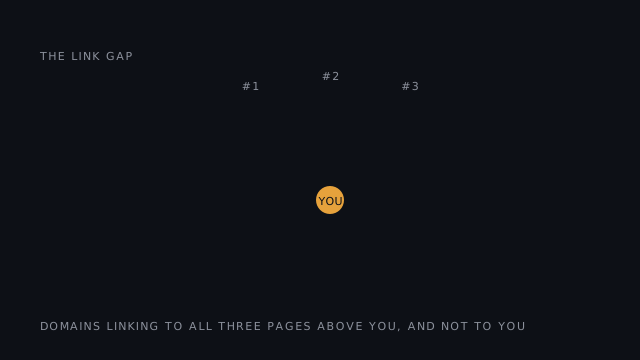
- A backlink gap analysis, the referring domains linking to competitors but not to you, usually hands you the outreach campaign itself, ready to send the same day it lands.
- I skip toxic links, stale broken-link opportunities, and duplicate site-wide links outright; DR alone is never the filter I lead with.
What competitor backlinks are, and why I pull them before anything else
Search engines still treat backlinks as votes. Competitor backlinks are the links pointing at a site that outranks yours for the keywords you want. Not every link on a competitor's profile matters, only the ones sitting on pages that earn real search engine visibility.
When I take on a new client, competitor backlink analysis is the first thing I run, before I touch their own site at all. It tells me faster than anything else what it costs to outrank the pages currently sitting above them.
I learned this the expensive way. Early on, I'd start every engagement by auditing the client's own backlink profile first, looking for gaps and weak spots in isolation. It took me a solid year of campaigns to realize I had the order backwards. A client's profile only means something next to what their competitors have built. Now I don't open a strategy call without a competitor backlink analysis already sitting in front of me.
How I find my competitors' backlinks
Monitoring competitors' backlinks is how I discover most of my outreach opportunities. Cold prospecting accounts for the rest. Here's the process, unchanged in its bones for six years even as the tools around it improved.
Step 1: picking the right competitors at the page level
Most people run this wrong from the first click. They plug in their competitor's domain and pull every backlink pointing anywhere on the site. That's domain level competitors' data, and it's mostly noise.
What I want is page level competitors: the specific URLs outranking my client for the exact target keyword. A domain can be enormous and still have a thinly linked page winning a specific SERP on relevance alone, so I always start by identifying the competing URLs for that one keyword before I look at the wider domain.
Identifying your true SEO competitors means analyzing which sites are outranking you for that target keyword right now, a different list than the brands you'd name off the top of your head if someone asked who your competitors are. I've had clients hand me a list of "competitors" that barely overlapped with who was sitting in positions 1 through 10 for their money keywords. The SERP doesn't care about your competitor set slide from three years ago.
Step 2: running it through a backlink checker
Once I have the right URLs, I check competitor backlinks through a checker tool, almost always Ahrefs, sometimes Semrush as a cross-check. The Ahrefs backlink checker shows backlinks pointing to a specific blog post as well as the domain, which is what makes page-level competitor analysis possible on the exact ranking URL.
Ahrefs reports that Moz's own beginner's guide to SEO carries roughly 3,200 backlinks, which puts "high authority" in perspective the first time you see it. Semrush's database includes over 43 trillion backlinks, a number that sounds like marketing copy until you're hunting competitor backlinks in Semrush for a client in a genuinely obscure niche.
I've had searches where Ahrefs missed a small but relevant referring domain that Semrush caught, and vice versa. Neither tool sees everything, so I check backlinks in both places whenever a client's budget allows it.
Step 3: reading the competitive gap
Backlink gap analysis is the single most useful move in this whole process. That comparison shows you sites linking to competitors but not you, which turns competitor backlink analysis from a research exercise into an actual outreach list.
I ran this for a SaaS client in 2023, comparing them against their three closest competitors. The report handed me 40-something referring domains linking to at least two of the three competitors but nobody on our client's own profile. That list became the entire first quarter of outreach, and half of it converted: a site that already links to two of your direct competitors has proven twice over it's open to linking to companies exactly like yours.
Step 4: filtering for backlink quality over volume
A raw list of competitor backlinks is only a starting point. I filter hard before a single outreach email goes out. High authority backlinks pass more link juice than low-authority ones, but authority alone isn't what decides it for me. I check the page holding the link for real traffic, note if it's dofollow or nofollow, and check if the site sits in a niche that could drag my client's own backlink profile down by association.
I'll cut a domain with a great domain rating (DR) if the specific linking page is orphaned, buried, or sitting next to outbound links to a dozen unrelated niches, the same page-level checks I run in my junk backlink checklist.
Before I call any competitor backlink analysis finished, I run a short pass across the backlink data: how many backlinks point at the page itself, how many are dofollow links against nofollow links, if the referring domains pointing at it are themselves reputable, and how the total backlink count compares against unique linking domains.
A page with 400 backlinks from 12 linking domains is a red flag; site-wide links inflate the count without adding anything real. I prefer 40 backlinks from 35 different site owners over 400 repeating across the same domains, and I only need the backlinks sitting on pages that rank. DR gets treated like the only seo metric that matters; it's one signal among several I weigh.
Score any single link from a competitor's gap list against the same checklist before you chase it:
The SEO tools I pay for and use every week
People ask me constantly which seo tool is "best" for competitor backlink analysis. Wrong question. I run three, and each earns its subscription for a different reason.
Ahrefs backlink checker
Ahrefs is what I open first for almost every competitor backlink analysis. The backlink index runs deep, the referring domains view filters fast, and it checks backlinks at the exact URL level as well as the whole domain, which is what makes it my default seo software for finding competitor backlinks fast.
Semrush
I lean on Semrush when a client competes in a market where I've had Ahrefs come back thin. Its backlink data overlaps with Ahrefs maybe 70 to 80% of the time in my experience; the rest is exactly the kind of unique referring domains that make the difference between an average outreach list and a genuinely good one.
Free backlink checkers, and when they're enough
A free backlink checker is fine for a quick gut check on a single competitor before you commit budget to a full audit. I still use one when a prospective client wants a rough sense of their gap before they've signed anything. Just don't mistake it for a substitute once real budget and real link building efforts are on the table; the sample size on most free tools is a fraction of what a paid backlink checker returns.
Is it worth paying for a backlink checker?
For anyone doing this more than once a quarter, yes. I've tracked this across enough client engagements to say it plainly: the paid seo tools pay for themselves inside the first gap analysis they enable, because the outreach list they produce is the actual revenue driver. The report itself is just the paper trail.
If you're checking competitor backlinks once a year out of curiosity, a free backlink checker will do. If competitor backlink strategies are part of how you plan quarterly link building, the paid backlink data is the cheapest line item in the whole campaign.
What a real gap analysis looked like on one of my campaigns
Here's what an actual gap analysis looked like on one campaign. A fintech client came to me ranking on page 2 for their core category term, sitting behind two direct competitors with domain authority within a few points of theirs.
I pulled all three backlink profiles, ran the gap, and found the two competitors shared 26 referring domains our client had zero links from, almost entirely industry publications and roundup posts. I built the outreach list straight off that comparison, prioritized by estimated organic traffic on that page itself over the referring domain's overall size.
Fourteen weeks and a stack of personalized pitches later, the client had 9 new backlinks from that list and had climbed from page 2 into the bottom of page 1. That's the kind of result this work produces when you act on the findings and stop admiring the spreadsheet.
Competitor backlink strategies that turned into real links for my clients
Guest posts pulled straight off a competitor's list
Guest posts remain one of the most reliable ways to secure backlinks once you know which sites already accept them, and a competitor's backlink profile tells you exactly that. If a site links out to your competitor's guest post, that site owner has already shown they'll run a byline from someone in your space.
I've built entire quarters of link building strategy around nothing more complicated than that one observation. Personalized outreach emails consistently get better response rates than anything sent in bulk, which matters more here than the gap list itself, more on that in my companion piece on backlink outreach.
Content built to close the exact gap I found
Content that earns links on its own typically means original research or an ultimate guide, the kind of piece other sites want to cite without being asked. When this kind of comparison shows the same three or four competitor pages getting cited over and over for a topic, that's usually a signal the existing content is thin, dated, or missing an angle.
I've built more than one client's best-performing linkable asset directly off that pattern: find what everyone's citing, work out what it's missing, build the version that fixes it.
Reading anchor text like a map of competitor keyword strategy
Analyzing anchor text across a competitor's referring domains tells you which keywords they've been quietly building authority around. If the anchor text pattern skews heavily toward one commercial phrase, that's a deliberate choice on the competitor's part, and it's usually a keyword worth taking seriously in your own keyword list.
I check this on every audit I run. It's one of the fastest ways to reverse-engineer a competitor's actual SEO priorities without guessing from their published content alone.
Backlinks I skip even when they're sitting right there on the list
Not every link on a competitor's profile is worth chasing, and treating the whole export as one undifferentiated pile of opportunity is how outreach budgets get wasted. I skip toxic backlinks and spammy links outright, the kind sitting on link farms or sites that exist purely to sell placements, the kind a tool like WebCEO's toxic-link detector would flag automatically with its customizable scoring formula.
I skip dead link and 404 opportunities almost entirely at this point; broken link building rarely earns back the time it costs once you compare the reply rate against a straight link exchange. I note nofollow links but rarely lead a campaign with them, since the actual authority passed is close to zero even when the placement itself looks clean.
And I flag duplicate links, the same domain showing up a dozen times through site-wide links in a footer or nav, because that's one relationship worth counting once, however many times the domain repeats.
What I mean when I say "link opportunities"
A gap report is just a ranked list of link opportunities, and treating every row the same is the mistake most people make. Not every competitor backlink profile hides genuine link opportunities; plenty of it is noise from directories and scraped footers.
Backlinks from the right pages are the goal, well ahead of raw count. I sort what is left by traffic first and DR second, then hand the client a shorter list built on real backlink quality.
I run this against multiple competitors whenever the budget allows, never just one. Comparing multiple competitors at once is how you spot the referring domains that show up again and again, the ones already primed to link to a third or fourth company exactly like yours.
Competitor backlinks are valuable backlinks only when the page holding them still earns traffic, and high quality backlinks tend to cluster on the same handful of sites across an entire niche once you've looked at enough of them.
How to check competitors' SEO beyond just their backlinks
Backlink checker data is half the picture. I pair it with Google Search Console data where I can get access to it (my own GSC data, since a competitor's isn't visible to me), and with a straight look at which of a competitor's pages are winning the rankings for our shared target keywords.
A competitor with a strong backlink profile but thin, outdated content on the actual ranking page is a different opportunity than one who's genuinely earned the position on both fronts. I've walked into engagements where the backlink profile looked intimidating and the actual linking page was five years stale, an opening dressed up as an obstacle.
Finding competitor backlinks in Semrush, step by step
When a client's stack includes Semrush over Ahrefs, the workflow barely changes. I drop the competitor's domain or the specific competing URL into Semrush's Backlink Analytics, filtering by unique websites linking over raw backlink count.
From there I cross-reference against my client's own domain using the Backlink Gap tool, surfacing every referring domain pointing at one or more competitors but not at us. It's the same filtering pass I run with any seo software: quality first, volume second.
A few more things worth knowing before you start
Search engines reward the same basic pattern they always have: relevant, earned competitor backlinks from sites people visit, the same core backlinks benefits that make this whole exercise worth running. That's exactly why competitor backlinks stay worth tracking long after the first campaign ends.
Search engines have also gotten sharper at spotting manufactured link building tactics, and a link building strategy built entirely around a gap list without real relationships behind it produces diminishing returns fast. I've watched search engines devalue entire link networks overnight; the competitor backlinks still standing afterward belonged to sites with a genuine backlink strategy behind every placement.
None of that changes how useful it is to check competitor backlinks first. I run the check at onboarding, again every quarter, and a third time whenever rankings move without an obvious cause.
Finding competitor backlinks is the easy part now that a decent seo tool is cheap and the process is documented everywhere. Deciding which competitor backlinks are worth chasing is where six years of pattern recognition pays off.
Any seo tool worth paying for lets you filter by page level competitors over raw domain totals. A link building tool that can't separate a page-level competitors view from a domain-level one isn't one I'd recommend to a client.
External backlinks matter less to me than the specific ones sitting on a page I am studying; a domain's total external backlinks count is closer to a vanity number next to what a single strong placement can do. When I search competitors' backlink profiles I am identifying websites willing to link to businesses like my client's, competitors sites included, and I check the same pattern across same keywords whenever two brands are fighting for the same handful of rankings.
I search competitors' backlink activity twice a year at minimum, even for retained clients, because backlink opportunities don't stay static. Competitors lose backlinks to redesigns and pick up new ones from campaigns I wasn't tracking.
Those lost backlinks are often reclaimable by anyone paying attention, and the backlink opportunities hiding in a competitor's oldest, highest-traffic content are usually better than anything in their newest posts. A page stuffed with outbound links to a dozen unrelated niches rarely passes much authority to any single one of them, and auditing a website's backlinks in isolation, without a competitor to measure it against, tells you almost nothing on its own.
Every gap report I've pulled turns up a mix: some backlink opportunities worth an email that day, plenty that aren't. I rank them the same way every time, traffic first, relevance second, domain metrics a distant third, and I revisit lost backlinks on every retained client's competitor set at least once a quarter, because a competitor's loss is sometimes the fastest new backlinks a client will ever land.
A thin link profile can still outperform a bulky one if the handful of links it has are strong. I've seen one website out-rank a competitor with triple the backlink count on the strength of a dozen genuinely high quality links over a thousand average ones, the same math I walk through in how many backlinks you need to rank.
Inbound links from directories rarely move anything on their own, but valuable links from a single respected publication can outweigh fifty of them combined; more links is never automatically better than fewer, stronger ones. I'd hand a client ten quality links over a hundred backlinks pointing at pages nobody will ever read.
Broken links on a competitor's site are worth a look too, since a dead page that used to hold real backlink data is sometimes an easier reclaim than building something from scratch, using the same removal-first approach from how to spot a junk backlink. None of this replaces watching domain authority alongside DR. The two measure related things but rarely agree completely, so a real backlink strategy tracks both and never leans on one metric alone.
Free backlink reports are usually enough for that first pass. Real budget only kicks in once a client is ready to act on what a free backlink checker or a paid one turns up. Link building gets expensive once you're paying for placements themselves; the research that tells you which ones are worth pursuing is the cheap part.
FAQ
How do I find my competitors' backlinks?
Identify the exact URLs outranking you for your target keyword, run them through a backlink checker like Ahrefs or Semrush, then use a gap analysis tool to see which referring domains link to them but not to you.
What are competitor backlinks?
Links pointing at pages that outrank yours for keywords you're targeting. They matter because they show you which sites are already willing to link to businesses like yours, and which pages Google currently trusts enough to rank.
How to find competitor backlinks in 2026?
The process hasn't changed in the six years I've been running it: pick page-level competitors, pull their backlink profile, run a gap analysis, and filter hard for quality before you send a single outreach email. What's changed is how fast the tools return the data. The logic behind using it is the same as it was six years ago.
How to check competitors' SEO?
Backlinks are one input. Combine backlink checker data with a look at their on-page content quality, their search engine results positions across your shared target keywords, and how often their linking pages get updated.
How to find competitor backlinks in SEMrush?
Enter the competitor's domain or URL into Backlink Analytics, then run the Backlink Gap tool against your own domain to see which referring domains point at them and not at you.
Is it worth paying for a backlink checker?
If you're doing this more than once a quarter, yes. The list a paid gap analysis produces is usually the outreach campaign itself, ready to send the same day it lands.
What I'd tell you if you asked me directly
Competitor backlinks are valuable link-building prospects only when you act on what the data shows you. I've seen agencies hand clients a 40-page backlink analysis PDF and call it a deliverable, when it's just homework for someone else to act on.
That first comparison is only the start of the work. Six years in, the campaigns that moved a client's rankings were never the ones with the prettiest spreadsheet; they were the ones where I turned the gap into forty personalized emails the same week the data came back.
← back to all posts