Key takeaways
- Backlink outreach only works when the site owner has a real reason to say yes before your email lands; the template matters far less than that.
- Guest posting, digital PR, unlinked mentions, and link exchange are the four channels I run, and digital PR now produces the highest average monthly link volume of any of them for practitioners running it seriously.
- About 80% of the backlinks I land in any given month come from ongoing link exchange, one trade at a time, and the volume compounds: 40 links in a weak month, 70 in a good one, 100 in a record one.
- Broken link building and the skyscraper technique still get taught everywhere, but six years of running both showed reply rates well behind guest posting, digital PR, and exchange; I've filed them under tactics of the past.
- Relationships outperform one-off asks every time: I still work with site owners I first pitched cold in 2021, and building that trust up front is what earns a second and third link from the same site over a two or three year stretch.
What backlink outreach is, once you strip out the templates
Backlink outreach is the process of contacting other website owners to secure a link, usually by offering something in return: a guest post, a quote, a link exchange, or a genuinely useful piece of content worth citing. Link building outreach and backlink outreach get used interchangeably in most of the industry, and I use them the same way here.
Every link building outreach program I run starts from the same premise: it only works when the site owner has a real reason to say yes. Search engines still reward links earned this way over links bought in bulk, which is the entire reason outreach still exists as its own discipline, separate from a line item bought off a marketplace shelf.
I've run backlink outreach campaigns for six years, mostly for tech and SaaS clients, and the biggest thing that separates a successful link building campaign from a wasted month of sending emails is if the person on the other end had any reason to say yes before your email ever landed. The template rarely matters as much as people think.
What outreach in SEO covers
Outreach in SEO covers more than backlink requests. It includes digital PR, unlinked mention recovery, link exchange, and guest posting, anything that involves a human on the other end deciding if your site deserves a mention. What is outreaching in SEO comes down to one thing: building outreach relationships methodically enough that link acquisition stops depending on luck.
Backlink building without a relationship behind it is cold email, and cold email backlink outreach campaigns convert at a fraction of the rate warm ones do. I learned this running my own outreach process for years before I had a single employee helping: the entire process gets easier once you've engaged with a site's content before you ever ask it for anything.
Are backlinks still relevant in 2026?
Yes, and by a wide margin. Backlinks are one of Google's top three ranking factors, and I break down exactly what that's worth in practice in a full look at backlinks benefits; nothing in six years of client campaigns has shown me a credible replacement for a link from a real site with organic traffic and an actual audience.
Each backlink acts as a vote of confidence for your content, the same framing search engines have used since the earliest days of PageRank, and it still holds up against every algorithm update I've tracked since 2020.
A strong backlink profile drives targeted traffic to a website from other platforms directly, on top of whatever it does for rankings. I've had clients pull meaningful visits from a single well-placed guest post on an authoritative site months after the SEO value had already paid for itself.
High quality backlinks boost your site's credibility and trustworthiness in a way that compounds, and high quality backlinks from the right handful of sites do more than a hundred average ones; each additional quality backlink from a reputable domain makes the next placement easier to land, because prospects checking you out before replying can see you already keep good company.
What is an example of a backlink, in practice
A backlink outreach campaign I ran for a fintech client in 2024 is the clearest example I can give. We identified 40 industry publications covering fintech compliance, built one piece of original research nobody else in the space had published, and sent personalized pitches referencing each journalist's or editor's actual prior coverage.
Eleven placements came back inside two months, all dofollow, all from real sites with organic traffic in the tens of thousands monthly. That's a backlink: a citation from a real site that trusts your content enough to send its own readers to it.
Guest posting in 2026: still viable, differently weighted
Guest posting effectiveness has declined to 16% in 2025, down from where it sat even three years earlier, and I've watched that decline happen firsthand across client accounts. It remains a top choice for link builders despite that drop, because when it works, it still works well. The difference is what "working" means now.
High-authority sites are key for successful guest posting today in a way they weren't a few years ago, back when a guest post on almost any site with a pulse moved rankings. Quality placements on high-authority sites yield better results than volume ever did, and guest posting is still viable but requires quality placements, full stop, no exceptions I've seen in six years of running these campaigns.
I turned down 30 guest post opportunities last year for every one I accepted, filtering on the same page-level traffic and editorial standards I'd apply to any other backlink outreach target.
The sites that still accept guest posts worth having are the ones with strict quality standards for what they'll publish. If a site will run anything for a fee, the backlink it hands you is worth close to nothing regardless of its domain rating.
Digital PR: the outreach channel that's gaining ground
This channel generates an average of 15.58 links per month for practitioners running it seriously, and 67.3% of SEO experts rate Digital PR as the most effective link-building tactic available today, ahead of guest posting, ahead of everything else in the outreach toolkit. 33% of practitioners produce 31+ quality links monthly once the process is dialed in, which is a volume guest posting alone rarely reaches anymore.
This approach focuses on creating shareable content for journalists, the kind that earns a link without a direct ask. It aims to earn editorial links from authoritative sources by giving relevant journalists something genuinely newsworthy: original data, a contrarian take backed by evidence, or commentary tied to a story already trending.
I've placed clients in trade publications this way that would never have accepted a cold guest post pitch, because the ask wasn't "will you link to me," it was "here's a stat your readers would want."
The prep work is the entire game. I build the data or the angle first, identify the right reporters second, and only then start building outreach around it. Sending the same pitch to fifty reporters covering unrelated beats is guest posting's spray-and-pray problem wearing a press-release costume.
Personalizing outreach emails, and why it's not optional anymore
Personalize every aspect of your outreach email, from the subject line to the sign-off. Use the recipient's name in the email subject line when it's natural to do so, and reference the recipient's work or interests in your email body in a way that proves you read something they wrote.
Emails with 150 words achieve 15X higher response rates than longer ones in the data I've seen, which matches my own experience: the shorter, sharper pitch nearly always outperforms the three-paragraph explainer.
Engage with prospects' content before sending outreach emails. I comment on a target's recent post, share it, or reference a specific detail from it days before I ever send the actual pitch. It sounds like extra work and it is, but a compelling subject line built off something you've already engaged with converts at a completely different rate than a cold one.
My own outreach templates are closer to skeletons than finished emails. Every send gets the subject line rewritten, the opening line rewritten, and at least one specific reference to that site's actual content, never generic flattery about how much I "love their blog."
How I build outreach relationships, not one-off asks
Backlink outreach is all about building relationships, and treating it as a series of one-off transactional asks is the fastest way to burn a list. Engaging with potential partners' content can establish initial contact well before any pitch goes out; I follow a target list on social media, comment on posts, and generally show up as a real person months before I need anything from them.
Regular communication is key to maintaining outreach relationships once they're established. A site owner who's linked to a client once is far more likely to link again if I check in occasionally without an ask attached, sharing something relevant to their coverage or congratulating them on a piece that did well.
Personalizing outreach emails increases the likelihood of a response the first time; the relationship is what gets you a second and third link from the same site over a two- or three-year engagement.
Building long-term relationships can lead to more backlink opportunities than any single campaign, because the second and third asks get easier once trust is established. I still work with three site owners I first pitched cold in 2021. None of those relationships would exist if the first email had been the last contact.
Following up without becoming the person everyone mutes
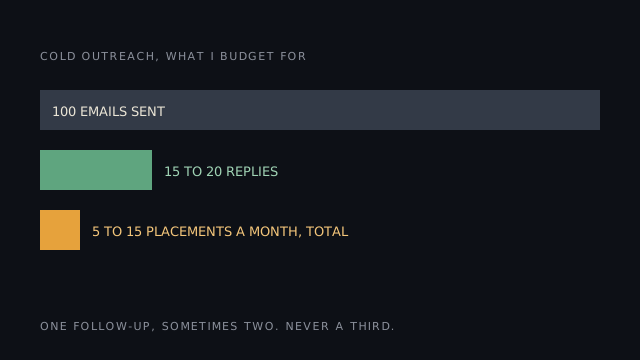
Following up with polite reminder emails can increase response rates in backlink outreach meaningfully; most people forget your first email, they don't reject it. I send one follow-up, sometimes two, spaced a week apart, always adding something new and never just bumping the thread. A third follow-up almost always does more harm than good and I've stopped sending them entirely.
A subject line that references the original pitch, plus one new detail (a fresh stat, a related piece that just published, a reason the timing matters now), performs far better than "just following up" on its own. If a prospect's spam folder has already swallowed the first send, a slightly different subject line on the follow-up sometimes gets through where the original didn't.
Two tactics I stopped running, and why
Broken link building and the skyscraper technique show up in almost every link-building guide still being published, and I ran both for years. I don't anymore. Broken link building asks a site owner to notice a dead link, care enough to fix it, and pick your replacement over whatever else lands in their inbox that week, for a page they've often already stopped maintaining.
The favor framing sounds good in a blog post; in six years of sending that pitch, the reply rate never got close to what guest posting or digital PR produced for the same hours spent.
The skyscraper technique has the same problem from a different angle. It asks someone who's already linking to a page to agree that your version is better and go update their own content on your say-so, with nothing exchanged and no relationship behind the ask. Content quality alone was never a strong enough reason for a stranger to do that, and it's gotten weaker as more of the web has published a "better" version of everything.
Both tactics still get taught as reliable plays. Six years of running them left me filing both under tactics from an earlier era of SEO, plays I no longer build new campaigns around.
Link exchange: where most of my backlinks come from now
About 80% of the backlinks I land in any given month come from ongoing link exchange, one trade at a time, with partners I keep coming back to. Planned campaigns account for the rest. Reciprocal linking carries a bad reputation left over from the footer-swap era, when anyone with a directory page would trade links with anyone else who had one.
The version running today works through the dozens of active Slack groups built specifically for link builders, where you trade with someone whose site you can check first, inside a group where reputation carries between deals.
Once a few of those relationships are running, the volume compounds on its own. A weak month for me lands around 40 links this way. A good month lands closer to 70. My record month hit 100. The end of the month is when it moves fastest, because plenty of the people I trade with are working against their own monthly targets, and a partner sitting short with a few days left will say yes to a trade they'd have passed on three weeks earlier.
The mechanic is barter. You start with whatever you have, a page with real traffic and a workable DR, and trade up incrementally, never landing a top-tier link in one move. I describe it to clients as trading a paperclip up to a house: each swap only needs to be slightly better than the last one, and they add up fast once the chain is moving.
It took me four trades to reach a link on HubSpot's blog. Two of those trades ran at 2-for-1 or 3-for-1, a lopsided ratio in their favor: the other side wanted three DR70 links or two DR80 links for one HubSpot mention. The whole chain started from a single paid placement I bought for $30 to $40, then I used the domain that placement landed on to open the next trade, and the one after that.
Domain A led to B, B led to C, and by the time I reached HubSpot I was somewhere around E, close enough to F that I was half-joking about needing to borrow letters from the Polish alphabet just to keep track of them all. It took real effort and a lot of back-and-forth messaging, and a HubSpot link earned that way is a serious win.
Unlinked mentions: the fastest wins in backlink outreach
Unlinked mentions can provide quick backlink opportunities that convert faster than almost anything else in the outreach process. Unlinked mentions outreach requests links for brand mentions without links already sitting on the page, which means the site owner has already decided your brand is worth naming. You're asking the site owner to close out a formality they've already decided in your favor.
I run a mention search across every client's brand name monthly and flag anything unlinked. The reply rate on this kind of outreach beats cold pitching by a wide margin, since half the persuasion work is already done before the email goes out.
How I run a backlink outreach campaign, start to finish
Creating linkable content is essential for successful backlink outreach; no outreach strategy survives contact with a prospect if the thing you're asking them to link to isn't worth linking to. I build the asset first: original research, an ultimate guide, or a genuinely useful tool, before a single outreach email goes out.
Step 1: create content worth linking to
Every strong link building campaign I've run started with a piece of high quality content strong enough to justify the ask. I focus on quality over publishing volume here, one strong asset outperforms ten mediocre ones for outreach purposes. The goal is more value for the site owner's readers than anything already ranking on the topic, be it original data, a genuinely useful free tool, or coverage of trending topics nobody else has written up yet.
Step 2: build the prospect list
Identify relevant websites and relevant journalists covering the target niche closely enough that a mention would reach the right target audience. I build a list of potential link partners ranked by site authority and actual organic traffic, weighted well above raw domain rating, then cross-check against all the referring domains a competitor already has that my client doesn't.
Step 3: write outreach templates worth personalizing
These should read like skeletons, loose enough to personalize before every send. I write one starting template per campaign, then rebuild the subject line, the opening line, and at least one specific reference to that recipient's own work each time it goes out.
Step 4: track everything and treat outreach efforts like a funnel
I track opens, replies, and placements on every campaign, so each new campaign builds on the last without starting from zero every time. A detailed report at the end of each quarter shows a client exactly where the outreach efforts are converting and where they're stalling, subject line, first reply, or final placement.
Tools like Ahrefs and SEMrush are commonly used for backlink analysis at every stage of this, from finding all the referring domains a competitor has that you don't, to checking a prospect's own domain authority and organic traffic before you ever draft a pitch.
I don't send a single outreach email without checking a prospect's site authority first; a site with high domain authority but a thin, dying organic traffic graph is rarely worth the effort a good pitch takes to write.
A few tips that consistently move the needle on response rates
A few tips I give every client starting their own link building outreach: keep the ask small on the first email, never lead with your own website before you've mentioned theirs, and always leave a version of the pitch that requires zero extra work for the site owner to say yes to.
None of these are complicated. Most outreach efforts fail because people skip these under deadline pressure. The tips themselves are easy to execute; keeping the discipline to run them every single time is the hard part.
Reputable websites get pitched constantly, which means the bar for a reply keeps rising every year. I check google news and recent coverage on a target before I pitch, so the email references something timely and skips the generic opener. Building relationships with website owners before your first ask, even briefly, still outperforms a perfectly written cold email every time I've tested it head to head.
How I qualify a prospect before adding them to a campaign
Link building specialists all develop their own version of this filter eventually. Mine hasn't changed much in six years: check the site, check the specific page, then decide.
Domain authority isn't the only signal
High domain authority helps, but I've walked prospects off a list with domain authority in the 70s because organic traffic had collapsed over the prior year, and added others with domain authority barely in the 30s because the specific blog post I wanted a link on was still getting real search engine results pages visibility for target keywords my client cared about. A relevant anchor text mention on a smaller, active site beats a dead link on a bigger one.
What proves a site is real, beyond the metrics
A logo wall of "as seen in" badges is worth nothing on its own. Real sites publish regularly, respond to comments, and keep an actual social media presence, the checkable signals a badge wall can't fake. I check a prospect's last three months of blog post output before adding them to any outreach campaigns, the same crawl-activity check the Page Freshness Checker runs automatically; a site that's gone quiet for six months is unlikely to reply to your email either.
Reputable websites still say no, and that's fine
Even the most reputable website with strict quality standards will decline plenty of pitches, and a competitor's site landing a placement you didn't get usually comes down to relevant queries and timing, and rarely a failed pitch. I budget for a baseline response rate of 15 to 20% on cold link outreach and treat anything above that as a good month.
Where backlink outreach shows up beyond the SEO report
Clients notice backlink outreach results in places that have nothing to do with rankings, and it's worth naming those explicitly, beyond just reporting position changes.
Referral traffic and a site's visibility
Referral traffic from a well-placed guest post or digital PR hit often shows up within days, long before any ranking movement does. A single feature on an authoritative site can move a brand's online visibility more in a week than three months of quiet link building efforts, even before Google catches up. I track a client's site's visibility across both channels separately so neither gets credit for the other's work.
Social media as a relationship warm-up
I use social media constantly in building outreach relationships before the first email goes out, following a prospect and engaging honestly with what they publish across web pages and social alike. It's slower than cold emailing a list, but the reply rate difference is large enough that I default to it for every retained client now.
What a client's detailed reports include
A client's detailed reports cover every placement, the domain authority and organic traffic of each linking page, and a running count against the original target audience the campaign set out to reach. I'd sooner hand over three real placements with full detailed reports behind them than a stack of forty low-value ones nobody can verify, the kind of padding that shows up in a lot of agency backlink profiles.
None of this replaces the core work: build backlinks the same way every time, through content worth citing and outreach that respects the person reading it, site owners are people first, prospects second.
Link building strategy versus link building tactics
A link building strategy sets the direction: which channels, which audiences, what backlink profiles you're trying to build toward over a year, since strong backlink profiles rarely happen without that direction set first. Individual tactics, guest posting, link exchange, digital PR, sit underneath that strategy and rotate based on what's converting that quarter.
I've seen too many link building specialists confuse the two, chasing outreach link building tactics with no strategy tying them together, and burning a list of real sites and other websites in the process without building anything that compounds.
High quality backlinks from authoritative sites and authoritative websites don't happen by accident inside a strategy like that; they happen because every blog post, every piece of content, and every prospect on the list was chosen with that direction in mind first. Quality backlinks compound. More backlinks without a strategy behind them just add noise to a backlink profile that already needed cleaning up.
Search engines are getting better every year at telling the difference between the two approaches, and outreach link building done as a genuine strategy is the only version I've seen hold up across multiple algorithm updates.
When outreach emails go out as part of a real link building strategy and not a one-off sprint, the search engine results pages movement tends to be slower to arrive and far more durable once it does; a link building campaign built that way rarely needs to be redone from scratch eighteen months later, unlike the sprint-based version.
Link exchange is the standing leg underneath most of my accounts now, running quietly month over month alongside guest posts and digital PR, and not sitting off to the side as its own sprint. Outreach emails for every channel get the same personalization pass before they go out, whichever one they're feeding.
High quality backlinks earned through exchange, alongside the quality backlinks that come from digital PR and the ones that come from a strong blog post going properly viral inside a niche, are three of the legs I build every real backlink profile on.
What I check on a site before I ever send the pitch
Domain rating tells you almost nothing on its own, and I've said as much in a companion piece on how to find competitor backlinks, one of the site owners' favorite objections I hear on every link building outreach call. Before I add a prospect to any outreach campaign, I check organic traffic on the specific page I'd be linked from, the number that matters more than domain-wide traffic.
I check if the site publishes content regularly or has gone quiet for a year. I check if other website owners in the niche treat it as a reputable website worth citing themselves.
High domain authority helps a placement carry more weight, but I've walked away from high authority sites with a link-selling problem and chased placements on lower domain authority sites that still send real visitors every month. A high domain rating on a site that's stopped publishing is a placement that ages badly within a year.
I run every serious prospect through the same checklist as my backlink quality scorer before it goes on an outreach list, non-negotiables first, everything else second.
Where backlink outreach fits into a wider SEO strategy
Link building is critical for boosting a website's domain authority and search engine rankings, though it's one input among several inside a wider SEO strategy. I pair backlink outreach with on-page work and technical fixes for every client; a perfect backlink profile pointed at a page that doesn't deserve to rank still won't rank.
Backlinks drive organic traffic to your website from referral sources directly, on top of whatever ranking lift they provide, which is a benefit clients notice faster than the SEO impact, sometimes within days of a placement going live. Backlinks help search engines index your pages faster too; a new page linked from a frequently-crawled site tends to get discovered and indexed well ahead of one sitting in isolation.
Avoiding the tactics that used to work and now just get you penalized
Avoiding spammy and manipulative link-building tactics is key for long-term SEO success, and I've turned down more "guaranteed placement" offers than I can count from vendors selling exactly that. Genuine editorial endorsements are rewarded by search engines over manipulative schemes every time an algorithm update rolls through and flushes another round of link networks out of the index.
I've inherited client accounts with backlink profiles built entirely on private link networks and expired-domain flips, exactly the pattern I walk through in how to spot a junk backlink. Cleaning those up costs more than building a real backlink outreach program from scratch would have, and it's a conversation I have with new clients more often than I'd like: what you saved on a bulk-link package, you'll spend twice over on disavows and recovery.
FAQ
What are outreach backlinks?
Backlinks secured through direct contact with a website owner, editor, or journalist, and not earned passively or bought outright. Guest posts, digital PR placements, link exchanges, and unlinked mention conversions all fall under this umbrella.
Are backlinks still relevant in 2026?
Yes. Backlinks remain one of Google's top three ranking factors, and no substitute has replaced them in six years of client campaigns I've tracked personally.
What is an example of a backlink?
A link from an industry publication's article to a client's original research piece, placed because an editor decided their readers would find it useful on its own merits.
What is outreaching in SEO?
Contacting website owners, editors, and journalists directly to secure a link, mention, or placement, covering guest posts, digital PR, link exchange, and unlinked mention recovery.
What is the purpose of a backlink?
To act as a vote of confidence from one site to another, both for search engines evaluating authority and for real readers deciding if a source deserves their trust.
What is outreach in SEO?
The relationship-building and direct-contact side of link building, distinct from on-page optimization or content creation, focused specifically on earning links other sites currently don't have pointing at you.
What I'd tell you if you were starting a campaign tomorrow
Backlink outreach can lead to partnerships and collaborations in the industry that outlast any single campaign, which is the part most guides skip in favor of templates and subject-line formulas. I've had guest post relationships turn into referral partnerships, and digital PR contacts turn into standing sources for future client stories. None of that shows up in a spreadsheet of placements, but six years in, it's most of why the work still holds up.
← back to all posts