Key takeaways
- The backlinks benefits that matter most are domain authority, referral traffic, faster indexing, and a trust signal search engines still weigh heavily in 2026.
- High quality backlinks are among the top-3 Google ranking factors overall, and a single high quality backlink can be more impactful than multiple low quality links.
- Not all backlinks carry equal weight: dofollow links pass ranking value, nofollow links drive referral traffic without passing it, and a natural profile needs both.
- Domain authority is a metric used to estimate ranking potential, and more backlinks from reputable sources increase it over time.
- Quality over quantity is increasingly important in link building; earning backlinks through high quality content is the only sustainable strategy I've seen hold up across six years of client work.
What these benefits break down into
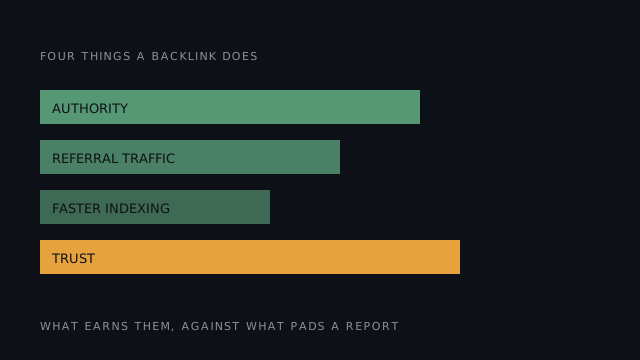
The real payoff worth caring about in 2026 comes down to four things: authority, direct traffic, faster indexing, and a trust signal search engines still weigh heavily despite years of updates aimed at gaming it. Every client conversation about link building eventually circles back to one of these four.
Domain authority: the compounding benefit
Backlinks are essential for building domain authority, the metric I use to estimate a site's overall ranking potential, over judging one page at a time. More backlinks from reputable, authoritative websites lift that number gradually, in slow, steady gains, which is why I pull it first in any new client audit. Clients who expect one placement to move it are usually disappointed until they see the compounding effect eighteen months in.
Backlinks as trust and confidence signals
Backlinks act as votes of confidence from other websites, the plainest way I've found to explain link value to a client new to SEO. Search engines prefer backlinks from reputable and authoritative sites specifically because those sites have a reputation to protect, so their endorsement carries more weight than a link from other websites with no track record.
Search engines use backlinks to evaluate site trustworthiness continuously, and that trust compounds across a domain's full history, showing up in search engine rankings and, less directly, in search engine results pages.
Backlinks send traffic directly
Backlinks send referral traffic to your site independent of whatever ranking benefit they provide, and I've had clients see that traffic within days of a placement going live, well before movement shows up in search engine rankings.
That traffic lands most reliably when the linking page itself gets real visits, which is why I check a linking page's own numbers before pitching it. Nofollow links do not pass ranking value the way dofollow links do, but they still send real traffic worth having, and I keep a healthy share of both in every client's mix.
Faster indexing through links already in place
Backlinks help search engines discover and index new content faster, since search engine bots follow existing links across the web as one of their primary paths to a new URL, well ahead of waiting on an organic crawl. A new post sitting a few clicks deep on a small site might wait weeks without outside help; one backlink from a site bots already visit daily can cut that wait to a day or two.
Brand exposure as a quieter benefit
Backlinks improve brand exposure well beyond whatever click-through a link generates, since every mention on other websites is a small, compounding piece of presence across the web. A name showing up organically, tied to a real link, does work a paid ad campaign of similar reach usually costs far more to achieve.
Quality over quantity in link building
Quality over quantity is increasingly important; a single high quality backlink can be more impactful than multiple low quality links stacked together. I've watched rankings move more from one editorial placement on a relevant, authoritative site than from thirty directory submissions combined, and that gap keeps widening as search engines get better at telling the two apart.
Earning backlinks through quality content is the sustainable version of this link building strategy; content worth citing keeps attracting quality link building opportunities long after an outreach push ends, and more high quality backlinks tend to follow on their own once the first few prove the content deserves them.
Not all backlinks carry the same benefit
Not all backlinks are created equal, and treating every placement as an equivalent win is how a budget gets wasted on volume that moves nothing. I sort every new backlink into a bucket, ranking value, direct traffic, or neither, before it counts toward a client's report.
Editorial and guest blogging backlinks
Editorial backlinks are earned through valuable content references, cited because the content genuinely deserved it, which is why editorial links carry more weight in a backlink profile than a directory listing, and a single quality link earned this way outlasts a dozen paid ones.
Guest blogging can generate backlinks and increase site authority, and one guest post placement on a genuinely relevant, well-trafficked blog regularly outperforms several backlinks from other sites with no real readership.
Dofollow links and what they pass
Dofollow links pass ranking value to the linked page, the core mechanism behind why a backlink affects search rankings at all, and search engines expect a natural mix over an all-dofollow profile.
Broken link building as a smaller source
Broken link building replaces dead links with relevant content, giving a site owner a reason to update their page while earning a new backlink. I run it sparingly now, since search engines have gotten pickier about it, but it still produces more links worth the outreach hours.
Relevance changes the size of the benefit
Backlinks from niche-relevant sites are more valuable to SEO than the same volume from unrelated industries, since search engines weigh topical fit alongside raw authority. Relevant links and relevant backlinks from a mid-authority site squarely inside a client's niche routinely outperform a much higher authority link with no topical connection.
Contextual links placed inside an article's body carry more benefit than the same link sitting in a footer, since readers see and click the version sitting in real content.
Internal links and website links working together
Internal links spread the authority external backlinks bring into a site across the rest of that site's pages, a structure search engines reward on top of whatever the backlink itself earns. Website links from other domains build website authority incrementally, the same way a professional reputation builds through repeated endorsement, and that website authority tends to persist for years, well past any single overnight dip.
Backlinks remain a top ranking factor
Backlinks remain a top-3 Google ranking factor heading into 2026, and I haven't found a credible substitute in six years of tracking client campaigns. Other search engines besides the market leader weigh backlinks somewhat differently, though the underlying logic, more trust from more reputable sources, stays consistent.
Search engines view backlinks as one signal among many shaping search results, and search engine algorithms evaluate a link on several axes at once: the linking site's authority, the page's relevance, and where it sits, in real content or a template element.
Reputable and authoritative sites: what they add
Reputable and high authority websites both add more to a backlink profile than an average site would, since search engines have had time to build confidence in how they vet and publish. An authoritative site tends to link out more selectively than a low-authority one does. A mention on a genuinely relevant news outlet, tied to real coverage, tends to get cited by other websites long after it first runs.
Website owners, incoming links, and one website at a time
Most website owners underestimate how much a handful of the right incoming links from one website, on a relevant page among other websites in the same niche, can do compared to a pile of average links where far fewer sites link back to the same page. A single quality link from the right source beats a dozen average ones.
Backlink profile diversity as its own benefit
A diverse backlink profile, spanning editorial links, guest blogging, and the occasional directory listing, offers more long-term stability than one built from a single source. More organic traffic tends to follow once a profile stops leaning on one channel and starts looking like something that grew on its own.
SEO backlinks, off page SEO, and search engine optimization
SEO backlinks exist to do two things at once: pass ranking authority and send traffic straight from the linking site's own readers, and backlinks in SEO campaigns get judged on both fronts. Off page SEO covers everything away from a site's own pages, and link building sits at the center of it, which is why a search engine optimization plan that skips it rarely competes.
SEO tools and tracking seo performance
SEO tools built for backlink tracking, Surfer and similar platforms, let me watch a client's domain authority and organic traffic move against specific placements, over guessing at the connection. Watching seo performance this way is how a budget earns its keep. A recurring invoice nobody questions is what happens without that visibility.
Sponsored links: a benefit with real limits
Sponsored links can drive traffic and brand exposure, but they carry a required disclosure tag that keeps them from passing the ranking value an editorial or guest blogging placement does. I still recommend sponsored links occasionally for traffic and exposure alone, as long as the client understands the seo value stops at the disclosure line.
Spammy backlinks and low quality sites: the other side of the ledger
Not every backlink is a benefit; a manufactured pattern from a low-authority network can work against a profile once it gets dense enough to draw a manual review. I vet every prospective linking site against the same checklist I use to spot a junk backlink, since a shiny domain rating means nothing next to real traffic and content quality.
Irrelevant sites and the benefit gap
A link from an off-topic source, however authoritative the domain, delivers a fraction of the benefit a topically relevant link from a smaller, high quality websites source provides, since search engines increasingly weigh subject-matter fit alongside raw authority. I turn down placements on high-DR but off-topic domains more often than clients expect, because the outreach time rarely pays off against that gap on relevant websites where it counts.
Building quality backlinks as an ongoing practice
Building quality backlinks is an ongoing practice with no natural end point, one that compounds the longer a client sticks with it. More high quality backlinks earned over a year produce a different trajectory than the same total rushed into a quarter, since search engines reward a natural pace, natural backlinks and natural links included, as much as the links themselves.
How much it takes to see these benefits
How many backlinks it takes to see a meaningful shift depends entirely on keyword competition; I walk through the full link gap process for finding that number in a separate article, so there's no fixed number I hand out in a kickoff call.
A handful of genuinely high quality links from relevant, authoritative sources routinely produces more benefit than a much larger pile of average ones, and the higher your chances of a real ranking shift, the more that handful skews toward editorial placements over volume.
The 80/20 rule in SEO and what it means here
The 80/20 rule in SEO shows up in backlink data: roughly 20 percent of a profile's placements, the editorial placements and genuinely authoritative mentions, typically account for around 80 percent of the benefit found in search results and search engine results pages. That imbalance is why I spend disproportionate outreach effort chasing the rare, high-value placement. Spreading effort evenly across every prospect on a list wastes most of it.
Is it worth paying for backlinks?
Paying directly for links that pass undisclosed ranking value violates search engine guidelines, so I don't recommend it regardless of a bulk vendor's pricing. Disclosed sponsored content is a different, acceptable category, but it buys exposure alone, well short of the ranking benefit an editorial link provides.
How often should you build backlinks?
Link building works best as a continuous, monthly practice, well beyond an occasional sprint before a launch. I keep every active client on a steady monthly cadence, since the benefits of backlinks depend more on consistency than on any single month's count, and backlinks important to that consistency compound the same way inbound links do on a schedule.
A real example of these benefits compounding
A SaaS client spent eighteen months on a slow, editorial-first strategy, skipping directory volume entirely. Domain authority climbed steadily, organic traffic roughly tripled, and one guest blog post placement kept sending direct traffic and ranking gains a year after it went live. That placement, alongside one more blog post from the same campaign, outperformed the rest of the year's efforts combined.
What I'd tell you if you only remember one thing
The real benefit of backlinks comes from links earned through content worth citing, assembled patiently over a rush job. Search engines find that distinction easily now, and every client relationship that's respected it has outperformed the ones chasing shortcuts.
FAQ
Are backlinks still relevant in 2026?
Yes. High quality backlinks are still among the top-3 Google ranking factors, and nothing across six years of campaigns has replaced the trust and referral traffic they provide.
What is the 80/20 rule in SEO?
Roughly 20 percent of a backlink profile, the editorial and highly authoritative placements, typically drives about 80 percent of the actual ranking and traffic benefit.
Is it worth paying for backlinks?
Not for undisclosed ranking value; search engines penalize that, and it risks a manual review. Disclosed sponsored placements can still be worth it for exposure and referral traffic alone.
Do backlinks still matter for SEO?
Yes. They remain one of the clearest trust and authority signals search engines use, alongside content quality and technical health.
How often should I build backlinks?
Monthly and consistently. A steady cadence over a year outperforms the same total number of links rushed into a single quarter.
Want to know what your current backlinks are doing for you?
Send me your backlink report and I'll tell you which placements are earning their keep.
get a free eye test