Key takeaways
- Domain Rating describes the domain as a whole; the specific page your link sits on is a separate question, and that gap is where most wasted link-building budget disappears.
- Before I trust any placement, I check page-level organic traffic, indexation, internal linking, and content quality on the exact URL itself.
- A meaningful share of "high traffic" placements rank for keywords that have nothing to do with the site's niche, casino, adult, or unlicensed pharma terms buried in an old post, which makes the domain-wide traffic graph meaningless.
- DR can be inflated within weeks through private blog networks and expired-domain flips; legitimacy, traffic, and trust only show up once you check the linking page itself.
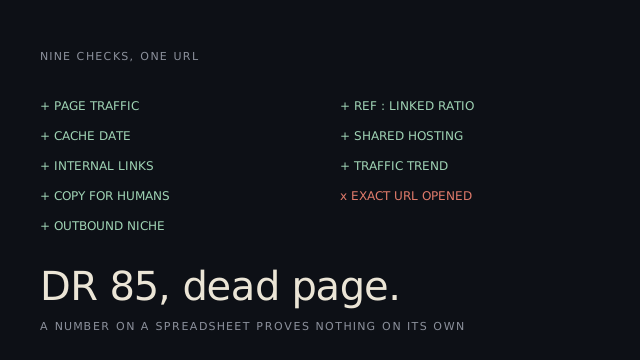
- My actual vetting process runs to nine checks covering traffic, indexation, internal links, content quality, outbound link volume, referring-to-linked domain ratio, shared hosting, and traffic trend, and none of it takes more than a few minutes per link.
- Run the same checklist yourself with the free backlink quality scorer further down this page.
- Most low-quality backlinks get ignored by Google's algorithms automatically; what triggers a manual action is a sudden spike or a manufactured-looking pattern of them.
- If a backlink profile does need cleaning up, request removal from the site owner first. The Disavow Tool is a last resort that takes 1 to 3 weeks to process and can do real damage if you disavow more than you need to.
Most link reports are designed to look good in a spreadsheet. Moving rankings is a separate question the spreadsheet never answers. I've reviewed hundreds of backlink profiles built by agencies and freelancers, and the pattern is almost always the same: a page full of domain ratings, a handful of impressive logos, and almost no information about if the page holding the link is alive, crawled, or worth anything at all.
Domain Rating (or DR, or DA, whatever metric your tool of choice reports) describes the domain. It says nothing about the specific page your link sits on. That distinction is where most wasted link-building budget disappears.
Vet the exact page holding the link
The single biggest mistake in link vetting is stopping at the domain level. A site can have DR 80 and a homepage full of real traffic while the exact page your link is sitting on gets zero visits, sits five folders deep, and hasn't been recrawled in months.
Before I approve or accept any placement, I pull up the actual URL and check:
- Page-level organic traffic. Filter by the exact URL in Ahrefs or Semrush, since domain-level traffic tells you nothing about this one page.
- Indexation. Is the page indexed by Google? Search
site:plus the exact URL. If it's not there, the link is functionally invisible. - Internal linking. Is the page linked to from anywhere else on the site, or is it an orphan that only exists to hold outbound links? Orphaned pages get crawled rarely and trusted even less.
- Content quality around the link. Does the paragraph the link sits in make sense, or was it stitched together to justify the anchor text?
Verify what the traffic is ranking for
A surprising number of "high traffic" placements are ranking for keywords that have nothing to do with the site's actual niche. I've seen SEO and marketing blogs pull in thousands of visits a month for random casino, adult, or unlicensed pharmaceutical terms buried somewhere in an old, forgotten post. The domain-level traffic graph looks fantastic. The link itself is worthless, and sitting next to that kind of content can actively hurt the brand it's supposed to help.
Pull up the top pages and top keywords report for the domain. The summary traffic number alone won't tell you enough. If the keywords driving traffic don't match what the site is supposed to be about, that traffic is bought, botted, or irrelevant to your audience. Each of those outcomes costs you the same thing: a link that carries no real weight.
Empty DR is still empty
Domain Rating can be bought. Private blog networks, expired domain flips, and reciprocal-linking schemes can push a domain's DR into the 40s or 50s within weeks without a single real visitor ever landing on it. None of that shows up in the number itself. DR is one number: link equity. Legitimacy, traffic, and trust live in the page-level checks above.
Reports heavy on DR and light on page traffic, indexation, or relevance skip the URL-level check entirely. Filtering by the exact page takes a few extra minutes, and vendors selling volume rarely spend them.
DR is also why the scorer below doesn't gate on it. Clients ask for a DR minimum because it's the one number every tool surfaces up front, but it's a domain-wide average, and it's cheap to inflate. Here's the comparison I'd make between two real placements:
Site A · DR 10, 500 visits/mo
- 5 outgoing linked domains, 15 referring domains
- Link sits one click from the homepage
- The linking page itself earns real traffic
- No other outbound links crowd that page
- The page has external links pointing to it
- Well linked internally from elsewhere on the site
Site B · DR 85, 5,000 visits/mo
- 50,000 outgoing linked domains, 10,000 referring domains
- Link buried deep in the site structure
- The linking page itself gets no traffic
- Low traffic value across the site as a whole
- Stale cache date on the linking page
Site A's referring-to-linked-domain ratio, page-level traffic, internal linking, and cache freshness all point to a page Google actively trusts and crawls. Site B's DR 85 is a domain-wide average. The page carrying the link tells a different story, and every page-level signal on it points the other way. A client who insists on a DR floor would reject Site A and pay for Site B, then wonder why the link did nothing for rankings.
Score a link yourself
This is the checklist I run when a placement lands in my inbox, packaged as a free tool. Tick what you observe on the site in question; the non-negotiables at the top are hard gates, and the score below them reflects everything else. There's a full version of this at jansuski.com/tools/backlink-quality-scorer, ready to use outside the post.
My actual checklist
When I'm handed a link report, mine, an agency's, or a freelancer's, I run through this before I count it as a real asset:
- Open the exact linking URL. Skip the homepage.
- Check page-level traffic and the keywords driving it, filtered by that exact URL.
- Confirm the page is indexed, and check the Google cache date with the Page Freshness Checker. A cache from days or a couple of weeks ago means Google actively crawls the page; a cache from months ago means it barely does.
- Look for internal links pointing to that page from elsewhere on the site.
- Read the surrounding content and judge if it was written for humans or stitched together around an anchor text.
- Check the domain's outbound links for volume and niche. Fifty unrelated niches, or heavy links to casino, adult, or unlicensed pharma content, mark a link farm regardless of DR.
- Compare referring domains to linked domains, aiming for a ratio around 3:1 or better.
- Check if the domain shares an IP or hosting setup with other referring domains, a common PBN signal.
- Look at the site's traffic trend over time. A chart in freefall says more than the current snapshot.
None of this takes more than a few minutes per link. It's the difference between a backlink profile that moves rankings and one that just looks impressive in a monthly report.
Everything above is link building done right: vetting a placement before you ever accept it. Bad backlinks are the other side of link building, the ones already sitting in your profile that arrived by accident, by a negative seo attack, or because an old link building vendor cut corners years ago. The rest of this post covers how to spot bad backlinks already on your site, and what to do about them.
What counts as a bad backlink
Bad backlinks are hyperlinks from low-quality sources that violate the link spam policies search engines publish. That's a real policy violation, and it goes well beyond a link that merely looks ugly in a spreadsheet. Paying for backlinks violates those spam guidelines outright, no gray area there.
Private blog networks sit a tier up from a single paid link: a cluster of sites built specifically to sell backlinks, dressed up enough to look independent at a glance. Low quality directories, link farms built purely to house outbound links, forum posts dropped solely for the SEO value, and link building bots that mass-produce placements on autopilot round out the list of common bad backlinks I flag on a backlink audit.
Careless link exchange belongs on that list too. Exchanging links for SEO in bulk, with unrelated, unvetted sites, just to trade something back, creates exactly the unnatural link pattern search engines are built to catch.
The exchange relationships I run are vetted first: real traffic, a workable DR, a partner whose site I've checked myself. That vetting is the entire difference between a link pattern that gets quietly nullified and one that gets flagged as link spam.
Not every bad backlink is hurting you
Search engines aim to nullify unnatural links at scale, so most low quality backlinks sitting on an established site's backlink profile stop counting; punishment is rare. Not all low quality backlinks harm websites: search engines ignore plenty of random spammy links and spam links that show up on a backlink profile without the site owner doing anything at all.
What escalates things is a sudden spike in low quality backlinks, the kind a negative seo attack produces on purpose, or a backlink profile whose pattern looks built on purpose, the opposite of one earned over time. That pattern, well beyond the existence of a few toxic backlinks scattered through a backlink profile, is what can trigger a manual action or a real hit to search engine rankings.
I'd still prefer zero toxic backlinks on a client's backlink profile over explaining away a pattern of them, so a routine backlink audit stays on the calendar even when nothing looks urgent. Low quality signals get flagged the moment a backlink audit turns them up, before they can turn into the next scare.
Finding toxic backlinks before they cost you rankings
Between Google Search Console's free Links report and one paid backlink audit a quarter, catching bad backlinks and toxic backlinks early is cheap link building insurance, far cheaper than losing search engine rankings to a pattern you never checked for.
Google Search Console is the free starting point for identifying bad backlinks: its Links report shows every linking site search engines currently have on file for your domain, and I check it before reaching for anything paid.
For a deeper backlink analysis, a toxic backlink checker like Semrush scores each linking site with a Toxicity Score, and a similar backlink checker sits inside Ahrefs if that's already part of your stack. I run a full backlink audit quarterly on every retained client, more often if search engine rankings move without an obvious cause.
Manual backlink analysis, opening the linking site over trusting a toxicity score alone, catches spammy websites and spam sites an automated toxic backlink checker sometimes misses, especially newer link farms the tool hasn't indexed a pattern for yet.
What I'm looking for once I start a backlink audit: link text stuffed with the same commercial anchor across dozens of unrelated sites, a site with no organic traffic sitting behind a suspiciously high DR, blog comments and forum posts that exist only to host a website link, and any domain sharing hosting or an IP block with other top linking sites already on my watch list.
I keep a running backlink data sheet per client, so this backlink audit takes minutes; starting from zero every quarter is no longer part of the process.
Getting rid of bad backlinks: removal before disavow
Requesting link removals is the preferred first step, full stop, and it's how I start every attempt at cleaning up bad backlinks. I email the website owner directly, point at the exact URL, and ask them to pull it.
Google recommends manual removal of bad backlinks before using the Disavow Tool. In my experience, roughly a third of legitimate site owners will sell links or pull a link once asked, especially if it was placed by an old vendor and not the site's current owner.
The Google Disavow Tool is the last resort for clearing bad backlinks, reached for only after removal requests and time have run their course. Google recommends disavowing links only when necessary, generally after a manual action has already landed or after link removal requests went nowhere on a pattern serious enough to matter.
Using the Google Disavow Tool incorrectly can harm your website's search performance just as easily as the bad links themselves; I've seen accounts disavow their entire referring-domain list after one scare, killing legitimate links that were helping their backlink profile. A disavow file lists domains or specific URLs one per line, and once submitted, disavow files can take 1 to 3 weeks to process before search engines act on the update.
Google may issue manual actions for sites participating in link schemes or buying links outright, and that's the scenario the Google Disavow Tool exists for. Outside of a manual action or an obvious negative seo attack, earning high quality backlinks matters more than removing low quality ones; I'd spend a week landing three good placements over a week disavowing forty toxic links search engines were already ignoring.
Most bad backlinks never touch your rankings, because search engines already discount toxic backlinks before they can do damage. What separates harmless toxic backlinks from a real backlink profile problem is pattern and speed, well beyond the mere presence of one bad link.
Run a lightweight backlink audit every quarter, treat link building as the offense you control and bad backlinks as the defense you rarely need to play, and reserve the Disavow Tool for a manual action or an actual negative seo attack over routine toxic backlinks your audit turns up. A healthy link building program treats bad backlinks as background noise and not a crisis.
Most toxic backlinks fade from relevance long before a search engine ever acts on them, so I keep toxic backlinks and other low quality signals in a low quality corner of the quarterly report and don't let stray toxic backlinks drive the whole strategy.
FAQ
What is a bad backlink?
A hyperlink from a low-quality source, a link farm, a spam website, a private blog network, or a paid placement, that violates the spam policies search engines publish. It isn't earned editorially.
How do I find bad backlinks?
Start in Google Search Console's Links report, then run a toxic backlink checker like Semrush for a Toxicity Score on every linking site, followed by a manual backlink analysis of anything the score flags as high risk.
How do I remove harmful backlinks?
Request removal directly from the website owner first. File a Google Disavow Tool submission only once removal requests fail or a manual action has already landed on your backlink profile.
What is considered a good backlink?
One from an authoritative, relevant domain that sends real organic traffic to the specific page holding your link, the same page-level checklist covered earlier in this post.
Do backlinks still matter in 2026?
Yes. Quality backlinks remain one of the top ranking factors search engines use and act as a vote of confidence for a site's credibility, which is exactly why a backlink profile full of toxic backlinks is worth cleaning up in the first place.
Want a second look at your link profile?
Send me three URLs from your last link-building report and I'll tell you, plainly, if they're helping.
get a free eye test