Key takeaways
- Powerful backlinks are hyperlinks from reputable, high-authority websites, and editorial links, the ones a writer or editor adds because your content genuinely earned the citation, are the most powerful type I've ever landed.
- Contextual links placed in the main body of an article carry more weight than the same link sitting in a footer or sidebar, and a page with 4 outgoing links passes more equity per link than one with 16.
- Dofollow backlinks pass link equity and improve search rankings; nofollow backlinks do not pass ranking value but still drive real referral traffic worth having.
- Backlinks are a top-three ranking factor in SEO, and a handful of quality backlinks from authoritative, niche-relevant sites outweighs a much larger pile of average links.
- Link building itself is not illegal; the manipulative tactics search engines penalize (paid links disclosed as editorial, link schemes, PBNs) are policy violations enforced through rankings, never a legal matter.
What makes a backlink "powerful"
Powerful backlinks are hyperlinks from reputable, high-authority websites, and that authority has to show up beyond a domain rating number. Search engines view links from authoritative sites as a stamp of approval, but the specific page holding the link, its own traffic, its own topical relevance, does most of the real work.
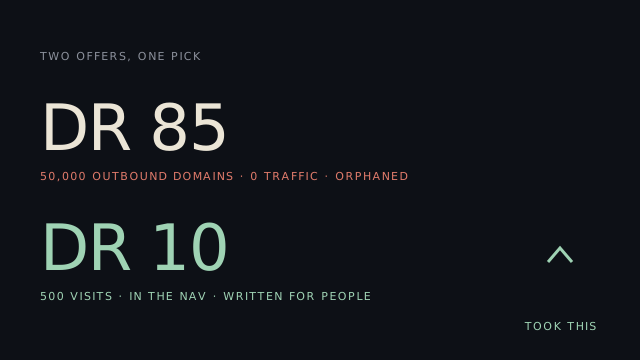
I've seen plenty of DR-70 sites hand out backlinks that move nothing, and DR-30 sites hand out backlinks that move a page five positions in a month, because the second linking page mattered to the topic.
Editorial links: the most powerful type of link
Editorial backlinks are the most powerful type of link, earned when content is deemed valuable enough that a writer or editor cites it without being asked. Editorial links are earned through valuable content references and not negotiated placements, which is exactly why they're harder to fake and worth more when search engines evaluate a backlink profile.
I chase editorial backlinks first on every campaign, before guest posts, before directory listings, before anything transactional.
Why .edu and .gov links get treated differently
Links from .edu and .gov sites are highly authoritative, and links from .edu and .gov sites are considered some of the strongest citations a backlink profile can carry, mainly because those domains are gatekept in ways commercial sites aren't.
I don't chase them aggressively since genuinely relevant opportunities are rare, but when a university research page or a government resource page cites a client's original data, I treat it as one of the strongest placements in that entire campaign.
Contextual links beat footer and sidebar links
Contextual links are more effective than those placed in footers or sidebars, since a link sitting inside the actual body of an article gets read, clicked, and trusted by both humans and search engines in a way a footer credit never does. Links placed in the main body of content carry more weight than the identical link parked in a widget or navigation element, and I write that requirement into every guest post pitch and outreach email I send.
Dofollow vs nofollow: what each one does
Dofollow backlinks pass link equity to improve search rankings, which is the entire mechanism behind why a backlink affects a page's position at all. Nofollow backlinks do not pass ranking value but can drive traffic, and I still want a healthy number of them in any natural backlink profile, since an all-dofollow profile looks manufactured to anyone checking it by hand or by algorithm.
Anchor text: the clearest relevance signal available
Natural, descriptive anchor text provides the clearest relevance signal search engines have for what a linked page is about. I avoid exact-match commercial anchor text beyond a small fraction of any client's backlink profile, since a profile stacked with identical anchor text across dozens of domains is one of the fastest ways to draw an unwanted algorithmic look.
Run your own anchor list through the Anchor Text Composition Scorer if you want a number on where your mix sits.
Fewer outgoing links means more equity per link
A page with 4 outgoing links passes more equity per link than one with 16, since every additional outbound link on that page dilutes the authority split across a wider pool. Topical relevance amplifies the authority benefit of backlinks further, so a page with four tightly relevant outbound links in a focused niche resource passes noticeably more value than a sprawling, generic "50 useful tools" roundup post ever will.
Niche relevance changes the value of a backlink
Niche relevance increases the value of a backlink, and a link from a mid-authority site squarely inside your niche routinely outperforms a much higher authority link from a site with no topical connection to your business. Backlinks from niche-relevant sites are more valuable to SEO for exactly this reason, and it's the first filter I apply before domain authority ever enters the conversation.
What established sites pass that new blogs can't
Links from established sites pass more "link juice" than those from new or unknown blogs, since search engines have had years to build confidence in an established domain's editorial standards and traffic patterns. A brand-new blog might publish excellent content, but it hasn't earned that accumulated trust yet, which is exactly why one link from an established, relevant publication is often worth more than five from sites still building their own reputation.
Building genuine connections, not cold-pitching everyone
Building genuine connections can result in high-quality backlinks that a pure cold-email campaign rarely produces, since a site owner who already knows and trusts you skips most of the vetting a stranger's pitch has to survive. I spend real time engaging with a target list months before I ever ask for anything, the same relationship-first approach that shows up across every campaign I've run in six years of doing this.
Unlinked mentions: an easy source of high-value backlinks
Unlinked brand mentions can convert into backlinks by asking for attribution, since the site already decided your brand was worth naming, you're only asking for the citation to become clickable. High-value backlinks drive direct, targeted referral traffic from relevant audiences this way without requiring a single piece of new content, which makes unlinked mention recovery one of the highest-return plays in any outreach process.
Guest posts: still a reliable source of editorial-style links
Guest post backlinks come from contributing content to other sites; negotiation gets you the placement, but a guest post placed on a genuinely relevant, well-trafficked site still behaves like an editorial link once it's live.
Finding broken links and suggesting quality content can help backlink creation too, though I run that play sparingly now compared to guest posting and genuine editorial outreach, since the response rate has thinned considerably over the years.
Resource pages: a quieter but reliable source
Resource pages built by universities, industry associations, and established publications quietly collect some of the most powerful backlinks available, since inclusion signals a human curator judged your page worth listing among a small, vetted set. I check resource pages in a client's niche every quarter specifically because they update slowly and a placement, once secured, tends to stay live for years.
Why a diverse backlink profile beats a deep one
A diverse, high-quality backlink profile offers long-term SEO stability that a narrow one never matches, since search engines reward a natural-looking spread of domains, anchor text, and link types over a pile concentrated on a handful of sources. A natural backlink profile blends editorial links, guest post links, resource page mentions, and the occasional directory listing, and not leaning on one single source of supply.
Quality over quantity, restated one more time
Focusing on quality over quantity is key in modern SEO strategies, and quality backlinks from authoritative sites are more valuable than numerous low-quality links stacked on top of each other. Backlinks impact rankings in a way where more of them, at real quality, typically lead to higher positions, but that relationship breaks down fast once quality gets sacrificed to hit a volume target.
Why backlinks still matter as a ranking factor
Backlinks are a top-three ranking factor in SEO, and nothing in six years of client campaigns has shown me a credible substitute for a real link from a real site with an actual audience. Search engines use backlinks as ranking factors precisely because they're hard to fake at scale without leaving a detectable pattern, unlike almost every purely on-page signal.
What SEO backlinks are supposed to do
SEO backlinks exist to do two things at once: pass ranking authority to the linked page and drive referral traffic directly from the linking site's own audience. High-quality backlinks drive referral traffic to your website on top of whatever ranking lift they provide, and I've had clients notice that direct traffic benefit within days, well before any movement shows up in search engine results pages.
Backlinks and faster indexing
Backlinks enable faster indexing of your new content by search engines, since a link from a frequently-crawled site gives a crawler a fresh path to a page it might not have discovered on its own for weeks. Backlinks help search engines discover and index content noticeably faster than sitting and waiting for an organic crawl to stumble across a brand-new URL.
Is link building illegal?
No. Link building itself is completely legal; it's a standard, widely practiced part of SEO. What search engines penalize is a specific set of manipulative tactics, paid links passed off as editorial, link schemes, and private blog networks, which violate a platform's own guidelines and not any actual law. I've never had a client face legal exposure over link building; the real risk always plays out as a ranking penalty and not a courtroom.
How to get powerful backlinks
Getting powerful backlinks starts with link-worthy content: original research, a genuinely useful tool, or coverage of something nobody else has covered well. Link worthy content is the precondition for every tactic on this page; editorial outreach, guest posting, and resource page pitches all fail at a much higher rate against a mediocre asset than a strong one. I build the content first, then spend the outreach hours, never the reverse.
Inbound links vs backlinks: same thing, different label
Inbound links and backlinks describe the same thing from the same direction, a link pointing into your site from somewhere else, and I use the two terms interchangeably in client reports since most people search for both. Powerful inbound links share the exact traits powerful backlinks always share: real traffic on the linking page, topical relevance, and a placement inside real content and not a template element every page on the site repeats.
Where nofollow links earn their keep
Nofollow links do not pass ranking authority the way dofollow links do, but I still want a healthy share of them in any client's backlink profile, since an all-dofollow spread is one of the fastest patterns to look manufactured under a manual review. Comment sections, most social platforms, and a large share of guest post bylines default to nofollow links, and a natural profile reflects that mix and not fighting it.
Spammy sites: the backlinks that actively work against you
Spammy sites, link farms, and PBNs dressed up as blogs produce backlinks that do close to nothing for rankings and can actively drag a profile down if the pattern gets dense enough. I check every prospective linking site against the same page-level checklist I use to spot a junk backlink, since a spammy site with a shiny domain rating still fails the moment you look at its actual traffic and content quality.
A blog post's placement matters as much as the domain
The specific blog post holding your link matters more than the domain average, since a single strong article buried on an otherwise mediocre site still sends real signal, while a weak one on an otherwise strong site sends almost none. I check every individual placement before counting it toward a client's target, the same page-level habit that runs through every checklist on this site.
Links pointing at the specific page that needs them
Links pointing at the specific page you're trying to rank do far more work than the same volume of links pointing at your homepage or an unrelated page. I've watched clients accumulate an impressive backlink count aimed at the wrong URL entirely, technically real links, technically from decent sites, doing nothing for the actual target keyword because they never pointed at the page competing for it.
SEO link building as a discipline practiced over time
SEO link building only works as a discipline practiced consistently over months and years, a pace no single sprint can substitute for. Every powerful backlink on a mature client's profile traces back to a real link building decision made months or years earlier, which is exactly why I set expectations in quarters and not weeks on every new engagement.
Not all backlinks are created equal, and that's the whole point
Not all backlinks carry the same weight, and treating a backlink report as one undifferentiated pile of wins is how budgets get wasted on volume that never moves anything. I sort every placement by authority, relevance, and placement type before it counts toward any target, the same filter that separates a genuinely powerful backlink from a line item that just pads a monthly report.
Domain authority still matters, just not alone
Domain authority is a useful first filter for spotting powerful backlinks, but a domain authority number divorced from page-level traffic and topical relevance tells you less than most reports imply. I check domain authority second, after relevance, and again after page-level traffic, and not leading with it the way a lot of vendor pitches still do.
Search engine optimization and backlinks: still inseparable
Search engine optimization without a real backlink strategy behind it rarely holds up against competitors who are building links properly, since on-page work alone can't replicate the trust signal a genuine external citation provides. Every search engine optimization plan I build treats backlinks as a core pillar sitting alongside content from day one, and not an add-on bolted on after the fact.
Authoritative websites: what earns the label
Authoritative websites earn that label through consistent publishing, real traffic, and a track record other sites and readers already trust, well beyond whatever a domain rating number alone suggests. I'd take a link from an authoritative website in a client's exact niche over a higher-DR link from an authoritative website in a completely unrelated field, every time.
How many backlinks does a powerful profile need
How many backlinks a genuinely powerful profile needs depends entirely on keyword competition; I walk through that full link gap process for figuring out a real target number in a separate article, since it deserves more room than a section here can give it.
A handful of genuinely powerful backlinks from editorial, authoritative sources routinely outperforms a much larger pile of average ones, which is the whole argument this article has been making from the first section down.
How much link building it takes to build a powerful profile
Link building toward a genuinely powerful backlink profile is slower than most people want to hear: real editorial links and real resource page placements take months to secure at any volume, well past the weeks a bulk vendor promises. I budget six to twelve months of consistent link building before a client's profile starts looking like the kind search engines reward, and every account that's stuck with that pace has outperformed the ones that tried to compress it.
Link building done well compounds. A powerful backlink secured in month one keeps sending referral traffic and passing authority in month twenty-four, while a bulk-bought placement from the same month has usually gone dead, been deindexed, or quietly de-listed by whatever network sold it. High quality links age well. Low-quality ones don't age at all.
Anchor text diversity inside a powerful backlink profile
Anchor text diversity matters as much as anchor text relevance; a profile where every single link uses the same commercial phrase looks manufactured regardless of how authoritative the linking sites are. I mix branded anchor text, naked URLs, and natural descriptive phrases across a client's profile deliberately, matching the pattern a genuinely earned set of editorial links would produce on its own without any coordination behind it.
Resource pages and editorial links: where the strongest evergreen placements live
Resource pages and editorial links share one trait that makes both worth the extra outreach effort: once secured, they tend to stay live far longer than a guest post or a paid placement ever does. A university resource page or an industry association's curated list rarely gets edited once published, which means a single successful pitch can keep sending both referral traffic and ranking authority for years without any maintenance.
High quality links vs high quality backlinks: is there a difference
High quality links and high quality backlinks describe the same asset from two angles, quality as a general property of the link itself, and quality specifically as it applies to SEO value. Both terms point at the same checklist in practice: real traffic on the linking page, topical relevance, a dofollow attribute where it matters, and placement inside real content and not a template element.
Search engines keep getting better at spotting the fakes
Search engines keep getting better at spotting manufactured link patterns every year, which is exactly why the gap between a genuinely powerful backlink profile and a bought one keeps widening and not closing. Search engines reward the slow, relationship-driven version of link building precisely because it's the version that's hardest to fake at scale, and that gap is what makes real link building worth the extra time it takes.
A real example of chasing powerful backlinks over volume
A SaaS client came to me with a backlink profile heavy on directory listings and light on anything editorial. We spent four months on link worthy content instead, an original benchmark report nobody else in the space had published, and pitched it to eleven relevant, authoritative sites and not the fifty low-quality directories the previous agency had targeted.
Six placements came back, every one an editorial link inside real body content and every one sitting squarely among the client's high quality backlinks by any measure we checked afterward, and search engine rankings for the client's three target keywords moved more in the following quarter than the previous year of directory submissions had managed combined.
That's the case for powerful backlinks over raw volume in one paragraph: six genuinely powerful backlinks outperformed fifty average ones, because search engines were never confused about which set reflected real-world authority. Link worthy content is the one input that made every subsequent step of that campaign possible.
What I'd tell you if you only remember one thing
Powerful backlinks come from content worth citing, placed by people who chose to cite it without being paid or pressured into it. Search engines have gotten good at telling that apart from everything else, and link building that respects that distinction is the only version of this work that's held up across six years of algorithm updates I've tracked personally. Everything else on this page is detail sitting underneath that one idea.
FAQ
Which type of backlink is most beneficial for SEO?
Editorial backlinks, links earned because an author or editor decided your content deserved the citation, without payment or negotiation involved.
Do backlinks still help with SEO?
Yes. Backlinks remain a top-three ranking factor, and quality backlinks from authoritative, relevant sites still move search engine rankings in every account I've tracked over six years. I've never found a substitute signal that replicates what a genuine editorial citation does for search engine rankings specifically.
Are backlinks still relevant in 2026?
Yes, and by a wide margin. Nothing has replaced a real link from a real site with organic traffic as a trust and authority signal, despite plenty of tools claiming otherwise.
What is the best way to get backlinks for SEO?
Build link-worthy content first, then pursue editorial outreach, guest posting, and unlinked mention recovery against sites genuinely relevant to your niche.
What is a good backlink number?
There's no fixed number; a link gap analysis against your specific competitors gives a far more useful answer than any generic benchmark.
Which backlink is most powerful?
An editorial link, placed in the main body of a relevant article on an authoritative, topically-relevant site, using natural anchor text.
What are the best backlinks?
Editorial links from authoritative, niche-relevant sites, contextual placements inside real content and not footers, and dofollow links that pass full ranking value.
Is link-building illegal?
No. It's a standard SEO practice. Only specific manipulative tactics violate search engine policy, and the consequence there is a ranking risk and not a legal one.
How to get powerful backlinks?
Build content worth citing, prioritize editorial outreach and unlinked mention recovery, and favor contextual placements on authoritative, niche-relevant sites over volume plays.
Not sure which of your backlinks are powerful?
Send me three placements from your last report and I'll tell you, plainly, which ones are doing real work.
get a free eye test