Key takeaways
- How many backlinks you need to rank depends on your target keyword's competition, your own site's existing authority, your link building pace, and how strong the current top-ranking pages already are.
- The fastest real answer comes from a link gap analysis: counting how many referring domains the current top 10 have that you don't. That number beats any generic backlink benchmark.
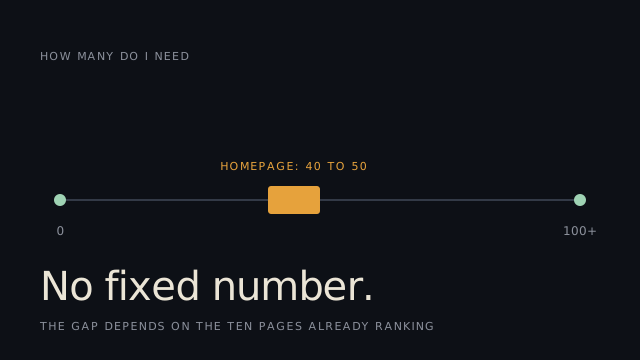
- A well-established homepage typically carries 40 to 50 backlinks, but a single page competing for a specific keyword might need anywhere from 0 to 100+ depending on how contested that keyword is.
- High quality backlinks from sites with domain authority over 60 do more for rankings than a much larger pile of average links, and one exceptional placement can outweigh a dozen mediocre ones.
- Acquiring too many links too quickly is one of the fastest ways to trigger a Google penalty, so pacing matters as much as the total count.
How many backlinks do I need to rank? There's no fixed number
Every client asks this in the first call, usually within the first ten minutes, and I get why. It feels like it should have a clean answer, the same way a contractor can quote a fixed number of bricks for a wall.
How many backlinks you need to rank depends on three things at once: how competitive your target keywords are, how much authority your own site already carries, and how strong the pages sitting in the top 10 already are.
Search engines weigh backlinks alongside content quality and search intent together, so the raw count is one input among several. It's the part people ask about because it's the part they can count on a spreadsheet.
I've had individual pages break into position one with a handful of genuinely relevant backlinks. I've also watched other pages sit on page two despite a backlink profile most sites would envy, because the competing pages had better content and a stronger existing footprint.
Individual pages may require anywhere from 0 to 100 backlinks to rank well, and that range is wide on purpose. A low-competition, long-tail keyword can rank on decent on-page work alone. A genuinely competitive keyword may require 100 or more backlinks before it has a real shot at page one.
The link gap: how I estimate the number for a client
A practical way to estimate how many backlinks you need is to analyze the sites already ranking for your target keywords. Their own referring domain counts make a sharper benchmark than any generic SEO guide (more on why referring domains matter more than raw totals in my piece on how many backlinks from one website counts).
I pull the top 10 pages for a target keyword, check how many referring domains each one has through Ahrefs or Semrush, and calculate what I call the link gap: the difference between what those pages have and what my client's page has.
That gap is the actual target a real campaign gets built around, and it changes for every keyword and every client.
Competitive analysis this way reveals how many backlinks the top sites have, and it's almost always more specific and more useful than any fixed rule of thumb. Replicating a competitor's best backlinks, the ones on relevant, high authority sites that are realistically reachable, tends to produce faster results than building links in a vacuum and hoping search engines reward them later.
What a well-established homepage's backlink count looks like
A well-established website typically carries 40 to 50 backlinks pointing at its homepage, based on the patterns I see across client accounts running a real link building program for a few years. That's homepage backlinks specifically, a much smaller slice than the full domain-wide count once every individual page's links get added together.
My own placement table tells the same story from the building side: surferseo.com sits at DR84, storychief.io at DR74 with 1,500+ page-level US visits a month, and zeeg.me at DR80 with 1,100+. Each one is an individual placement, built one link at a time. None of them came from a bulk buy.
Newer websites with low authority generally need more backlinks to prove trustworthiness, since they haven't built the track record search engines already extend to an older, established domain. A new site can occasionally rank with only a few genuinely high-quality backlinks when the content is strong and the keyword isn't heavily contested, though that's the exception more than the plan I'd build a campaign around.
Why the source matters more than the count
High quality backlinks typically come from sites with domain authority scores of 60 or above. I treat that threshold as a strong signal: I've accepted links from sites in the 30s when the specific linking site had real, relevant organic traffic behind it.
Aim for backlinks from sites with domain authority over 30 as an absolute floor, and treat domain authority over 60 as the range where a single link starts doing real, visible work on its own.
A single high-quality backlink can outweigh dozens of low-quality links. That's the entire reason quality and relevance outweigh raw quantity in how I build a backlink profile.
Nofollow links do not pass ranking authority to the page they sit on, and spammy backlinks from low-quality, irrelevant websites do closer to nothing than most vanity reports admit. A link profile built from ten reputable websites in your actual niche will outperform one stitched together from a hundred low-quality links from unrelated sites, every time I've tested it against a client's existing profile.
I keep a running scorecard on every client's own placements for exactly this reason, tracking the same DR, page-level traffic, and topical relevance the Backlink Quality Scorer checks. A link that looks impressive on paper gets checked against what it sends before it counts toward any target.
What "high quality links" means when you're counting them
High quality links share three traits I check before counting a placement toward any target: the linking site itself carries real organic traffic, the specific linking page sits in a topic close enough to matter, and the link sits inside real content. Footer links and sitewide credits don't count toward it.
A page can rack up multiple links from one linking site and still add close to nothing to a link profile. Search engines tend to compress the value of repeat links from the same source down toward a single vote: ten links from one site count closer to one vote than ten separate ones.
I build links across ten different high authority sites before I'll land ten placements on one, even when the second option is easier to negotiate.
External links from varied, relevant domains build a stronger, more natural-looking link profile than the same volume concentrated in one place, and that diversity is exactly what a healthy backlink profile is supposed to look like to search engines evaluating it.
The 80/20 rule, applied to backlinks
The 80/20 rule in SEO, as I apply it to link building, holds that roughly 20% of a backlink profile, the links from genuinely high authority sites in your niche, drives close to 80% of the actual ranking benefit. The remaining 80% of a typical link profile, the directory listings, the smaller mentions, the nofollow links that never passed authority to begin with, mostly rounds out a natural-looking profile.
Search results still respond to that top 20% first, which is why chasing five more high authority sites beats chasing fifty more average ones on almost every account I run.
Acquiring too many links too quickly is its own risk
Acquiring too many links too quickly can trigger a Google penalty even when every individual link looks clean on its own, because the velocity itself reads as unnatural to search engines built specifically to flag that pattern.
I pace link building deliberately for this reason: a healthy backlink profile grows its domain footprint gradually from varied, relevant sources, landing a handful of links most weeks. A sudden batch of forty links in one week, followed by forty more the next, is the pattern I actively avoid.
More links delivered on a natural timeline outperform the same high quality links dumped all at once, even when the destination pages and anchor text are identical.
Toxic links compound this risk further. A backlink profile that mixes a genuine link building effort with toxic links from an old vendor or a forgotten directory push can trigger a manual review even when the important backlinks in that same profile are doing everything right, which is one more reason a quarterly backlink audit earns its keep.
Content quality can reduce how many backlinks you need
Google's ranking systems weigh content quality and search intent alongside backlinks, and high-quality content can meaningfully reduce the number of external links a page needs before it ranks. A page that answers a target keyword's search intent better than every other result in the top 10 sometimes climbs with fewer backlinks than a thinner competing page needed to get there first.
That's still a reason to build the page worth linking to before spending a single outreach hour on it. Organic traffic follows a page that earns its position honestly far more reliably than one propped up on links alone.
Why the same number doesn't travel between industries
The number shifts by industry in ways that surprise people who've only worked in one niche. E-commerce category pages compete against retailers with decades of accumulated links and near-limitless content budgets, so a realistic target for a mid-size online store often sits well above what a B2B SaaS company needs for an equally competitive-sounding keyword. So many more sites already exist to link to a shopping category than to a niche software feature.
Local service businesses sit at the other end entirely: a plumber or dentist competing in a single metro area is often up against three or four real competitors total. A dozen genuinely local citations plus a handful of relevant regional press mentions can hold page one indefinitely.
I've also watched the number creep upward over the six years I've been doing this, independent of any single client's niche. The same keyword that needed 15 to 20 quality placements to rank in 2021 often needs closer to 30 to 40 today, because more competitors now run link building as a planned discipline with its own budget.
Treat that as a signal to run link building as an ongoing program with no fixed finish line, the same way you'd treat content refreshes or technical maintenance.
The number stays knowable, but only once it gets re-derived for each client, each keyword, and honestly, each year. A client who last ran a real link gap analysis three years ago is working from a stale number even if nothing else about their strategy changed, because the competitive set they're measuring against kept building the entire time they weren't looking.
A quick gut-check before you start any campaign
Before I start any link building campaign, I run a fast gut-check to make sure the target number makes sense. I look at how many backlinks the client's own best page already has, compare it against how many backlinks the top three ranking pages carry using the same page-by-page read I described in backlink strength and keyword difficulty, and treat that difference as the campaign's floor: a minimum to clear, with room built in above it.
If a client asks how many backlinks they need to rank for a genuinely competitive term and the honest answer is hundreds of individual links built up over years, I say so upfront. I won't promise a number I can't defend.
Two clients, two different backlink targets
A regional service client I took on last year needed nine backlinks total to move a page from position 14 to position 3 for its main target keyword, because the local competition was thin and nobody else had bothered with real link building at all.
A SaaS client running in a genuinely competitive category needed closer to 60 individual placements over eight months to make the same jump, because the top three search results all carried backlink profiles built over five-plus years. Same process, same checklist, a completely different number for each: neither client would have been served by a generic answer pulled from a blog post over their own actual link gap.
What stayed constant across both accounts: link building never outran the pace a real relationship-based outreach process could sustain, and neither client ever needed more links than their own target keywords' competition demanded. How many links a page needs always traces back to that same comparison, honest only once the analysis has been run.
Search results reward consistency across every ranking factor, backlinks included. How many links a page needs is only ever half the brief; the page itself still has to deserve the rank once it gets there.
I've turned down link building retainers where the client's own page had no real shot, regardless of how many backlinks I could build them. Piling on links against a page that doesn't answer the target keyword properly wastes a budget better spent on content.
A last practical note on volume: build links at a pace of roughly five to fifteen high quality backlinks a month for most competitive keywords. Treat anything moving noticeably faster as a warning sign on pace. More links from high quality sources always beats more links from filler sources.
Link building only works as a real ranking factor when it's paired with content that deserves the traffic it brings. I build links to pages I'd defend in a strategy call, ones whose ranking earns the nice-looking target keyword already sitting in their URL.
Ask how many links a competitor's best page has, match that pace with your own link building, and search results tend to follow within a couple of quarters, provided you keep the pace sustainable throughout.
FAQ
How many backlinks should my website have?
A well-established homepage typically carries 40 to 50 backlinks, while individual pages need anywhere from 0 to 100 or more depending on how competitive the target keyword is.
Do backlinks still matter in 2026?
Yes. Backlinks remain a top ranking factor search engines use, alongside content quality and search intent, and no substitute signal has replaced them in six years of client campaigns I've tracked myself.
Can too many backlinks hurt my site?
The pace of acquiring too many links too quickly is what tends to trigger a Google penalty, more than the total count itself. A large, gradually built backlink profile is safe; a sudden unnatural spike is the actual risk.
Is it worth paying for a backlink checker?
For anyone running a link gap analysis more than once a quarter, yes. A paid backlink checker like Ahrefs or Semrush pays for itself the first time it turns a competitor's link data into an actual outreach list.
What is the 80/20 rule in SEO?
Roughly 20% of a backlink profile, the links from genuinely high authority, relevant sites, drives close to 80% of the actual ranking benefit, with the rest mostly rounding out a natural-looking profile.
What is a good number of backlinks?
Whatever number closes the link gap against the sites currently outranking you for your target keyword, a far more useful answer than any fixed benchmark.
How many backlinks does it take to rank an entire website?
A whole-site number is close to meaningless since every page competes for a different keyword against a different set of competitors, and averaging across all of them hides more than it reveals. I run a link gap analysis on the five or six pages driving the most revenue instead. A single site-wide figure hides how uneven the real competition is from one page to the next.
Not sure what your own link gap looks like?
Send me your target keyword and I'll tell you, plainly, how big that gap is between your page and the top 10.
get a free eye test