Key takeaways
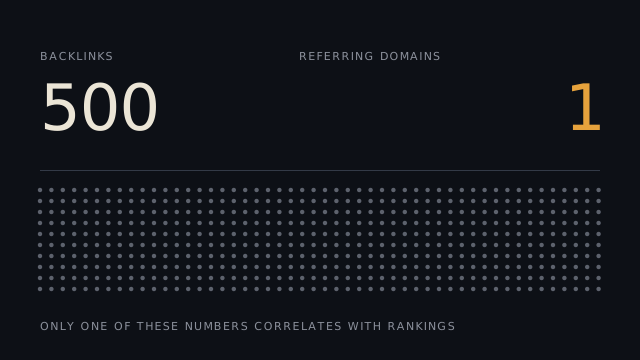
- 500 links from one domain still count as one referring domain, so the number of backlinks piling up on a single website matters far less than how many different websites you collect them from.
- Links from multiple domains typically provide a stronger signal than many links from a single domain, which is why I stop chasing a site once I've landed one genuinely good placement on it.
- High quality backlinks come from sites with domain authority scores of 60 or above; medium-quality backlinks sit between 40 and 59, and anything below that needs real page-level traffic to earn a place on my list at all.
- A homepage typically carries 40 to 50 backlinks, while an individual important page may need anywhere from 10 to 100, and competitive keywords often require 40 to 100+ referring domains, not 40 to 100 raw links.
- Roughly 66% of pages have zero backlinks at all according to Ahrefs, and over 90% get zero organic traffic as a direct result, so the baseline most sites are competing against is lower than it feels from inside a busy niche.
How many backlinks from one website is useful
The honest answer is: fewer than most people assume, and past a certain point, more backlinks from the same website barely move anything. Total backlinks count every link including multiple links from one site, so a domain that links to you fifty times across its footer, sidebar, and old blog posts shows up as fifty backlinks in a raw count.
Referring domains count unique websites, a number that matters more for SEO than the raw total, since search engines compress that same fifty-link domain down to a single vote. 500 links from one domain count as one referring domain in practice, no matter how the total backlinks number looks on a report.
Links from multiple domains typically provide a stronger signal than many links from a single domain, and that's the whole reason I stop actively pursuing more placements on a site once I've landed one strong one there. A second or third link from the same linking site rarely adds meaningful lift, and the outreach hours are almost always better spent opening a new domain than squeezing a fourth link out of one that's already said yes once.
Total backlinks vs referring domains: the distinction that matters
Total backlinks and referring domains answer two different questions, and conflating them is where most backlink ranking confusion starts. Total backlinks tells you how many individual links point at a page or domain, useful for spotting site-wide link patterns but nearly meaningless for judging real authority on its own.
Referring domains tells you how many separate websites have vouched for you, and that number correlates far more closely with search engine rankings than total backlinks ever does.
I've reviewed backlink profiles with a backlink count in the thousands that were built almost entirely from a handful of directories and a couple of sitewide footer links, real referring domain counts in the single digits once you strip the duplication out.
A backlink profile like that looks impressive in a monthly report and does close to nothing in the search engine results pages. I'd take 20 referring domains over 2,000 raw backlinks concentrated on the same five sites, every time.
Why most pages never get a single backlink at all
66% of pages have zero backlinks according to Ahrefs, and a separate study found 94% of online content has no external backlinks pointing at it whatsoever. Over 90% of pages receive zero organic traffic as a direct downstream result, since search engines lean on backlinks as one of the clearest trust signals available when deciding what deserves search traffic and what doesn't.
That statistic matters more than it looks: it means most of the content competing against you online was never built with real link building in mind, which lowers the actual bar more than most people assume walking into a new niche.
Backlinks signal trustworthiness to search engines the same way a citation signals it to a human reader, and backlinks from authoritative sites carry more weight in that signal than backlinks from anonymous or low-traffic ones. A page that earns even a modest number of backlinks from reputable websites is already ahead of the 66% sitting at zero, before a single other ranking factor gets considered.
What domain authority tiers mean for backlink quality
High-quality backlinks typically come from sites with domain authority scores of 60 or above, the tier where a single placement carries real, on-its-own ranking weight. Medium-quality backlinks sit between 40 and 59 DA, useful in relevant niches but rarely enough to move a competitive keyword alone. Below 30 DA, a link needs real page-level traffic behind it before it's worth counting toward a target at all.
Spammy backlinks come from low-quality, irrelevant websites regardless of what domain authority number they display, since DA can be inflated through private link networks in ways real traffic can't be faked as easily. I check backlink quality on the specific linking page itself, ahead of the domain-wide DA score, for exactly this reason: a DA 70 domain with a dead, unindexed linking page is worth less than a DA 35 domain with an actively-read one.
How many backlinks a single page needs
A homepage should have roughly 40 to 50 backlinks pointing at it once a site is genuinely established, based on the pattern I see across retained client accounts. Each important page beyond the homepage may need anywhere from 10 to 100 backlinks, and that spread depends entirely on how many backlinks the competing pages in that specific search results listing already have.
Competitive keywords often require 40 to 100+ referring domains specifically, since domain diversity is what search engine algorithms reward well ahead of the raw link count sitting on a report.
New sites typically need more backlinks to rank than an established site chasing the same keywords, since a new domain hasn't built the trust an older one already carries with search engines. It starts the trust-building process from zero while an established competitor is compounding years of existing signal.
How many links from one linking site is too many
Too many backlinks from the same linking site is a real pattern I watch for on every backlink audit, less because the links themselves are individually harmful and more because a pile of links from one domain starts looking manufactured past a certain point.
Two or three links from that domain, spread across different pages over time, read as normal editorial behavior. Ten or twenty landing in a single month reads as exactly what it usually is: a link building program that's run out of new sites to approach and started reusing the same one.
Multiple backlinks from a single linking site do occasionally make sense, a resource page that links to you from three different articles, or a publication that's genuinely covered your company more than once. What I watch for is if those extra links arrived through separate, organic editorial decisions, or through one bulk negotiation dressed up as several placements.
Search engines seem to reach the same conclusion I do: after the first link from a given linking site, the marginal value of the next one from that same domain drops fast. That's exactly why link building programs built around depth on one site over breadth across many tend to plateau early.
A diverse backlink profile beats a deep one
A healthy backlink profile spreads referring domains across as many genuinely relevant, high authority sites as a niche can support. It doesn't lean on the handful of website owners who've already said yes once.
Building links across 30 different domains at a slower pace beats packing the same volume into 10 domains twice as fast: the first approach produces a backlink profile that looks earned, the second one that looks purchased, even when every individual link is completely clean.
Website owners talk to each other more than most link builders assume, especially inside a tight niche. Spreading requests across many relevant website owners, over repeatedly pushing the same few for more coverage, keeps a link building program's response rate healthy for years, well past the single quarter a burned-out list survives.
I track which website owners I've already secured a placement from specifically so I don't accidentally ask twice within the same year.
What competitive keywords demand in referring domains
Competitive keywords often require 40 to 100+ referring domains before a page has a realistic shot at page one, and that referring domain count matters more for where a page ranks than any total backlink figure sitting on the same report.
I've pulled backlink ranking data on dozens of competitive SERPs over the years, and the pattern holds close to every time: the page with the most diverse referring domains outranks the page with the most raw backlinks in the large majority of head-to-head comparisons I've run, even when the raw backlink totals favor the other page by a wide margin.
Rankings respond to referring domains the way a hiring panel responds to references: one reference who's worked with you for years carries real weight, but ten references who all happen to work at the same company carry barely more weight than that one did alone. Search engine algorithms appear to apply similar logic, treating genuine diversity as a proxy for real-world reputation over a manufactured one.
Guest posts and quality links: where the best diversity comes from
Guest posts remain one of the most reliable ways to add a genuinely new referring domain to a backlink profile, since every accepted pitch is, almost by definition, a new website owner agreeing your content is worth publishing.
Quality links from guest posts on sites with real search traffic outperform quality backlinks bought in bulk from link marketplaces every time I've compared the two approaches head to head, because a marketplace seller's entire business model depends on selling the same site's link to dozens of buyers, quietly recreating the too-many-backlinks-from-one-place problem at internet scale.
I budget roughly a third of every client's monthly link building hours toward guest posts specifically, because the format forces genuine domain diversity by its nature: one pitch, one website owner, one new referring domain, over five placements bundled from a single negotiation on the same property.
Dofollow, nofollow, and where sponsored links fall
Dofollow links pass authority between websites, which is the entire mechanism behind why backlinks affect rankings at all. Nofollow links do not pass authority to linked sites, though they still send referral traffic and occasionally get partial credit search engines rarely disclose publicly.
Sponsored links are treated as nofollow by search engines by default, which matters for anyone building a link building program around paid placements or affiliate partnerships, since those links won't do the ranking work a genuine dofollow editorial link does.
I track the dofollow-to-nofollow ratio on every client's backlink profile the same way I track referring domains, because a profile that's accidentally gone heavy on nofollow links, sponsored content, or guest posts run through a nofollow-by-default platform ends up with a healthy-looking raw link total and a much smaller amount of actual ranking authority behind it.
Quality over quantity: ten well-chosen backlinks beat a hundred average ones
Quality over quantity is essential for building effective backlinks, and I'd take ten genuinely relevant quality backlinks from high authority sites over a hundred quality links scattered across marginal ones every time. Replicating competitors' best links can yield high-quality backlinks faster than cold outreach from scratch, since a site that already links to two or three direct competitors has already shown it's open to linking to companies exactly like yours.
I've walked clients through backlink profiles built almost entirely on ten to fifteen well-chosen placements, each one run through the same Backlink Quality Scorer checklist first, that outperformed a competitor's much larger link total. Every one of those quality backlinks sat on a genuinely relevant domain, over a volume play across low-quality placements.
Quality backlinks compound; quality links from the wrong sites just add noise to a report nobody ends up trusting.
How many backlinks is realistic to build in a given month
Clients regularly ask how many backlinks a realistic monthly pace looks like, and the honest range for a genuine link building program sits closer to five to fifteen high quality backlinks a month than the fifty-plus a bulk vendor will promise.
That range holds if the target keywords are local and lightly contested, or genuinely competitive, because the real limiting factor is the number of website owners realistically willing to say yes to a specific pitch inside any given month. Budget is rarely what caps the pace.
Search engines seem to reward that exact pace: a backlink profile that adds five to fifteen high quality backlinks steadily every month for a year builds a stronger, more durable position than one that adds sixty in a single burst and then goes quiet.
How many links a program builds in its first month is almost never representative of its long-term pace, since the first month usually clears the easiest, most relationship-driven placements on the list.
Build links against the harder, more competitive targets in months two and three, and expect the monthly count to level off well short of that opening pace.
I tell clients to expect eight solid placements a month for a year. That beats promising forty in month one and quietly under-delivering every month after.
Domain authority thresholds I use, client by client
Domain authority is a starting filter for me, never the final word, and the exact threshold shifts depending on how competitive a client's target keywords are. For a genuinely competitive B2B SaaS keyword, I lean toward DA 50 and up as the working floor, since the sites already ranking carry backlink profiles built almost entirely from that tier.
For a local service business, DA in the 20s and 30s on a genuinely relevant regional site often outperforms a DA 60 general directory that's never heard of the client's actual market.
High quality backlinks earn that label through domain authority, page-level traffic, and topical relevance working together as a set, rarely one signal alone. Quality links from a site with DA in the 40s and a real search intent match for a client's target keywords routinely outrank pages sitting on backlinks from DA 70+ sites with no topical connection at all. I've stopped treating domain authority as a gate and started treating it as one column in a wider scorecard.
How this connects to actual search traffic
More organic traffic is the entire point of building backlinks in the first place, well ahead of the backlink count as a vanity number, and referring domains correlate with search traffic more directly than raw backlink totals do in every account I've tracked.
A client asking how to get 1,000 visitors a day to a new website is asking a backlink question in disguise: that kind of search traffic almost never arrives without a real link building program feeding search engine rankings behind it, alongside content that deserves the visits once they land.
More search traffic follows referring domain growth with a lag, usually a quarter or two, which is why I set expectations around timelines as carefully as I set them around the target number itself.
A step-by-step way to work out your own number
Start by asking how many backlinks the page you're trying to rank already has, broken out as total backlinks and as referring domains separately, since the gap between those two figures usually tells you more than either one alone. A page with a hundred total backlinks and eight referring domains has a concentration problem dressed up as a volume advantage, and no amount of additional link building against that same handful of domains fixes it.
Next, check how many backlinks the top three or four ranking pages for your target keywords carry, again split by total backlinks and referring domains. Search engines have already told you, through the current rankings, roughly what it takes to compete for that specific term, and reading that signal correctly beats guessing at it.
If the top three average 45 referring domains and your page has 12, that gap of roughly 30 is a far more useful planning number than any generic backlink benchmark pulled from an article like this one.
From there, build links at a pace your outreach process can sustain without cutting corners on quality links or high quality backlinks specifically.
I'd quote a client 8 to 12 months to close a 30-domain gap with genuinely relevant, high authority placements over promising the same gap closed in six weeks through a bulk provider, since search engines tend to reward the first approach and eventually discount the second.
Link building done at a sustainable, well-paced rhythm, checked against real referring domain movement every quarter over a raw link total, is the version of this process that's held up across every account I've run it on for six years.
Both traffic and rankings follow that same disciplined process with a lag, typically a quarter or two behind the referring domain growth itself, which is worth setting as an expectation before the first outreach email even goes out.
Two edge cases worth knowing before you plan a budget
The first edge case: a brand-new site with zero backlinks competing against established players. How many backlinks that site needs in year one is almost always higher than the steady-state number it'll need in year three, because early link building has to do double duty, building both authority and the trust search engines extend to a domain with real history behind it.
I tell new-site clients to expect their first-year link building spend to outpace what a five-year-old competitor spends for the identical target keywords, purely to close that trust gap.
The second edge case: a site that already has too many backlinks concentrated on a handful of domains, the opposite problem from having too few. In that situation, how many additional backlinks a site needs is almost beside the point until the existing concentration gets diluted with genuinely new, diverse referring domains.
I've told clients with an impressive-looking link total to pause new link building entirely for a month while we mapped out exactly how concentrated their existing profile was, since building on top of a lopsided foundation just makes the eventual fix harder. Real traffic gains never compound until that concentration problem gets resolved first.
Search engines evaluate both situations the same underlying way: how many backlinks exist matters less than how diverse and trustworthy the sources behind them are. High quality backlinks from ten different domains beat the same count concentrated on three, in a new site's first year and in an established site's tenth year alike.
FAQ
How many backlinks should my website have?
A homepage typically carries 40 to 50 backlinks, while individual pages may need 10 to 100 depending on keyword competition, and competitive keywords often require 40 to 100+ referring domains specifically, well beyond what a raw link total alone would suggest.
Are backlinks still relevant in 2026?
Yes. Backlinks remain one of the clearest trust signals search engines use, and 66% of pages still have zero backlinks according to Ahrefs. That gap keeps a real backlink profile a genuine competitive advantage, well beyond a commodity metric.
How to get 1,000 visitors a day to your website?
Pair content that deserves the traffic with a real link building program targeting relevant referring domains; more organic traffic at that volume almost always traces back to a backlink profile search engines already trust.
How many backlinks does it take to rank a website?
There's no single number for an entire website, since every page competes against a different set of pages for a different target keyword. A link gap analysis against your specific competitors gives a far more useful answer than any fixed benchmark (I walk through that process step by step in my piece on how many backlinks you need to rank).
Do backlinks from the same website count more than once?
They count toward your total backlinks number, while referring domains, the figure that correlates with rankings, only count that site once. How many backlinks a single site sends you matters far less than how many other sites also link to you.
How many backlinks is too many to get in a short period?
There's no fixed daily or weekly cap, but a pace well beyond what a comparable, established competitor adds in the same window is the pattern that tends to draw attention. Steady beats fast on this specific question almost every time.
How many backlinks do competitors typically have for a given keyword?
It varies by keyword and industry, which is exactly why I check the actual top-ranking pages for that specific term over quoting a fixed range from memory or a generic industry average. How many backlinks a competitive B2B keyword's top three pages carry can run into the dozens of referring domains, while a low-competition local term might only need a handful.
Should I count how many backlinks my competitors have before starting a campaign?
Yes, always. Counting how many backlinks and how many referring domains the current top three or four pages carry is the single most reliable way to set an honest target before spending a dollar on outreach.
Not sure if your backlinks are diverse enough?
Send me your referring domain list and I'll tell you, plainly, how much of it is doing real work versus padding a total backlinks number.
get a free eye test