Key takeaways
- Natural backlinks are earned without solicitation, added by other websites organically because your content deserved the citation.
- 66.31% of web pages have no backlinks at all, and pages in position one carry 3.8 times more natural backlinks than the rest of the results.
- A natural backlink profile includes diverse referring domains and varied anchor text, the mix search engines associate with a profile that grew on its own over time.
- High-quality backlinks are a top-3 ranking factor for SEO in 2026, and natural backlinks help avoid Google penalties that unnatural link building can trigger.
- Long-form content attracts 77% more natural backlinks than shorter posts, and infographics generate 25.8% more backlinks than plain text posts.
What a natural backlink is
Natural backlinks are earned without solicitation, meaning nobody asked for them, negotiated them, or paid for them. Natural backlinks are created organically by other websites, cited because a writer or editor decided your content was worth referencing on its own. That's the whole definition, and every tactic in this article exists to make that kind of citation more likely without faking it.
Natural vs unnatural links: the core distinction
Unnatural links are links assembled through link schemes, private blog networks, or paid placements designed to manipulate rankings. Natural links show up because the linking site's owner found something worth citing on their own.
Google's algorithms have gotten better at telling the two apart, comparing a site's backlink profile against what a genuinely growing profile in that niche typically looks like.
Why natural backlinks are the gold standard
Natural backlinks are considered the gold standard for link building, and every client conversation I have about strategy eventually comes back to that one point: nothing else survives algorithm updates the way a genuinely earned link does. Natural link building takes longer than any shortcut, but it's the only version of link building that keeps paying off years after the initial work.
Natural backlinks and E-E-A-T
Natural backlinks improve a site's E-E-A-T, which stands for Experience, Expertise, Authoritativeness, and Trustworthiness, Google's framework for judging if content deserves to rank. A natural backlink profile signals to search engines that other sites, and by extension their readers, already trust your content enough to cite it, the kind of external validation E-E-A-T is designed to capture.
The trust signal search engines use
Natural backlinks are considered a trust signal by Google, one that's proven far harder to fake at scale than almost any on-page signal. Natural backlinks improve a website's trust and credibility in the eyes of search engines specifically because they represent an independent, third-party judgment about your content's value, something no amount of on-page optimization can substitute for.
Votes of confidence: editorial links explained
Natural backlinks are viewed by search engines as votes of confidence for content value, the same plain framing I use with clients who've never thought about link building before. Editorial links, earned because a writer cited your work without being asked, sit at the top of that hierarchy, the same type of link I break down in detail in what makes a backlink powerful, and I chase them ahead of every other tactic on this page.
Natural backlinks and search rankings
Natural backlinks are key for improving search rankings, and natural backlinks help improve search rankings and visibility in a way that compounds the longer a site keeps earning them. Google search rankings respond to a natural link profile more reliably than to any single burst of link building activity, since a genuinely growing profile's pace seems to matter as much as the links themselves.
Natural backlinks help avoid Google penalties
Natural backlinks help avoid penalties from Google, and a natural backlink profile helps avoid Google penalties specifically tied to manual actions against unnatural link building. Paid backlinks may violate search engine guidelines and risk penalties, which is why I steer every client away from paid placements even when a shortcut looks tempting.
The math nobody mentions: most pages get nothing
66.31% of web pages have no backlinks, a statistic that reframes the entire conversation about link building for most clients I meet. If a site's page has even a handful of natural backlinks, it's already ahead of two-thirds of everything indexed, and that baseline is worth remembering before panicking about a competitor's larger backlink profile.
Position one and the backlink gap
Pages in position one have 3.8 times more natural backlinks than pages further down the search results, a gap that keeps widening the longer a page holds that position. That compounding effect is why natural link building rewards patience: a page that earns even a modest lead in natural backlinks tends to keep extending it.
What a natural backlink profile looks like
A natural backlink profile includes diverse referring domains and varied anchor text, spread across earned citations, guest posts, curated listings, and the occasional directory. Natural backlink profiles include diverse referring domains and varied anchor text as a matter of course, since no single outreach channel produces every kind of link a genuinely organic profile accumulates over time.
Diverse referring domains and why they matter
Diverse referring domains improve a natural backlink profile far more than the same volume concentrated in a handful of sources; concentration itself reads as a signal of manufactured link building. I track referring domain diversity as closely as backlink profile size for every client, because a link profile spread across dozens of unrelated domains reads as far more credible than one leaning on five.
Anchor text: the detail that gives unnatural profiles away
Anchor text diversity is one of the clearest tells between a natural backlink profile and a manufactured one, and the Anchor Text Composition Scorer is a fast way to check where your own mix sits. A profile where every link uses the same exact-match commercial phrase looks assembled, regardless of how authoritative the linking sites are.
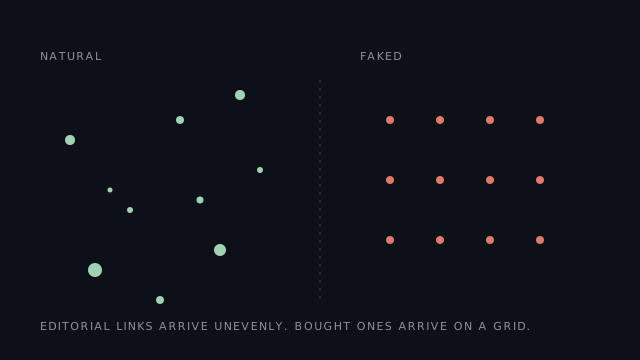
A natural link profile mixes branded anchor text, naked URLs, and generic phrases like "click here" alongside the occasional keyword match, the same pattern a genuinely earned set of natural links produces without any coordination behind it.
Domain authority and backlink strength
Domain authority climbs as a link profile accumulates natural backlinks from a genuinely diverse set of relevant sites, and I track that number monthly for every active client alongside the raw backlink profile count. A link profile heavy on high authority websites moves that number faster than the same volume from low-authority sources, though relevance still matters more than authority alone.
Link schemes, PBNs, and link farms: what unnatural building looks like
Link schemes cover any coordinated attempt to manipulate PageRank or rankings through reciprocal linking deals, paid placements, or automated link building. Private blog networks, clusters of sites built purely to manufacture backlinks pointing at a client's money site, are one of the clearest guideline violations I encounter in an audit.
Link farms function the same way, mass-producing links with no editorial judgment behind any of them. Both tactics carry real risk of a manual action once discovered.
Buying and selling links: what happens
Buying links or selling links that pass ranking value without disclosure violates Google's guidelines directly, regardless of how the transaction gets dressed up. I've had prospective clients ask about buying links as a shortcut more than once, and the answer is always the same: a paid link can drive referral traffic if disclosed properly, but it doesn't pass the ranking value a natural backlink does, and getting caught risks the whole domain's standing.
Link exchanges: careless versus deliberate
Link exchanges done as a mass, unvetted swap, dozens of unrelated sites linking to each other purely for reciprocal SEO value, are exactly the pattern Google's algorithms flag as manipulate pagerank behavior. A small number of genuinely relevant link exchanges between sites that would reference each other anyway is a different matter entirely, and I still recommend that vetted version to clients where the fit is obvious, the same process I detail in backlink outreach.
Active or passive solicitation: where the line sits
Active or passive solicitation of a specific link is what separates a manufactured backlink from a natural one in Google's own guidance; publishing content that happens to attract a link carries none of that risk. Reaching out to ask an editor to consider citing new research is different from demanding a specific anchor text and URL for payment, and that distinction matters more than most link building guides let on.
What Google's actual guidance says
Google's webmaster guidelines describe unnatural links as any link intended to manipulate PageRank or a site's ranking, including paid placements, excessive reciprocal linking, and automated link building software. Reading the guidelines directly holds up better than relying on secondhand summaries, worth doing once if you're serious about avoiding a manual action.
Is link building illegal?
No. Link building itself is completely legal, and search engine optimization built around earning genuine citations is standard practice across the industry. What violates search engine guidelines are specific manipulative tactics: link schemes, PBNs, and undisclosed paid links. None of those are illegal in a legal sense; the real risk is an algorithmic ranking penalty from Google.
Is buying backlinks illegal?
No, buying backlinks is legal on its own, but it does violate Google's own guidelines when the paid link passes ranking value without a nofollow or sponsored disclosure tag. The real consequence is algorithmic or manual: a ranking penalty or a lost link, strictly a search-engine matter. I still advise clients against it, even though nobody's going to face legal action over it.
Long-form content and natural backlinks
Long-form content attracts 77% more natural backlinks than shorter posts, a gap large enough that I default every client's cornerstone content to complete, in-depth treatment. Creating complete resources increases the likelihood of earning backlinks specifically because longer, more thorough content answers more of the questions a linking site's own readers might have, giving an editor more reasons to cite it.
Infographics and visual assets
Infographics generate 25.8% more backlinks than text posts, and publishing visual assets like infographics can encourage backlinks from sites that would never link to a plain article on the same topic. I still commission at least one infographic per major client campaign specifically because visual assets get shared and cited in ways dense paragraphs of text rarely do on their own.
Original research: the highest-use tactic available
Developing original research or data can attract natural backlinks, more reliably than almost any other content format I've tested across six years of campaigns. A genuinely new data point, survey, or benchmark gives every journalist, blogger, and industry site a reason to cite the source directly, which is exactly the kind of organic links a natural backlink strategy depends on.
Interactive tools as a natural link magnet
Interactive tools attract links because they offer utility that static content can't replicate; a calculator, checker, or generator solves a specific problem a reader has right now, and sites serving that same audience tend to cite it as a standing resource. I've built several of these for clients specifically because they keep attracting backlinks years after launch without any additional outreach.
complete resources and resource pages
Creating complete resources increases the likelihood of earning backlinks from curated lists specifically, since a resource page's whole purpose is linking out to the best available material on a given topic. I check those curated lists in a client's niche every quarter, since a placement there tends to stay live and keep sending both referral traffic and ranking signal for years.
Answering your target audience's real questions
Answering common audience questions effectively improves the chance of being referenced in backlinks, since content that solves a target audience's actual problem gets bookmarked, shared, and cited far more than content written to satisfy a keyword list. I build every client's content calendar around real questions their target audience is asking, pulled from search data and sales call transcripts alike.
Refreshing content to keep it link-worthy
Refreshing content with new information keeps it relevant and link-worthy long after the original publish date, since a stale page stops attracting new citations even if it earned plenty when it first went live. Run a page through the Page Freshness Checker before you assume it needs one; the crawl signals sometimes say otherwise.
I schedule a refresh pass on every cornerstone page at least once a year, updating statistics, examples, and screenshots so it keeps earning new natural links year after year.
Building relationships before cold-pitching anyone
Building relationships in the industry can lead to backlinks in a way a pure cold-outreach campaign rarely matches, since a site owner who already knows and trusts you skips most of the vetting a stranger's pitch has to survive. I spend real time engaging with a target list of relevant sites months before ever asking for anything, the same relationship-first approach that's outperformed every purely transactional campaign I've run.
Guest posts as a deliberate, editorial-style tactic
Guest posts remain one of the more reliable ways to build natural links, provided the placement lands on a genuinely relevant site with real traffic. Content farms that accept anything for a fee don't count. I pitch guest posts to a shortlist of relevant sites built around actual audience overlap, and a single guest post on the right site regularly outperforms a dozen placed on sites chosen purely for a fast yes.
Brand mentions: backlinks you don't have to build
Brand mentions that lack a clickable link can often be converted into backlinks by asking the site to add attribution, since the site already decided your brand was worth naming. I run an unlinked-mention sweep for every client quarterly, and it's consistently one of the highest-return plays in the whole outreach process, since the hardest part, earning the mention, already happened.
Social media's real role in natural link building
Social media doesn't pass direct ranking value the way a backlink does, but social media exposure puts content in front of the journalists, bloggers, and site owners who do the actual linking. I treat social media promotion as the discovery layer sitting on top of link-worthy content, supporting the content and the outreach that follows.
Blog comments and article directories: legacy tactics worth skipping
Blog comments and article directories were common link building tactics a decade ago, and both have lost most of their value as algorithms got better at discounting low-effort, low-relevance links. I don't build campaigns around either tactic anymore, though a genuinely thoughtful blog comment on a relevant, well-trafficked post can still occasionally drive real referral traffic even without much ranking value attached.
Link velocity: why pace matters as much as volume
Link velocity, the rate at which new backlinks accumulate, is one of the clearer signals search engines use to separate natural growth from a manufactured link building campaign. A site that goes from a handful of backlinks to hundreds in a single month looks manufactured even if every individual link would pass inspection on its own, which is why I pace client campaigns deliberately, spreading new links out over months.
Faster indexing through established sites
Search engines index content faster when crawled through established sites, since a link from a domain crawlers already visit frequently gives a new page a faster path into the index than waiting on an organic crawl. A new post sitting several clicks deep on a small site might wait weeks for that first crawl; one natural backlink from an established site can cut that wait to a day or two.
Is it easy to get natural links?
Rarely, and anyone promising an easy, fast way to build natural backlinks at scale is usually describing something closer to a manufactured campaign. Genuinely natural links take real content, real relationships, and real time, though a handful of tactics, original research, interactive tools, and long-form guides, meaningfully shorten the odds compared to publishing and hoping.
What is a natural backlink?
A natural backlink is a link earned without solicitation, added by a site owner because your content genuinely deserved the citation.
How to earn natural backlinks
Creating link-worthy content is essential: original research, complete guides, interactive tools, or visual assets that solve a real reader problem. Promoting that content is what turns its potential into actual backlinks, since even the best resource attracts nothing sitting unseen.
Pairing strong content with genuine outreach and social media visibility is how I build natural backlinks for every client, combining every piece into one campaign.
A real example of natural link building compounding
A SaaS client came to me with a backlink profile heavy on directory listings and light on anything editorial. We built an original benchmark report nobody else in the space had published, promoted it through targeted outreach and social media, and let the content do the rest.
Eleven publications picked it up organically within three months, each one a natural backlink earned without any direct ask beyond letting the right people know the research existed. The client's keyword rankings for three target terms moved more in that quarter than the entire previous year of directory submissions combined.
Creating inbound links through content worth citing
Creating inbound links starts with content people want to reference on their own, well beyond outreach bolted onto something forgettable. Building links at scale without that foundation rarely produces anything durable.
Every inbound link I've helped a client earn traces back to a piece of content that solved a real problem well enough to generate backlinks without a heavy ask. Content designed specifically to attract backlinks, a tool, a dataset, a definitive guide, consistently outperforms content that happens to attract them as an afterthought.
Nofollow links, link types, and why a natural profile needs variety
Nofollow links do not pass the same ranking value as dofollow links, but a natural backlink profile still needs them; an all-dofollow profile is one of the more obvious signals of unnatural link building.
The different link types, editorial, guest post, directory, nofollow, dofollow, all show up in a genuinely organic profile because no single channel produces every kind of citation a site earns over years.
A single quality link from a high quality links source outweighs a dozen average nofollow mentions, but the mix itself is part of what makes a natural backlink profile read as natural.
Organic traffic beyond the rankings themselves
Organic traffic is the benefit natural links deliver even before any ranking movement shows up, since a reader clicking through from a genuinely relevant site doesn't care about your domain authority. More links from real, active sites compound that traffic over time, sending direct web traffic to a client's own site independent of whatever rankings do later.
I've had clients see meaningful referral and organic traffic from a single well-placed natural backlink within days, well before any ranking change registered in the data. That's worth remembering when a link building campaign feels slow on the ranking side alone.
Search engine users and what earns a click
Search engine users trust organic listings more than they trust ads, and a natural backlink profile is part of what earns a page a spot readers click on. Google search itself uses backlinks as one signal among many when deciding what belongs on the first page of results.
A handful of google search operators, site:, intitle:, related:, are worth learning if you want to audit a competitor's natural backlink profile directly.
Planning content with the right tools before writing it
Semrush's SEO Content Template is one of the tools I use to plan high quality content before writing a single word, checking what a page needs to compete. Online marketing teams that skip this planning step tend to produce quality content that never attracts the natural links it should, since the content solves the wrong problem or misses the depth competitors already cover.
I run every cornerstone page through that kind of check before publishing, treating quality content as a prerequisite for natural link building.
Links intended to manipulate versus links that just happen
Links intended to manipulate rankings look different under inspection than links that happen because content earned them: the first cluster around exact-match anchor text from unrelated sites, while the second spreads across relevant sources with varied phrasing.
High quality backlinks almost always fall into the second category, earned by content that did the work on its own. That's the whole reason search engines keep investing in better ways to tell the two apart, and why unnatural links keep getting easier to catch every year.
Cleaning up a backlink profile's dead weight
Spam links from low-quality directories or link farms can drag down a site's ranking if the pattern gets dense enough to draw attention, which is why I run every prospective and existing link through the same checklist I use to spot a junk backlink, at least twice a year.
Broken links pointing at pages that no longer exist waste whatever authority they once passed, and fixing or redirecting them recovers value that's otherwise lost.
I also check how many of a client's indexed pages are accumulating natural backlinks over time, since a site can have thousands of indexed pages and still see nearly all its natural link growth concentrated on a handful of them.
Build natural backlinks: the practical sequence
To build natural backlinks, the sequence rarely changes: create something worth citing, make sure the right people know it exists, and give it time to attract links on its own. A natural looking backlink profile accumulates the same way a reputation does, one genuine citation at a time.
Clients who want natural backlinks faster than that pace usually end up disappointed. The ones willing to attract links patiently over a year consistently outperform the ones chasing volume in a month.
Natural link building as a long-term discipline
Natural link building works as an ongoing discipline practiced over months. Every business serious about it treats natural link building as a permanent function, the same way content or product development never finishes.
Natural links earned this way keep compounding long after the initial campaign ends, while natural links purchased or manufactured tend to lose value the moment search engines catch up to the pattern.
I've run natural link building programs for six years. The accounts that treated it as a quarter-long project consistently underperformed the ones that ran it as a permanent function, and the difference shows up in every backlink profile I've audited afterward.
Why natural links outperform manufactured ones long-term
Natural links survive algorithm updates in a way manufactured links never do, since search engines are specifically hunting for the patterns manufactured links leave behind. A site built on natural links keeps its rankings stable through updates that wipe out competitors leaning on link schemes, and that stability alone justifies the extra time natural link building takes compared to any shortcut.
I tell every new client considering a natural link building program the same thing: natural links are slower to accumulate, but they're the only version of link building that doesn't carry ongoing risk attached to it.
Building links the deliberate way
Building links deliberately still has a place inside natural link building: reaching out to niche publications, submitting to real curated lists, and pitching guest posts all count, as long as the underlying content earns the placement on its own merit.
I've helped clients build natural links this way for six years, combining patient content work with just enough deliberate outreach to make sure the right people see it.
A single quality link earned through that combination, sourced from a high quality backlinks source, outweighs a much larger batch of inbound links pulled from unrelated, low-traffic domains.
Why the compounding version of natural links wins
Earning links from genuinely relevant websites is what separates a natural link building program that compounds from one that plateaus after the first few months.
High quality content paired with real inbound links keeps producing natural links long after the initial campaign budget runs out, and every client who's stuck with that approach for a full year has ended up with far more natural links than the ones who chased volume early and stalled.
Natural links earned this slowly rarely disappear the way manufactured ones eventually do, and that durability is the actual return on the patience natural links require.
What I'd tell you if you only remember one thing
Natural backlinks come from content worth citing, promoted to the people who'd genuinely want to cite it, given enough time for that citation to happen on its own. Every shortcut in this article, coordinated schemes, PBNs, bought links, exists because that patience is hard to sell, and every client relationship that's respected it has outperformed the ones chasing a faster unnatural path.
FAQ
Are backlinks still relevant in 2026?
Yes. High-quality backlinks are still a top-3 ranking factor for SEO, and natural backlinks specifically remain the version search engines trust most.
Is it easy to get natural links?
Not consistently or quickly. It takes genuinely link-worthy content, real outreach, and time, though certain formats, original research and interactive tools especially, shorten the odds.
What is a natural backlink?
A link earned without solicitation, added because a site owner independently decided your content deserved the citation.
Is link building illegal?
No. It's standard SEO practice. Specific manipulative tactics violate search engine guidelines, but the consequence is an algorithmic ranking penalty.
How can I earn natural backlinks?
Build genuinely link-worthy content, original research, complete guides, or useful tools, then promote it through outreach and social media so the right people find it.
Is buying backlinks illegal?
No, but it violates Google's guidelines when undisclosed. The risk is a ranking penalty or a lost link, both enforced by the search engine itself.
Not sure if your backlink profile looks natural?
Send me your last link report and I'll tell you what a search engine would think of it.
get a free eye test