Key takeaways
- A KD score is built only from the backlink profiles of the URLs currently ranking; it says nothing about domain stability, historical volatility, or which specific spot in the top 10 is vulnerable.
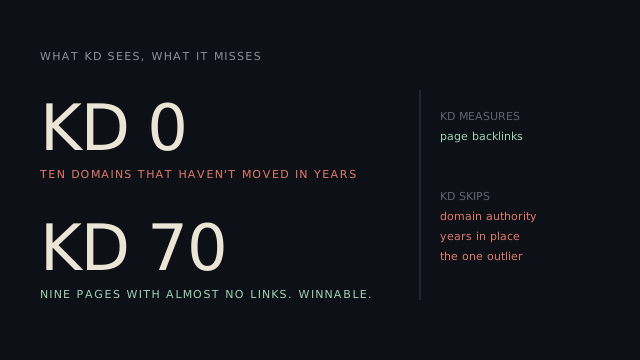
- A KD of 0 can be a wall: ten established domains that haven't turned over in years, with no thin page anywhere to attack.
- A KD of 70 can be mostly bluff: one page with a huge referring domain count drags the average up while the other nine spots sit on pages with close to no backlinks at all.
- How long the current top 10 has held its positions matters more than the KD number itself; a frozen top 10 signals brand and trust you can't outbuild, a volatile one signals real openings.
- Before committing budget to a keyword, I read the top 10 pages individually, check each one's page-level referring domains, and check how stable that lineup has been over the past 12 to 24 months.
Every keyword research tool spits out a Keyword Difficulty number, and most people treat it like a verdict. A KD of 20 reads as easy. A KD of 80 reads as forget it. I've stopped trusting the number on its own, because it measures one narrow thing well and stays silent about two others that matter just as much.
What a KD score is measuring
KD is built from the backlink profiles of the URLs currently ranking on page one, usually referring domains or a weighted link-equity estimate, averaged or scored across the top 10. That's it. It's a link-count snapshot of the current SERP. The domains behind those pages, how long they've held their positions, and what a new page would need to break in all sit outside what the number measures.
Two SERPs can produce wildly different real-world difficulty while landing on similar KD numbers, or the reverse: similar real difficulty with wildly different KD numbers. The score can't tell those cases apart, because it was never built to look at anything except the backlinks on the pages already ranking.
The outlier problem
Picture two SERPs for two different keywords, both 10 results deep, on opposite ends of the KD scale.
SERP A · KD reads 0
- All 10 ranking pages sit on DR85-95 domains
- None of those pages needed many backlinks to rank there
- No outlier anywhere in the top 10
- Same domains have held these spots for years
- No new domain has cracked this top 10 in years
SERP B · KD reads 70
- 1 page on an otherwise weak domain has 100 referring domains and holds the top spot without moving
- 7 pages have zero backlinks pointing to them at all
- 2 pages sit on strong domains with zero backlinks of their own
- Positions 2 through 10 reshuffle constantly; almost none of that traffic is held by strong domains
SERP A's 0 looks inviting and is a wall: ten established domains, nothing thin anywhere, nothing to attack. SERP B's 70 looks brutal and is mostly bluff: one page with 100 referring domains inflates the score, but that page only accounts for one of ten spots.
The other nine are held by pages with no backlinks at all, none of them stable, most of them not even on strong domains. Ask which SERP is harder to rank in and the KD numbers point you exactly backwards. The 0 is the wall. The 70 has nine open doors.
The mistake is treating the score as one number describing ten pages equally. It's closer to a single loud outlier drowning out nine quiet signals. A tool that averages or sums referring domains across the top 10 will let one page with triple-digit link counts drag the whole SERP's score into "hard" territory, even when that page is the only thing standing between you and an otherwise empty field.
Domain stability the score can't see
A KD number is a snapshot taken once, at the moment the tool crawled the SERP. It has no memory of what that top 10 looked like two years ago, or how many reshuffles it's been through since spring. That history matters more than the number itself.
Major, well-funded domains sitting in a frozen top 10 rarely move regardless of how many backlinks a new page picks up, since the incumbents aren't ranking because of a thin link profile you could outbuild. They're ranking on a mix of brand signals, historical trust, content depth, and user behavior that a KD tool doesn't model at all.
A volatile top 10, where positions change hands across quarters, tells you the opposite: whatever is keeping pages up there is not permanent, and a well-built page has a real shot at moving into that rotation.
What I check before trusting a KD score
KD still has a use: it's a fast way to shortlist a long keyword list down to something worth manually reviewing. But before committing budget to a keyword, I pull up the actual SERP and check:
- The top 10 pages themselves, each one read individually. I don't lean on the aggregate score.
- How many of the 10 pages have close to zero backlinks pointing at that specific URL. One page with a huge referring domain count can drag KD up even when most of the field is undefended.
- How stable the top 10 has been over the past 12 to 24 months. A rank tracker's history is the direct way to check this; a rough manual substitute is pulling each ranking URL's archive history to see how long it's held a similar position.
- Page-level referring domains for each ranking URL, separate from domain-wide DR. A domain can be enormous and still have a thinly-linked page ranking on relevance alone.
None of this takes much longer than reading the KD number off a dashboard. It just means the number becomes a filter, and the SERP itself becomes the actual evidence. For the fuller version of this process, turning that SERP read into an actual target backlink count, see how many backlinks you need to rank.
Staring at a keyword list and want to know which ones are real?
Send me your shortlist and I'll tell you which SERPs have an outlier worth chasing and which ones are locked down by incumbents no amount of link building will move.
get a free eye test