Key takeaways
- The mark is carried by which words Claude picks, so pasting output into a plain-text editor removes nothing. There are no hidden characters to strip.
- Anthropic uses SynthID-Text, the method Google DeepMind published in Nature in October 2024 and ran across roughly 20 million live Gemini responses before publication.
- Marking happens at the model level across the API, Claude Code, Claude Cowork and every cloud partner, so no request parameter switches it off.
- The driver is Article 50 of the EU AI Act, in force since August 2, 2026, with fines of up to €15 million or 3% of worldwide turnover.
- Long-form prose carries a strong signal. Factual passages, proofread drafts, functional code and short messages carry a weak signal or none.
- Researchers at ETH Zürich scrubbed the mark with an off-the-shelf paraphraser more than 90% of the time, and forged it into human text 15% of the time at 90,000 training queries.
- Anthropic's detection API has no launch date, no published pricing and no published error rates, so nobody outside Anthropic can check anything yet.
- For SEO, the honest answer is that almost nothing changes. Google has no text verification tool and Ahrefs' data shows 5.3% of top-ranking pages are fully AI-generated already.
Search interest in "claude watermark" rose more than 5,000% against the same week a year earlier in the days after August 9, 2026. I watched the spike happen, read the advice that filled the gap, and most of it was written by people who hadn't read Anthropic's post.
The correction worth making first: the mark is a change to how the model picks between words it already rated as equally good. Nothing gets appended to your text.
What Anthropic shipped on August 11
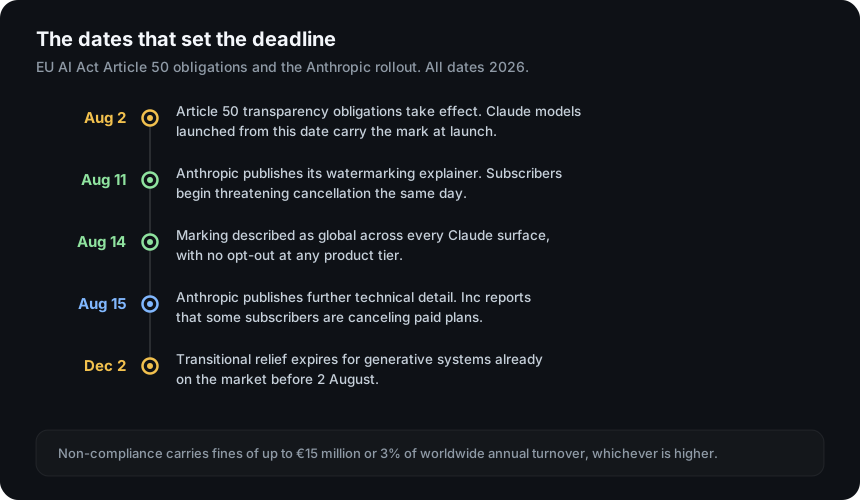
Anthropic published "How Claude's text watermarking works" on August 11 and described coverage as global by August 14. Models launched on or after August 2, 2026 carry the mark from launch day, and Anthropic's support docs list the retrofit of older models as in progress with no completion date.
Coverage spans the Claude Platform API, the Claude apps, Claude Code & Claude Cowork, Claude Tag, and deployments through AWS, Google Cloud and Microsoft Foundry. Marking happens at the model level, so no product surface and no API parameter can switch it off.
Anthropic's support page states the watermark "will travel with the text when it's copied and pasted." Paste into Google Docs, a CMS, a Slack message or a Word file and the pattern survives the trip, because the pattern is the words.
The sampling change that carries the mark
Language models generate one token at a time, and at most positions several candidates are close to equally good. Anthropic's implementation reaches into that ambiguity: when picking between near-equivalent options, the model skips an ordinary random source and uses "the key and a few words that come before to settle what word the model should pick."
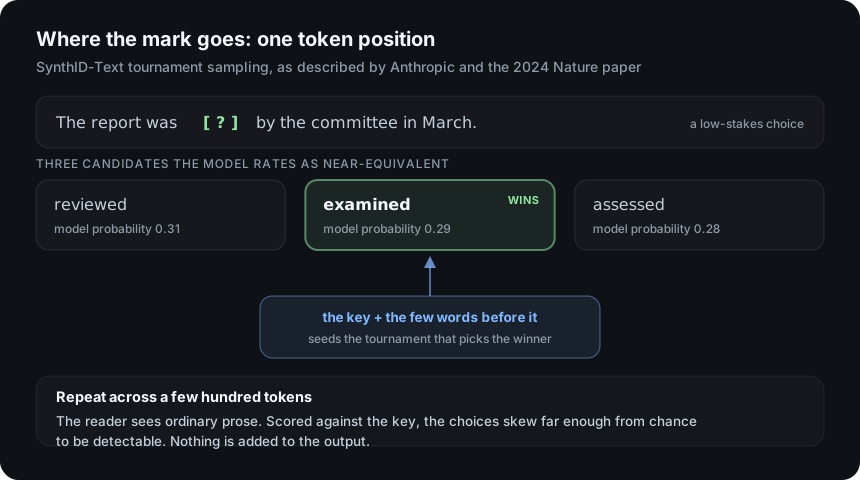
The output looks unremarkable to a reader. Measured against the key, the choices skew. Run enough tokens and the skew accumulates into a statistical signal a scoring function can separate from chance.
The method is Google DeepMind's SynthID-Text, published in Nature on October 23, 2024 by Sumanth Dathathri, Abigail See, Sumedh Ghaisas, Po-Sen Huang and colleagues. The underlying idea traces to a 2022 proposal by Scott Aaronson during his stint at OpenAI. Anthropic didn't invent the technique. It adopted one that had already run in production.
Several write-ups have described the mechanism as a red-list and green-list vocabulary split with a bias applied to the logits of approved tokens. That's the earlier scheme from Kirchenbauer and co-authors. The Nature paper uses it only as a comparison baseline; its own design works differently.
The deployment data supports it. DeepMind evaluated SynthID-Text across roughly 20 million live Gemini responses, and the gap between watermarked and unwatermarked models came to 0.01% on thumbs-up rates & 0.02% on thumbs-down. Controlled human evaluation found no measurable difference across five quality dimensions.
Anthropic states the watermark adds no tokens, raises no costs and has negligible effect on generation speed. The developers who predicted on X that the "cryptographic signature will degrade the output" were describing a mechanism that isn't in use here.
Which text carries a usable signal, and which doesn't
The technique needs entropy. Where Claude has real freedom over phrasing, the mark accumulates. Where it doesn't, there's nothing to encode into.
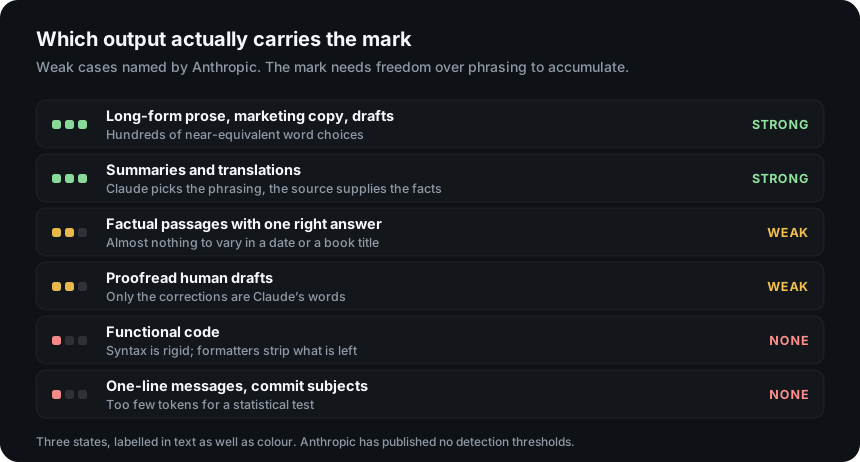
Factual passages with one correct answer carry little signal, since a sentence stating that Isaac Newton's most famous work was called Principia Mathematica leaves almost no room to vary. Proofreading a human draft marks only the corrections, because the surrounding words came from the writer.
Code is the third weak case. Syntax is rigid, identifiers have to match their declarations, and the remaining entropy sits mostly in comments, which is why Anthropic says comments may be marked while functional code generally isn't. Formatters & linters then strip whatever weak signal survived.
Short passages are the fourth. DeepMind's evaluation used 200-token texts as its standard length, and detection strength climbs with length, which makes a one-line commit message or a two-sentence Slack reply effectively unmarkable.
How images and other files are marked
Images don't get a statistical watermark at all. Anthropic writes C2PA content credentials into their metadata instead, covering .svg, .png and .jpg output.
C2PA is an open provenance standard, and the manifest it writes is cryptographically signed and tamper-evident. Tamper-evident and durable are different properties. The manifest is removed by re-saving the file in most editors, by converting the format, or by uploading to any platform that rewrites metadata on ingest.
Most social platforms rewrite metadata on ingest. A Claude-generated image posted to X or Instagram arrives with its provenance already gone.
Article 50 of the EU AI Act set the date
The rollout timing wasn't a product decision. Article 50 of the EU AI Act took effect on August 2, 2026, requiring providers of generative systems to embed machine-readable markings in synthetic audio, image, video & text output, and to make a detection mechanism available.
Alongside the Article, the AI Office published a voluntary Code of Practice on Transparency of AI-generated Content on June 10, 2026. Signing grants a presumption of conformity and a softer enforcement posture. By the end of July 2026 roughly 190 companies and organizations had signed, Anthropic among them.
Google signed on July 24 while warning that adding more rules during a period of rapid technical change could work against Europe's competitiveness goals. Signing the instrument and criticizing the regime it belongs to describes the industry position fairly well.
Anthropic applied the marking worldwide. Marking happens at the model level, and geographic routing at that layer isn't practical, so EU traffic was never singled out for separate gating. Every Claude user on every surface inherits an EU compliance obligation as a side effect of architecture.
What OpenAI built and chose not to ship
Anthropic's response to the backlash leaned on the industry: "other major model developers have signed the same Code of Practice and will be implementing their own watermarks." The record on the largest of those developers complicates the claim.
OpenAI has had a working text watermarking system for years. Internal reporting put its accuracy near 99.9%, and the company has repeatedly declined to deploy it, with commercial risk to its own user base among the stated reasons. Its public compliance work has gone into images and audio, where it applies C2PA manifests and SynthID pixel marks.
The Unicode story confused this further. Researchers at Rumi found unusual special characters, including narrow no-break spaces, in newer ChatGPT output, and a wave of coverage treated them as a covert watermark. OpenAI told Rumi the characters were "a quirk of large-scale reinforcement learning." The company described it as a training artifact, with no claim of a deliberate mark behind it.
That episode is why the paste-into-a-text-editor advice keeps resurfacing. It was aimed at a suspected OpenAI Unicode marker, and it does nothing at all to Claude output.
What a detection hit proves
Anthropic has committed to a detection API and published no pricing, no rate limits, no access tiers & no launch date beyond "soon." As of mid-August 2026 the mark exists in output nobody outside Anthropic can check.
That gap matters more than it sounds. A detection endpoint anyone can query at volume is also an oracle an attacker can query at volume, and the published research on watermark attacks assumes exactly that access.
The meaning of a positive result is narrower than the discourse assumes. Anthropic's framing is that a hit indicates Claude was likely involved. It carries no identifying information, can't be traced to a specific person, organization or conversation, and says nothing about who supplied the ideas, what share the model wrote, or if the content is accurate.
A negative result is close to meaningless. The model may predate marking support, the passage may be too short, or the text may have been translated or heavily rewritten. File metadata can also go missing in transit.
Building editorial policy on the absence of a mark is a mistake, and it's the same failure mode I keep flagging in link reports: a signal with a badly asymmetric error profile getting read as symmetric evidence. Teams working through formal data source attribution techniques will recognize the shape of it.
The reaction in the first week
The loudest complaint came from people using Claude on their own writing. Radio host and blogger Erick Erickson put it plainly: "I had ditched Grammarly for Claude for proofreading because it does a better job. But now the stuff I've written will be watermarked that Claude did the work. This is ridiculous."
A Reddit post TechCrunch quoted on August 12 turned the same point into a list of casualties. "Who will get caught? You. The student who used Claude to reorganize a paragraph. The journalist who asked the AI to summarize a two-hundred-page transcript," wrote a user posting as visionode.
The counter-argument circulated just as widely on r/ClaudeAI. One reply, also quoted by TechCrunch, held that the scheme "is not claiming credit though. It's about being able to detect AI generated outputs because of the risks AI generated outputs can cause in various situations."
By August 15, Inc reported that some subscribers were canceling paid plans. Anthropic declined to address the workplace and classroom question directly, restating instead that light editing probably won't remove the watermark completely, while "a complete rewrite where every word is replaced will."
That last sentence does more work than Anthropic seems to intend. It's a published instruction, from the vendor, for defeating the vendor's own mechanism.
What the security research says about removing it
SynthID-Text has been probed by academics since shortly after publication, and the results are less reassuring than the deployment numbers.
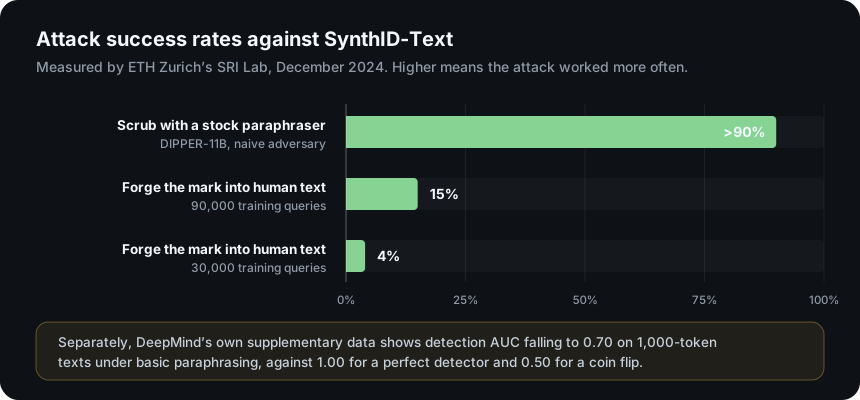
Against naive adversaries running off-the-shelf paraphrasers such as DIPPER-11B, the ETH team reported scrubbing success above 90%. DeepMind's own supplementary material shows detection AUC falling to 0.70 on 1,000-token texts under basic paraphrasing.
Forgery is harder and still within reach. Using 30,000 queries against the C4 dataset to generate 800-token watermarked responses, the team trained a Mistral-7B model and hit a 4% spoofing success rate at a false positive rate of 1e-3. Tripling the query budget to 90,000 raised that to 15%.
A 15% forgery rate is a serious problem for any institution planning to treat detection as evidence of misconduct, because it means the mark can be pushed into text a human wrote. Nature ran an editorial alongside the original paper making the point in its title: AI watermarking must be watertight to be effective.
What survives all of this is a signal with documented failure modes and a published attack cost, which is a weaker object than proof and a stronger one than nothing.
The removal market that formed in a week
Within roughly a day of the announcement, a GitHub project targeting AI provenance signals appeared. Text humanizer services that had spent three years positioning against GPTZero & Turnitin repositioned overnight to advertise Claude watermark removal.
Kevin Briody called this in his commentary on the announcement, expecting watermark scrubber tools to arrive and render detection moot for search purposes. The prediction had a short shelf life before it turned into a description.
Engineer Sean Goedecke made the general case bluntly, arguing that text watermarks will always be trivial to remove because "the watermark is inherent to subtle vocabulary choices," so re-wording removes it. Any unwatermarked model will paraphrase a document for a fraction of a cent.
The structural problem is one of incentives. Students, ghostwriters & content farms have the strongest reason to strip the mark, and paraphrase-based scrubbing is cheap enough for all of them. The proofreaders, summarizers and translators who never intended to hide anything are the ones carrying an unstripped mark into their published work.
What this changes for SEO and content teams
Almost nothing, on the evidence so far. That's the plain, non-alarmist answer.
Ahrefs' Director of Content Marketing Ryan Law called the watermark "unlikely to cause major disruption for most marketers," and his position on the underlying question is direct: "Google is apparently agnostic to AI use, and our own research backs that up." Ahrefs' page-level data puts 5.3% of top-ranking pages at 100% AI-generated and 9% at 80% or more, with roughly 8% to 12% of pages at every ranking position containing 80%-plus AI content.
The indexing gradient is real and shallow. About 40% of high-AI pages get indexed against 49% for low-AI pages, which is a nine-point gap.
Mark Barrera made the mechanical argument that a mark can't do the job people fear: "Google's concern is spam, not AI itself, and a watermark doesn't differentiate between the two." Bojan Maric put it in outcome terms, noting that "Google already penalizes thin or spammy content regardless of its origin."
Google has also given itself nothing to act on. It has offered SynthID verification for images in Search since May 2025, provides no public text verification tool, and Anthropic's detection API isn't live. A ranking system can't weigh a signal it can't read.
The new exposure sits in contracts. Clients, universities, agencies & content marketplaces are starting to ask for proof that deliverables are human-made, and no clean way to supply that proof exists. Teams already running structured AI output quality checks hold most of the audit trail this demands. Teams that aren't will be reconstructing it under deadline.
If you buy or sell content, this is the clause to watch
I've had three clients ask about AI disclosure language in the past week, which is more than the previous six months combined. The question they're all circling is if a marketplace or an agency can now verify a "100% human-written" guarantee.
Today they can't, because there's no public detector. When there is one, a positive hit still won't distinguish a ghostwriter who ran a spell check through Claude from one who generated the whole draft, and the 15% forgery rate means a competitor could plant the mark in a rival's copy.
Write the disclosure policy yourself before someone writes it for you. That's cheaper than arguing about a detection score you can't audit.
Practical steps that hold up
Record which models touched which deliverable, and when. Provenance you wrote down yourself beats provenance you're asked to reconstruct six months later, and it's the only version that survives a client dispute.
Audit what's already published. A site running AI-assisted content since 2024 has a marked portion consisting of whatever went through Claude after August 2, 2026, and the free page freshness checker will tell you which URLs fall inside that window by comparing the last Wayback snapshot, the Last-Modified header & the sitemap lastmod entry.
Stop treating heavy editing as a compliance strategy. It works, in that a full rewrite removes the mark, which means the effort of rewriting to defeat detection is roughly the effort of writing the thing.
Treat any detection result you eventually receive as one input. Given a 15% forgery rate in published research and no vendor-published false positive rate, a single API response should never be the basis for an accusation. It's the same standard I apply to a toxicity score in a backlink audit: the number starts the investigation, it doesn't finish it.
Keep writing the way you were writing. If the work is honest about how it was made, a mark on it costs you nothing, and the tools I use daily for content optimisation haven't changed their output requirements by a word.
What happens before December
Anthropic's retrofit of pre-August models runs against the December 2 date, as does every other signatory's text marking work. Roughly 190 organizations signed the Code of Practice, and text is the hardest of the four modalities to mark well, which is why OpenAI and Meta have favored images & audio so far.
The question that decides if any of this becomes load-bearing is interoperability. Five incompatible detection APIs, each covering one vendor's models, each with undisclosed error rates, produce a checking process nobody will run. A shared standard with published thresholds produces a signal institutions can use.
The industry currently has the first version, and about three and a half months to build the second.
FAQ
Does Claude watermark everything it writes?
Every model released on or after August 2, 2026 applies marking at the model level, across all surfaces and worldwide. Detectability is a separate question: long prose carries a strong signal, while factual passages, functional code and short messages carry a weak one or none.
Can I turn the Claude watermark off?
No. Marking is applied at the model layer, so no product setting and no API parameter disables it, including on AWS, Google Cloud and Microsoft Foundry deployments.
Does pasting Claude output into a text editor remove the watermark?
No. There are no hidden characters to strip. The mark is carried by which words were selected, so it survives copy, paste and format conversion. That advice was written about suspected Unicode markers in ChatGPT output, which OpenAI attributed to a reinforcement learning quirk.
Will Google penalise watermarked content?
There's no evidence of it, and no mechanism for it today: Google publishes no text verification tool and Anthropic's detection API isn't live. Ahrefs' research puts 5.3% of top-ranking pages at fully AI-generated, with a nine-point indexing gap between low-AI and high-AI pages and no sign of a hard ranking cliff.
How do you remove the Claude watermark?
A complete rewrite removes it, which Anthropic states directly. Published research from ETH Zürich scrubbed it more than 90% of the time with an off-the-shelf paraphraser. The point worth sitting with is that rewriting far enough to defeat detection costs about as much effort as writing the piece.
Can a watermark prove someone used AI?
It can indicate Claude was likely involved. It can't establish authorship, the share the model wrote, or accuracy, and the same ETH research forged the mark into human text 15% of the time at 90,000 training queries.
Sources
Primary and research sources for every figure above, in the order they appear:
- Anthropic, "How Claude's text watermarking works" and Claude support documentation on AI content marking
- Dathathri et al., "Scalable watermarking for identifying large language model outputs," Nature, October 23, 2024
- Nature editorial, "AI watermarking must be watertight to be effective"
- Jovanović, Gloaguen and Vechev, "Probing Google DeepMind's SynthID-Text," ETH Zürich SRI Lab, December 20, 2024
- Cooley, "EU AI Act: Transparency Obligations Take Effect 2 August 2026"
- European Commission, Code of Practice on Transparency of AI-generated Content
- TechCrunch, August 12, 2026 and TechCrunch, August 15, 2026
- Forbes, August 11, 2026
- Inc, August 15, 2026
- Ahrefs, "Claude Now Watermarks Everything It Writes"
- Search Engine Journal on watermarks and authorship
- Sean Goedecke, "Text AI watermarks will always be trivial to remove"
Wondering if your published content is exposed?
Send me a handful of URLs and I'll tell you, plainly, which ones fall inside the marking window and if it matters for your rankings.
get in touch